• Skip to primary navigation
  • Skip to main content
  • Skip to footer

Dancing Priest

Author and Novelist Glynn Young

  • HOME
  • BLOG
  • BOOKS
    • Brookhaven
    • Dancing Prince
    • Dancing Prophet
    • Dancing Priest
    • A Light Shining
    • Dancing King
    • Poetry at Work
  • ABOUT
  • CONTACT

research

7 Tips for the Novice Historical Novel Writer – Learned the Hard Way

January 9, 2025 By Glynn Young Leave a Comment

Writing one historical novel does not make one an expert in the genre. I have written exactly one historical novel, Brookhaven, a romance set in the Civil War era and in 1915.

To write Brookhaven, I didn’t turn to how-to works by historical novelists, historians, or romance writers, or read articles on the subject on web sites. In fact, I never intended to write a historical novel at all. Because I had the time, I began to pursue a lifelong interest in the Civil War, with a side-interest in the role of my great-grandfather.

At some point, I told myself, “This is a story worth telling.” And I began to write. 

I also continue to do research, because writing this kind of story demands it. What did people wear? What did they eat? How would they send a letter when railroads and the mail service weren’t functioning? What were prisons like for captured soldiers? How does a society function when social order breaks down?

I learned some lessons along the way. Each was hard-learned and hard-earned. I stopped counting the times I had to go back and revise something, sometimes extending to almost everything I’d previously written.

If you’re thinking about writing a historical novel, I have seven suggestions for how to do it and not do it. 

To continue reading, please see my post today at Tweetspeak Poetry.

Top photograph: a page from the 1850 census, listing the members of the Franklin Young family in Pike County, Mississippi.

An Inspiration for “Brookhaven”: The Family Bible

December 18, 2024 By Glynn Young 2 Comments

In the early 1980s, the Young family Bible was passed down to me from my father. We had looked at it together much earlier, especially the family records it contained. All of the entries for births and deaths, beginning in 1802 and ending in 1890, were in the same hand, presumably my great-grandfather’s. 

For years after I received it, I did the time-honored family thing: kept it wrapped in brown paper and twine and on a closet shelf. I did eventually buy an acid-free box to store it in, but it was fragile. The binding was coming apart, the ink on the family records was fading, and some of the pages were loose.

My wife read a story in St. Louis Magazine about a local book conservator who had trained at Oxford’s Bodleian Library. In early 2022, I contacted him, we made an appointment, and he offered an initial assessment of what it would cost. He also found something that had been missed for decades – tucked in among one of the Prophets was an envelope containing a lock of auburn hair, presumably that of my great-grandmother, Octavia Montgomery Young. 

I had copies of the family records, and it was these that I poured over and compared to listings in Family Search. Surprisingly, the Biblical records and the online listings were surprisingly identical. But the online list omitted a name contained in the Bible, that of Jarvis Seale, with the date of death recorded as April 6, 1862. Whoever he was, and no one in the family seemed to know (my father guessed a cousin), he was considered important enough for my great-grandfather to record his death. 

I stayed mystified, until I investigated the date. It was the Battle of Shiloh. 

More digging found he was the husband of one of my great-grandfather’s sisters. Mystery solved.

That discovery led me to consider two other dates – the ones for my great-grandfather’s two brothers. They, too, died in the Civil War, leaving my great-grandfather, still a teenager, as the only surviving son.

He was the one who bought the Bible and started the records. My book conservator said that the Bible was sold door-to-door by the tens of thousands in the late 1860s and 1870s. Many bought the book to record family records; so many people had died in the war that surviving families on both sides of the conflict were determined to keep a record. And too many, like Jarvis Seale, had been buried in unmarked mass graves.

I looked at the dates for those deaths, and I told myself there was a story here, a story of how a family survived the Civil War. 

Those deaths, and the lock of my great-grandmother’s hair, eventually became one of the inspirations for my historical novel (and historical romance) Brookhaven.

Related:

Restoring the Family Bible – and More.

The Mystery Man in the Family Bible.

Top photograph: a page from the Bible’s family records, before restoration.

When Fiction Seems to Predict Fact

November 18, 2024 By Glynn Young 3 Comments

The Dancing Priest novels seem to be back in the fiction-becomes-fact business.

Last week, after saying he would not resign, Archbishop of Canterbury Justin Welby did, in fact, resign. This followed the release of the Makin Report, which documented the failings of the Church of England (COE) in a cover-up of an abuse scandal. The scandal went back to the 1980s when a barrister named John Smyth abused young teens at COE church camps, slipped out of England when it appeared the law was onto him, and went on to victimize more boys in Zimbabwe and South Africa.

Welby’s sin: he learned about the abuse in 2013 but failed to report it to authorities. Smyth could have been brought to justice at that time; he died in 2018.

One as-of-yet-unanswered question is if Welby was the only COE official to know. It’s unlikely that others, including people high in the hierarchy, also didn’t know. The scandal may not be over. And lest we think this type of scandal only happens to the big established denominations like the Church of England or the Roman Catholic Church, there are lessons here for all of us. A church I’ve attended had a member of the staff get involved in an inappropriate and illegal relationship; the difference was that the head pastor, as soon as he was told, called the police. That’s how it’s supposed to work, no matter how damaging it might be to an organization’s reputation. Righteousness trumps reputation, as Bernard Howard wrote for the Gospel Coalition.

In Dancing Prophet (2018), the fourth of the Dancing Priest novels, Michael Kent-Hughes has an abuse scandal thrust upon him. He’s a former COE priest and now the king, and he’s simultaneously dealing with a developing church scandal and a collapse of the government of Great London. His church nemesis is the Archbishop of Canterbury, Sebastian Rowland, who has spent considerable time covering up an abuse scandal that threatens to blow the church apart.

During the research for the book, I learned that the Archbishop of Canterbury, along with the rest of the hierarchy and the church itself, is subject to the monarch. That’s how Henry VIII set it up in the 1530s during the English Reformation. And the archbishop functions at the pleasure of the monarch. That the current prime minister, Keir Starmer, refused to back Justin Welby publicly was of less importance than the silence that was coming from King Charles. Welby’s announcement noted that King Charles has graciously accepted his resignation. That’s how it works. The Catholic pope tells God and the church; the Archbishop of Canterbury tells the king (or the king asks for it).

In Dancing Prophet, Michael tells Sebastian Rowland he must resign. Rowland at first refuses, until Michael, in the presence of the police, explains the evidence against the archbishop, all of which will be made public. It’s worth noting, too, that Michael went to the police as soon as he became aware of the activities of one priest, which would soon explode into a global crime. And Michael, when he speaks to the British people, will tell them that the Church of England may not survive. Righteousness trumps reputation.

Dancing Prophet was written long before the John Smyth scandal was known publicly. What I did know concerned a COE abuse scandal involving some priests; it had first surfaced in the news in 2012. For the novel, I adapted the abuse scandal that has rocked (and continues to rock) the Roman Catholic Church to the COE.

I’m not a prophet; I can’t and don’t predict the future. But I’ve learned that, when you’re doing research for a book like any of the Dancing Priest novels (“future history,” one reader called them), you pick up on issues, concerns, trends, and ideas that are being discussed. You read about past events and troubles. You learn how people, especially people in authority, respond to what they see as threats. And you know what humans naturally tend to do: wish it would all go away, ignore it, make it worse, try to contain it, or cover it up. It might work for a time, but it usually doesn’t work forever.

We forget that lesson: righteousness trumps reputation.

Related:

Can Fiction Predict the Future?

Did Dancing Prophet Become Prophetic?

Top photograph by Ruth Gledhill via Unsplash. Used with permission.

Writing a Bibliography – for a Novel

February 28, 2024 By Glynn Young Leave a Comment

It’s been two weeks since I read a book about the Civil War, and it feels strange. My draft novel is done, at least for now. It’s not so much a novel about the Civil War as it is a novel of the Civil War.

If you grew up in the South, or even if you didn’t, what happened in the years 1861-1865 affected you, even when you didn’t know it. Both my maternal and paternal grandparents were children of Civil War veterans. They experienced the war in very different ways, both in the fighting and in civilian life. 

My mother’s grandparents were Franco-German immigrants who settled in New Orleans and descendants of the Acadians expelled from Canada after the French and Indian War who settled in what we called “the river parishes” – the stretch of territory along the Mississippi River between New Orleans and Baton Rouge. The men generally fought for the Confederacy; after 1862, the women, children, and elderly men discovered life under Union occupation. 

My father’s grandparents experienced much the same. The men fought for the Confederacy; after the fall of Vicksburg in 1863, their families in southern Mississippi lived under sometimes loose, sometimes tight federal occupation. My great-grandfather Samuel Young was the only son in the family to survive the war.

Much like World War II affected the Baby Boom generation, the Civil War affected my grandparents’ generation. A terrible and collective experience of one generation would inevitably affect their children. Louisiana had the highest per capita income in the country in 1860; it had the lowest in 1865. Family members had died in the fighting; the social order was in chaos and upheaval. What happened to my ancestors was repeated millions of times in both the South and, in a different way, the North.

My history classes in middle school, high school, and college focused on broad themes about the war – like slavery, state rights, battles, Reconstruction, the Jim Crow Era, and the rise of the “Lost Cause.” When you write a novel rooted in the war, you discover that, while all of that is important, the broad themes don’t tell you much about how people lived, died, fought, and coped with the war. 

Vicksburg during the 1863 siege

I turned to reading and research – not only histories but also memoirs, newspaper accounts, sociological studies, photographic essays, fiction, and even poetry. I had to be selective, and so I focused on 1863 and post-war Mississippi, including Grierson’s Raid of April 1863; the Battle of the Wilderness in Virginia in 1864; and the battles in April 1865 around Petersburg and Appomattox. But general histories were needed, too, and Bruce Catton’s The Army of the Potomac Trilogy and James MacPherson’s Battle Cry of Freedom were among the readings as well.

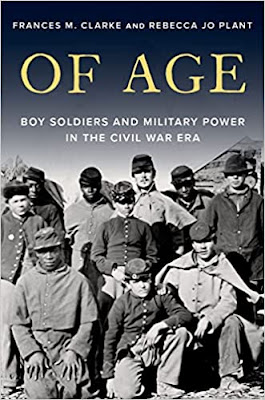
Three books were particularly helpful: Of Age: Boy Soldiers and Military Power in the Civil War Era by Frances Clark and Rebecca Jo Plant; Hearts Torn Asunder: Trauma in the Civil War’s Final Campaign in North Carolina by Ernest Dollar; and Ends of War: The Unfinished Fight of Lee’s Army after Appomattox by Caroline Janney. Louisa May Alcott’s Hospital Sketches and Irene Hunt’s Across Five Aprils were two works of fiction backed by extensive historical research, and they were both an inspiration. But everything I read helped in at least a small way.

The bibliography includes 84 books and two web sites. They represent an infinitesimally tiny portion of what’s available to read about the Civil War.

It’s awe-inspiring to read what soldiers and civilians alike experienced, including some pretty horrible things. Tragedies abounded. The devastation, especially in the South, was extensive. Soldiers on both sides committed crimes against civilians.

And yet, people coped and went on. They found strength in community and faith. What they had known was gone forever, except in memory. 

Even if the novel never sees the light of day, this has been a humbling and rewarding experience.

Top photograph by Thomas Kelley via Unsplash. Used with permission.

A Year of Reading (and Writing) the Civil War

January 3, 2024 By Glynn Young 1 Comment

My story connected to the Civil War has passed the 70,000-word mark, and the ending is in sight. I’m not sure when it was that I realized I was writing about something I had only the most surface understanding of, but I did. The only solution was to start reading and researching.

Many blogs and web sites have been helpful, but two especially so. Emerging Civil War, edited by Chris Mackowksi, is written by historians, National Park guides, and other who know their stuff. Most have published books. Civil War Books & Authors, penned by Andrew Wagonhoffer, posts notices of new books and full-length book reviews focused solely on the Civil War, its causes, and its aftermath. Both sites have been at this work for years, ECW for more than a decade and CWBA since 2005.

What was also a treat was discovering and visiting the Missouri Civil War Museum, located adjacent to the Jefferson Barracks National Cemetery here in St. Louis.

Missouri Civil War Museum

My reading and research this year has been less about military strategy, tactics, and battles, and more about what both civilians and soldiers experienced. For several decades after the war, officer and soldier memoirs were popular, and several publishers have made them available in digital format. The same is true for civilians, although there seem to be more memoirs by women and mothers on the Southern side than the Northern, likely reflecting the direct experience these women had.

I did pay attention to certain battles. For my story, the battles of Shiloh, Gettysburg, The Wilderness, Franklin, and Petersburg / Appomattox were the key ones, as was the whole surrender of the Army of Northern Virginia at Appomattox. The surrender, in fact, was the scene where the manuscript originally started, even if its now in another place. 

What’s also changed is that I’m reading other fictional accounts of the war – novels, stories, and poetry. Many people turned to fiction and poetry to make sense of what happened in the years between 1861 and 1865. As a friend once said, “Fiction can be truer that history.”

What follows is a list of the books I read in 2023. Given where my own fiction manuscript is, I expect to be reading far fewer in 2024. Then again, maybe not; the Civil War is a difficult subject to walk away from.

The Saddest Words: William Faulkner’s Civil War by Michael Gorda.

Irish-American Civil War Songs by Catherine Bateson.

Of Age: Boy Soldiers and Military Power in the Civil War Era by Frances Clark and Rebecca Jo Plant.

An Atlas and a Map of the Civil War

Contemners and Serpents: The James Wilson Family Civil War Correspondence, edited by Theodore Fuller and Thomas Knight.

Four Years with Morgan and Forrest by Col. Thomas Berry.

Grant vs. Lee, edited by Chris Mackowski and Dan Welch.

If We Are Striking for Pennsylvania, Vol. 1, by Scott Mingus & Eric Wittenberg.

Reading John Greenleaf Whittier, the “Abolitionist Poet”, edited by Brenda Wineapple.

A Season of Slaughter: The Battle of Spotsylvania Courthouse, May 8-21,1864 – Chris Mackowski and Kristopher D. White. 

Bear in the Wilderness by Donald Waldemer. 

“No One Want to Be the Last to Die”: The Battle of Appomattox, April 8-9, 1865 by Chris Calkins. 

The Summer of ’63: Vicksburg and Tullahoma, edited by Chris Mackowski and Dan Welch. 

Man of Fire: William Tecumseh Sherman in the Civil War by Derek Maxfield. 

My Dearest Julia: The Wartime Letters of Ulysses S. Grant to His Wife.

The Wartime Journal of a Georgia Girl by Eliza Frances Andrews. 

Recollections of a Confederate Staff Officer by G. Mosely Sorrell. 

The Civil War: The First Year by Those Who Lived It – Library of America.

President Lincoln Assassinated! The Firsthand Story of the Murder, Manhunt, Trial, and Mourning by Harold Holzer.

Bloody Promenade: Recollections on a Civil War Battle by Stephen Cushman. 

Belle Boyd: Cleopatra of the Secession.

If We Are Striking for Pennsylvania, Vol. 2 by Scott Mingus and Eric Wittenberg.

The Civil War: The Second Year Told by Those Who Lived It – Library of America. 

Service with the Sixth Wisconsin Volunteers by Rufus Dawes.

The Civil War: The Third Year Told by Those Who Lived It – Library of America. 

The True Story of Andersonville Prison by James Madison Page.

The Civil War: The Final Year Told by Those Who Lived It – Library of America. 

From Western Virginia with Jackson to Spotsylvania with Lee by Peter Luebke. 

The Story of Camp Douglas by David Keller.

Lee’s Miserables: Life in the Army of Northern Virginia from the Wilderness to Appomattox by J. Tracy Power. 

Belligerent Muse: Five Northern Writers and How They Shaped Our Understanding of the Civil War by Stephen Cushman. 

Hospital Sketches by Louisa May Alcott.

Shiloh, A Novel by Shelby Foote.

John Ransom’s Andersonville Diary.

John Brown’s Body by Stephen Vincent Benet. 

The Red Badge of Courage by Stephen Crane.

The Battle of Franklin by A.S. Peterson.

The Stolen Train by Robert Ashley. 

I also wrote four blog posts that discussed a little of my own great-grandmother’s experience in Union-occupied New Orleans and some of the struggles I had with the research. 

A Little of the Story of Wilhelmina Ostermann

When Research for Your Historical Novel Changes Your Understanding

My Enchantment with (and Addiction to?) the Civil War.

Research Can Teach You a Hard If Useful Lesson.

Top photograph, courtesy Wikimedia Commons: The Wilderness site, sometime after the battle. The dense scrub wasn’t conducive to fighting, but the dry weather made it conducive to being ignited by sparks from artillery fire.

Research Can Teach You a Hard (if Useful) Lesson

August 17, 2023 By Glynn Young Leave a Comment

I learned a very hard lesson while writing a historical novel. I learned how hard it can be, and it’s hard for both the research you do and for the research you have to ignore. 

I’m writing a novel that takes place in two historical periods – the Civil War and its immediate aftermath, and 50 years later, during the run-up to World War I. The story was loosely based on a story handed down in the family about what had happened to my great-grandfather. The emphasis is on the word “loosely,” because the more I researched, the more I discovered that what was passed down as a family story had very little basis in fact.

Because I discovered this about 40,000 words into the manuscript, it stopped me cold. For weeks. I kept hoping I was wrong, but I learned my extended family had two oral traditions about my great-grandfather. And the version passed down to me was the wrong one, or perhaps I should say “more embellished.” It made a great story, but it was flat-out wrong.

To continue reading, please see my post today at the American Christian Fiction Writers blog.

Photograph: Some of the 1,700 Union cavalry troops who rode through Mississippi in 1863 during Grierson’s Raid. 

  • « Go to Previous Page
  • Page 1
  • Page 2
  • Page 3
  • Go to Next Page »

Footer

GY


Meet the Man

An award-winning speechwriter and communications professional, Glynn Young is the author of three novels and the non-fiction book Poetry at Work.


 01_facebook 02_twitter 26_googleplus 07_GG Talk

Copyright © 2026 Glynn Young · Site by The Willingham Enterprise · Log in | Managed by Fistbump Media LLC