• Skip to primary navigation
  • Skip to main content
  • Skip to footer

Dancing Priest

Author and Novelist Glynn Young

  • HOME
  • BLOG
  • BOOKS
    • Brookhaven
    • Dancing Prince
    • Dancing Prophet
    • Dancing Priest
    • A Light Shining
    • Dancing King
    • Poetry at Work
  • ABOUT
  • CONTACT

Reviews

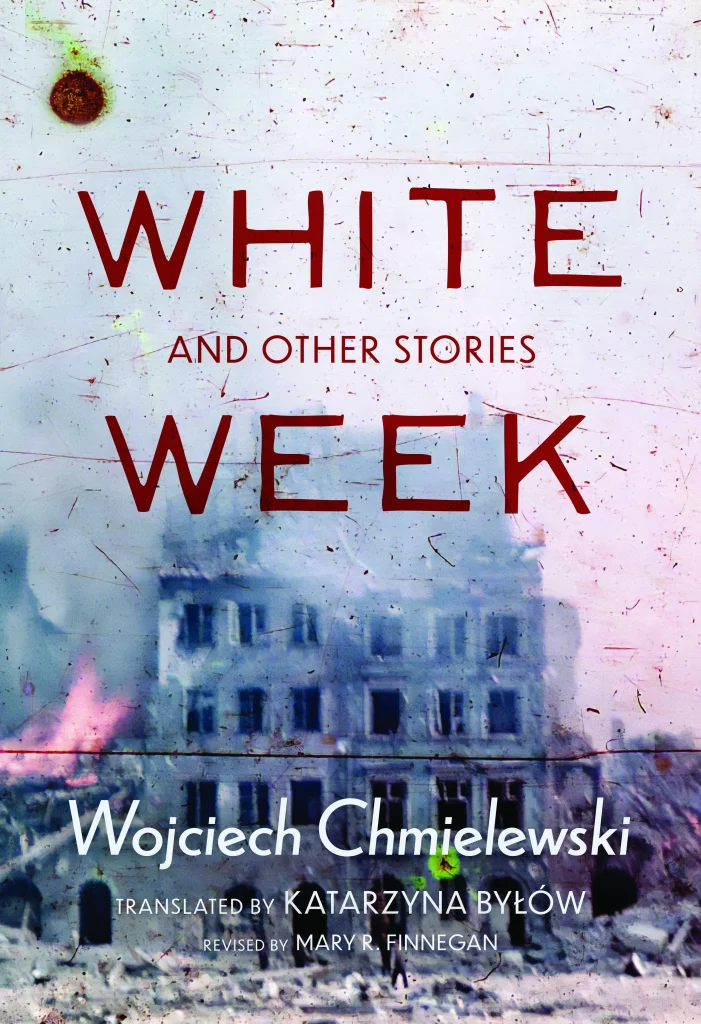
“White Week and Other Stories” by Wojciech Chmielewski

November 19, 2025 By Glynn Young 2 Comments

The Polish writer Wojciech Chmielewski isn’t exactly a household name in America, and for a very good reason. Up to now, none of his writing has been published in English. Wiseblood Books has changed that with the publication of White Week and Other Stories, translated by Katarzyna Bylow. 

Chmielewski is best known in Poland for his short stories, which have won awards in his home country. But he’s also an essayist, literary critic, and playwright for Polich Radio Theatre. This collection of stories, many previously published in Polish literary journals and anthologies. Re largely about Warsaw, a Warsaw that is there and the city that used to be. (Much of the city was destroyed during World War II and then rebuilt under communist rule.)

The stories are, in a word, haunting. The opening story is about the area near Grzybowski Square, with its church on one side and construction underway nearby. We see scenes of a marketplace, a boy selling strawberries (“Polish strawberries…all freesh”), an alleyway full of peonies, a group of drunken men arguing, a young woman waiting for someone, and the empty park with its playground. The story contains no named characters or dialogue; the character is the urban landscape itself. Slowly the reader comes to understand that this area was once part of the Warsaw Ghetto, which tens of thousands of Jews were confined before deportation to Auschwitz.

And so the stories go. Chmielewski will return to this theme of the Warsaw Ghetto, but along the way we’ll experience a religious procession (with a man dreaming about snakes), a woman working on her new novel (with some of the characters becoming parts of other stories), a man with an unfaithful wife who finds solace in eating dog food, a village that exists beneath the sand of a beach area, a man who pays a visit and seems to enjoy reading in a madhouse, conversations in a restaurant during a rainstorm, a saint awake in the dark, a young man in love with a girl whose face experiences allergic reactions, the title story about remembering a religious confirmation celebration, and others.

Like that opening story of the visible landscape not seeming to remember the history, all of the stories have that sense of “missing the context.” We’re there, but we don’t understand. We undertake our daily life, but we’re ignorant of what these streets and buildings have seen, what’s come before us, what has shaped this landscape just as it’s shaping us. 

Yes, haunting is the operative word for these stories.

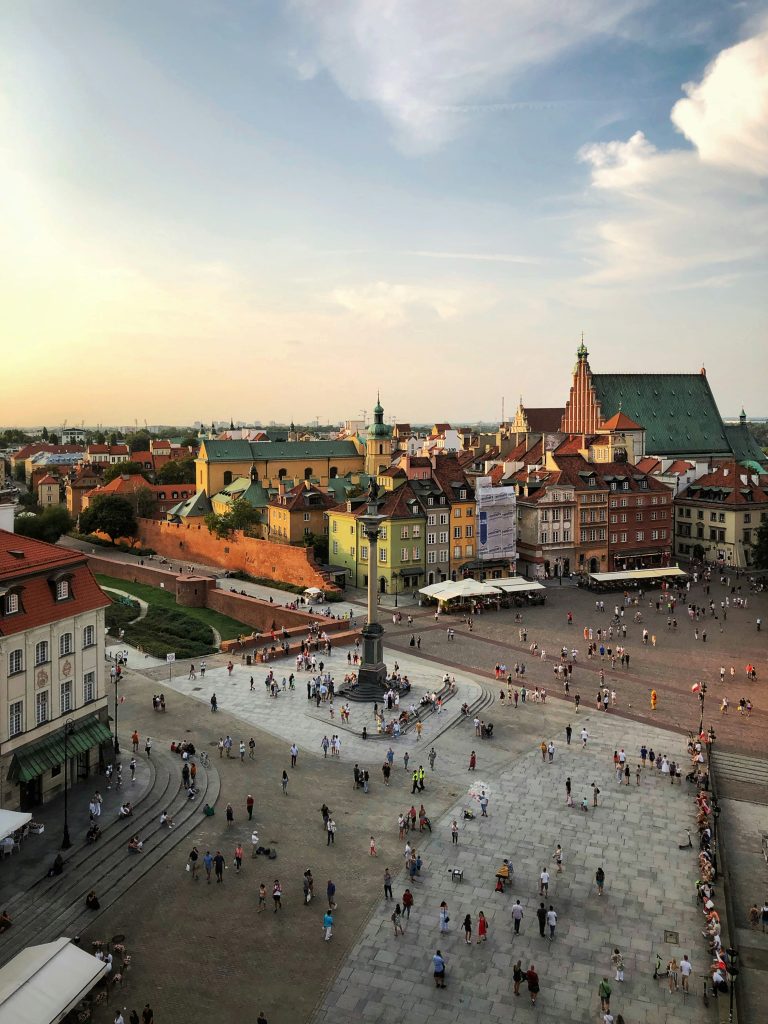
Top photograph: A scene of Old Town Warsaw by Victor Malyushev via Unsplash. Used with permission.

Single Dads in Non-Fiction and Fiction 

November 12, 2025 By Glynn Young 1 Comment

It was only coincidental. I read Joseph Luzzi’s In a Dark Wood: A Memoir (2015) and the next in my reading pile was Unconditional: A Novel by Stephen Kogon. Both books, one non-fiction and the other fiction, told the stories of young men suddenly finding themselves single fathers.

Luzzi is a professor of Italian and teaches at Bard College in New York. In 2007, just as his lecture class was about to begin, he noticed a security guard come into the room. The message was awful; Luzzi’s wife Katherine had been in an automobile accident and was seriously injured. Katherine was also eight-and-half months pregnant. The baby, a little girl, was delivered and survived.  Katherine didn’t.

And thus began a journey of grief, the loss of his wife, navigating funeral and death arrangements, caring for a newborn, and eventually dealing with lawsuits filed against Katherine’s estate and countersuits filed against the other driver. And that on top of trying to resume a “normal” life, as if life could ever be normal after that.

Luzzi turned to the poet Dante and his Divine Comedy. Like Virgil serves as Dante’s guide in the great poem, Dante served as Luzzi’s guide. He tells a moving, heartbreaking story, a man overwhelmed by loss and grief and with the responsibility of a child. If there is a hero in this story, Luzzi might be the first to admit it was his Italian mother, who essentially moves in to care for her granddaughter.

In addition to The Divine Comedy: A Biography, Luzzi has also published Romantic Europe and the Ghost of Italy (2008), A Cinema of Poetry: The Aesthetics of the Italian Art Film (2014), My Two Italies (2014), In a Dark Wood: What Dante Taught Me About Grief, Healing, and the Mysteries of Love (2015), and Botticelli’s Secret: The Lost Drawings and the Rediscovery of the Renaissance (2022). He received his Ph.D. degree from Yale University, and he teaches literature, film, and Italian Studies. He is also the founder of the Virtual Book Club, which focuses on the world’s great books and storytelling.

Writer and filmmaker Stephen Kogon has previously published a young adult novel and two children’s stories, and Unconditional is his first aimed at adult reader. It tells the story of Matthew Russell, a 35-year-old bachelor who is a photographer for the Arizona Cardinals in Phoenix. He’s attending the retirement part of his best friend (and football team member) Kenny when he receives the telephone call that changes his life. 

The Albuquerque police explain that Matthew’s estranged brother Paul and Paul’s girlfriend have been killed in an automobile crash. Apparent suicides, they’ve left behind a premature baby girl who’s in a hospital neonatal intensive care unit. The only note they left behind read “Please take care of the baby.”

And Matthew is the only person capable of doing that. Overwhelmed with loss, not to mention having to manage his brother’s death and funeral, he has to decide what to do with Allie, his new niece. What he decides is that he will take care of her, even if it means radically changing his life.

It’s a moving tory, sometimes borderline sentimental, but that’s of little account when you become engrossed with the story. Matthew surrenders his life to fatherhood, and that includes changing jobs and putting aside his relationship with his on-again, off-again girlfriend Monica. 

Kogon previously published Max Mooth, Cyber Sleuth and the Case of the Zombie Virus and two children’s stories, Squiglet the Ryming Piglet and Squiglet the Piglet Goes on a Nature Hike. His first film, Dance Baby Dance, was released in 2018. He’s also written screenplays, comedy sketches, and comic strips. 

Related:

Dante’s Divine Comedy: A Biography by Joseph Luzzi.

Top photograph by Illia Panasenko via Unsplash. Used with permission.

“A Słowy Dying Cause” by Elizabeth George

October 29, 2025 By Glynn Young Leave a Comment

It helped to have heard Elizabeth George speak in early October at the St. Louis County Library. She was doing a promotional tour for her new novel, and among many other things, she noted that Inspector Thomas Lynley would show up late in the story.

And Inspector Lynley does indeed show up rather late for story billed as “A Lynley Novel.” A Slowly Dying Cause, the twenty-first in the Inspector Lynley series, doesn’t even mention him until about page 120, and he and his detective sergeant, Barbara Havers, don’t really start assuming a significant role until about the middle of the book. 

The novel is 640 pages. The reader is well past the halfway point before Lynley learns there’s even a murder. Havers’ mother has died, and Lynley drags his DS with him when he has to go to Cornwall to attend to a leaking roof at the family estate. Lynley is an earl, even if he work for the Mtropolitan Police in London. He steps into the investigation almost accidentally, but once he’s there, no one doubts who’s really in charge.

It’s the local police who investigate the murder of a tin and pewter workshop named Michael Lobb. Potential suspects abound – the dead man’s ex-wife, whom he divorced to marry a woman abrely older than his own children; his children, both of whom need money; his brother, who owns 40 percent of the business and property it sits on; the young wife herself; the hired help, a man and his adult son; the hired man’s two daughters (one of whom is a former lover of Lynley in London); and the wife’s brother, who happened to be visiting from South Africa and opposed his sister’s marriage from the start.

Elizabeth George

The story is not a straight narrative. It includes the account of the murder investigation, interspersed by the story told by the dead man himself. Add to that the story of Lynley’s estate and its needed repairs. George writes mystery novels, yes, but she also writes novels that just happen to have a mystery as one of the story lines. 

I was 200 pages from the end when I realized exactly who the murderer would turn out to be, and more to the point, what the murderer’s motive was. Yet George is nothing if not an enthralling, compelling author; even when I knew (or guessed, correctly, as it turned out), I kept reading to see how it would all tie together. And George pulls it off. A Slowly Dying Cause is more of a novel than a mystery novel.

In addition to the Lynley novels, George writes a young adult series, set on the island in Washington State where she lives. She’s received numerous awards and recognitions for the Lynley novels, which have been adapted for television not once but twice, with the new Lynley series having started this year. 

Related:

Just One Evil Act by Elizabeth George.

An Evening with Elizabeth George.

Top photograph: Cornwall coast with tin mining tower by Danilo D’Agostino via Unsplash. Used with permission.

“Marce Catlett: The Force of a Story” by Wendell Berry

October 22, 2025 By Glynn Young Leave a Comment

Andy Catlett, whom we first met as a boy in an earlier novel by Wendell Berry, is now an old man. As old men are wont to do, he’s looking backward – at his life, his parents’ lives, and even earlier. And what he sees, far more clearly than he would have seen in his youth, is what shaped four generations of Catletts, including himself and his own children.

It is a story, a story that happened to his grandfather, Marce Catlett, a story that happened in less than 24 hours but lasted more than a century. And it shows every sign of continuing to last. 

Marce Catlett and his good friend and neighbor Jim Stedman travel together by horse and train to Louisville. Their tobacco harvests are finished for the season. Now comes the time when the crop is auctioned in Louisville. 

Marce and Jim both have an unspoken apprehension about the auction. Both know what they need to make a profit and continue to farm. And both know there is one bidder at the auction – the agent of James Buchanan Duke, who controls a near-monopoly on the U.S. tobacco business. 

When the auction ends, both Marce and Jim leave to return home. Their profit might cover the cost of their train tickets. 

In a few short words, Marce will tell his family what happened. Fear enters the home. Fortunately for the Catletts, they won’t starve; they have livestock and some diversification of crops. But tobacco is the lion’s share of the family income. 

Even then, however, that is not the story. The story is what Marce does next. He begins to make his plans for next year’s tobacco crop. 

Wendell Berry

That resilience in the face of financial disaster, what can only be called theft by monopoly, is what propels the family forward. Marce’s youngest son Wheeler will go on to become a congressman’s aide, an attorney, and the force behind the creation of the tobacco farmers’ cooperative to ensure farmers could make a decent profit. It will propel Wheeler’s son Andy to become a professional writer and then a farmer and writer. And it will influence Andy’s own children.

That’s the heart of Marce Catlett: The Force of a Story, Berry’s most recent novel and what feels like the last. Berry’s Port William novels are not precisely autobiographical, but they are clearly shaped by Berry’s own experiences. Marce Catlett reads like a summing up, not only of the series of novels but also of Andy Catlett’s, and Wendell Berry’s, life. The front and back inside covers suggest that as well – the front being a chart showing the relationships of the Feltner, Coulter, Beechum, Wheeler, and Catlett families, and the back being a map of Port William and its environs. 

The map is just as important as the genealogy. Together, they are two sides of the same coin – family and geography. The story that lies between them is the resilience that binds them together.

Berry is a poet, novelist, essayist, environmentalist, and social critic. His fiction, both novels and stories, are centered in the area he calls Port William, Kentucky, on the Ohio River. He’s won a rather astounding number of awards, prizes, fellowships, and recognitions. He lives on a farm in Kentucky. As he should.

Related:

My review of Berry’s That Distant Land.

Wendell Berry and the Land.

My review of Berry’s Jayber Crow.

Wendell Berry and This Day: Poems at Tweetspeak Poetry.

Wendell Berry and Terrapin: Poems at Tweetspeak Poetry.

Wendell Berry’s Our Only World.

The Art of the Commonplace by Wendell Berry.

Nathan Coulter by Wendell Berry.

Andy Catlett: Early Travels by Wendell Berry.

A World Lost by Wendell Berry.

A Place on Earth by Wendell Berry.

The Memory of Old Jack by Wendell Berry.

Wendell Berry and Another Day: Sabbath Poems 2013-2023.

Remembering by Wendell Berry.

Top photograph: Broadleaf tobacco field by Rusty Watson via Unsplash. Used with permission.

“Midnight on the Potomac” by Scott Ellsworth

October 1, 2025 By Glynn Young Leave a Comment

A considerable portion of my historical novel Brookhaven is set in the last year of the Civil War, and yet the novel only covers a few of the momentous events – the battles of the Wilderness and Spotsylvania Courthouse, the final siege of Petersburg, Lee’s surrender to Grant at Appomattox, and Johnston’s surrender to Sherman near Greensboro. 

Indirectly, the novel covers Grierson’s Raid through Alabama, the fall of Atlanta and Sherman’s march to the sea, and the political and social chaos that followed. People lived through those times; my own ancestors (on both sides of my family) lived through it.

The last year of the Civil War is also the focus of Midnight on the Potomac: The Last Year of the Civil War, the Lincoln Assassination, and the Rebirth of America. In almost a conversational vignette style, historian Scott Ellsworth guides the reader through the major events of 1864-1865, showing how they not only were significant in and of themselves but also how they shaped post-war America.

You meet spies and ghost armies, experience the horrific battle in the Wilderness near Richmond, and discover how slaves were liberated and sometimes abandoned by Union armies. You follow the acting career of John Wilkes Booth and how it led to that fateful night at Ford’s Theater. You learn how the fall of Atlanta assured Lincon’s reelection, and you join Booth in listening to Lincoln’s second inaugural speech. You meet the famous and not-so-famous, and you experience history in many of the words and first-hand accounts of the people who were themselves involved. 

Scott Ellsworth

It says something of Ellsworth’s skill that the writing and stories seem almost effortless. You know they’re not; a prodigious amount of research and knowledge was required for that “effortlessness.”

Ellsworth previously published The Ground Breaking: The Tulsa Race Massacre and an American City’s Search for Justice; Death in a Promised Land: The Tulsa Race Riot of 1921; The Secret Game: A Wartime Story of Courage, Change, and Basketball’s Lost Triumph; and The World Beneath Their Feet: Mountaineering, Madness, and the Deadly Race to Summit the Himalayas. He attended Reed College in Oregon and graduate school at Duke University in North Carolina. And he also worked as a historian at the Smithsonian Institution. He lives with his family in Ann Arbor, Michigan, and he teaches at the University of Michigan.

Through the power of stories, Midnight on the Potomac explains what happened that last, fateful year of the Civil War, and it does so in a highly readable, engaging way.

“The Summer of ’63: Gettysburg” by Chris Mackowski and Dan Welch

September 17, 2025 By Glynn Young Leave a Comment

My historical novel Brookhaven is set during the Civil War’s final two years and immediately after, and then in 1915, 50 years later. The moment that sets the story into motion happens in late April of 1863 – Grierson’s Raid, in which a troop of some 1700 Union cavalry made their way through Mississippi from the Tennessee border to (eventually) Baton Rouge, Louisiana. The soldiers came to Brookhaven, most notably burning the train station and tearing up railroad track. 

The raid had a specific point: divert attention from Gen. Grant’s army preparing to cross the river from Louisiana and end the siege of Vicksburg, the last Confederate position on the river. The fall of Vicksburg would been the Union controlled the entire length of the river and would split the Confederacy in two. 

The Vicksburg campaign was covered in a collection of articles edited by Chris Mackowski and Dan Welch, part of a series called “Summer of ’63.” Their Vicksburg & Tullahoma covered the events and milestones of that campaign, including a raid on Mississippi’s capital of Jackson, which eventually led to a Union victory.

Now Mackowski and Welch have done it again, this time turning to another major Union victory in 1863 – the Battle of Gettysburg.

The Summer of 1863: Gettysburg follows a similar format. Mackowski and Welch have gathered and edited articles from the Emerging Civil War web site (which I can’t recommend highly enough if you’re interested in American history generally and Civil War history specifically). When you read a concentration of work like this, you realize just how fine the historical scholarship is on the site. 

The subjects include understanding why the Battle of Chancellorsville is so vital to understanding Gettysburg; how Gen. Meade took control of the Union army on the eve of battle; the mascot of the 11h Pennsylvania; prominent local families; how the Union retreated through the town at the beginning of the three-day battle; the impact of three men on the battle’s outcome; the role of Stonewall Jackson; the poet and writer Herman Melville on Pickett’s Charge; the aftermath, including the effort to punish Gen. Meade for “allowing” Lee’s army to escape; how the wounded saw the battle; how the battle was memorialized; the famous 1913 reunion of both Union and Confederate veterans,; and much more.

Chris Makowski

A professor at St. Bonaventure University, Mackowski has received B.A., M.A., M.F.A., and Ph.D. degrees in communication, English, and creative writing. The author of some nine books, he’s written extensively on the Civil War for a number of publications. He also worked for the National Park Service and gave tours of the Civil War battlefields at Fredericksburg, Chancellorsville, Wilderness, and Spotsylvania. 

Dan Welch

Welch is an educator in a public school district in Ohio and serves as a seasonal park ranger at Gettysburg National Military Park and associate editor of Gettysburg Magazine. He’s written two books in the Emerging Civil War Series and co-edited several volumes. 

A collection like The Summer of ’63: Gettysburg makes you appreciate the quality of the articles at Emerging Civil War. It also reminds me of the debt I owe to the writers there; I spent considerable time using the site for research and background for Brookhaven. It’s a debt I can’t repay. And my book has been published for some months, yet I still spend considerable time on the web site.

Related: 

The Summer of ’63: Vicksburg and Tullaloma, edited by Chris Mackowski and Dan Welch.

Top illustration: The Battle of Gettysburg as depicted by artist Thure de Thulstrup for Harper’s Weekly.

  • « Go to Previous Page
  • Page 1
  • Page 2
  • Page 3
  • Page 4
  • Interim pages omitted …
  • Page 15
  • Go to Next Page »

Footer

GY


Meet the Man

An award-winning speechwriter and communications professional, Glynn Young is the author of six novels and the non-fiction book Poetry at Work.


 01_facebook 02_twitter 26_googleplus 07_GG Talk

Copyright © 2026 Glynn Young · Site by The Willingham Enterprise · Log in | Managed by Fistbump Media LLC