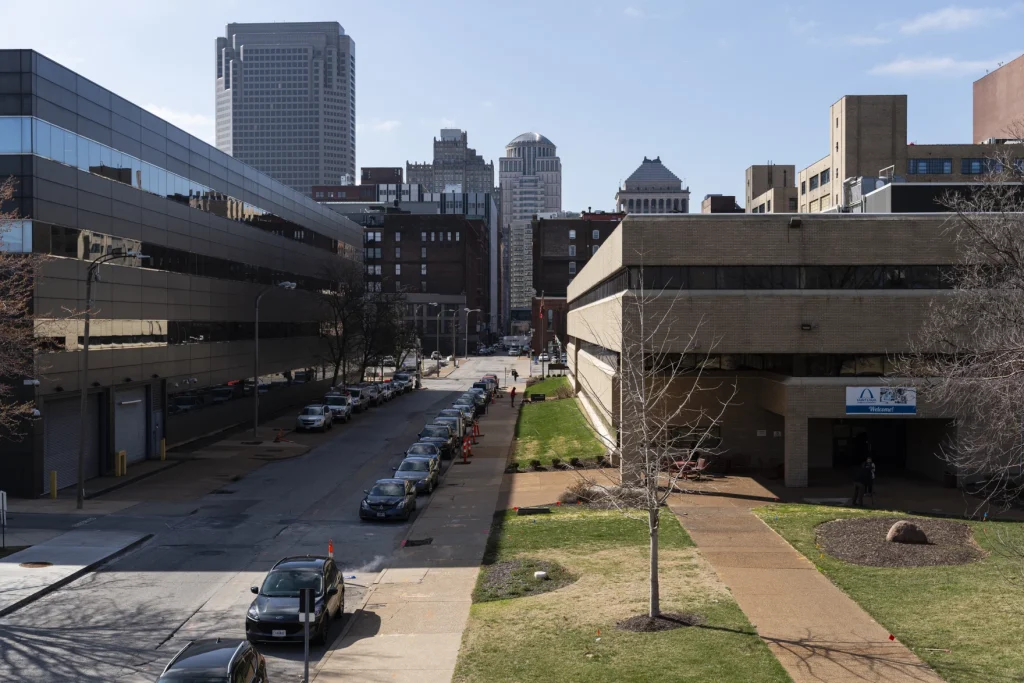
I’ve spent a few weeks reflecting on my incredibly short, and incredibly long, eight months with St. Louis Public Schools. What began with the strangest job interview I ever had, the weirdest first day on the job, and the ongoing chaos of every single day ended with a very quiet farewell.
In previous jobs in corporate communications, I’d experienced periods of media blitzes and controversies. But I’d never experienced a job in which every day was a media blitz, every day was a controversy, and I had to work and publicly communicate in a highly political environment where it was difficult to know who was telling the truth, whose information was accurate, and who was trying to help or merely trying to gain an edge on an opponent.
It’s often difficult to believe today, but I quickly learned that the news media were my most accurate sources of information. Several of the reporters had police radios and picked up reports of problems at individual schools, school bus issues, and conflicts within school headquarters itself that sometimes reached police report level.
With a budget that had been slashed from $1 million to $20,000, and that $20,000 already spent, we had to improvise how we communicated. What has been largely on paper before – newsletters, magazines, internal newspapers – became electronic – the web site, email, and message boards. I had to give myself a crash course in communicating online. I became allies with the IT team. I discovered how school parents and protesters (and they often overlapped) communicated.
I talked and listened to everyone. I answered every media call. I never turned down a request for a statement. I learned how to piece together statements when no one wanted to go on record. I had to learn quickly how to read between the lines. I learned there was one person I could trust completely, a guy on the staff of the management team that had been brought in to try to rectify the precarious situation the school district was in – too many buildings, declining enrollments, too large an administrative overhead, and was not just facing bankruptcy but, unknown to most, was already in it.
Actions like closing schools, laying off staff, and changing the pension program are the stuff of controversy, outrage, and protest. Those had started in June of that year; I arrived in October, following the resignation of the communications director who had lost the entire staff and budget. My one-half of a headcount and I did what we had to do – improvise, think on our feet, make decisions without the benefit or luxury of time to think them through.
We also had to deflect interference. The mayor’s office called daily, with instructions what we should be doing for the day. Yes, there was no official connection between the mayor and the school district, bit it happened. I’d listen politely and go back to my work. One School Board member would find a new public relations firm each month that had the ideas and plan that would immediately solve all the communication problems of the district. I would dutifully go to hear a presentation, usually, just a consultant spouting platitudes. I’d thank them and go back to work. Almost all of the members of the Board understood communications and weren’t shy about what we needed to do, and I’d listen politely, wondering how soon that member would be leaking the Board’s confidential information.
This was not an environment that inspired trust.
As I started my eighth month, I was hitting full-on physical exhaustion. And right at that point, I received a phone call, from a good friend I knew at my former corporate employer. The business that the company had spun off in 1997 had finally gone into bankruptcy, and under the terms of the spinoff, the environmental liabilities had returned to the former parent to manage until bankruptcy was resolved.
The relationship between the bankrupt spinoff and the former parent was not optimum. For months, in fact, it was being fought in the news media. I’d see the reports and shake my head, knowing how much the people in the parent company would hate the publicity. Then I’d go back to whatever crisis or chaos the school district had that morning.
Then came the call. The friend from the parent company chatted a bit and then asked a question. “Have you ever thought about coming back?”
My answer was immediate. “No.”
“Would you like to think about it?”
“Doing what, exactly?”
The job involved the parent company and the bankrupt spinoff. Managing media inquiries, developing positions, help manage the environmental issues that had returned with the bankruptcy, and work with my counterparts at the spinoff.
The fact that I had been on television – a lot – didn’t hurt. They’d noticed, and when they tried to figure out what to do, I kept showing up on television.
I interviewed. I got the job.
Top photograph, St. Louis Public Schools headquarters building by St. Louis Public Schools.



What a wild ride! I just reread some things about Monsanto and the Supreme Court. Another wild ride! A 7-2 victory. Interesting.
Supreme Court Ruling: The U.S. Supreme Court ruled in favor of Monsanto, deciding in a 7-2 landmark decision that federal law (specifically the Federal Insecticide, Fungicide, and Rodenticide Act) preempts state-law failure-to-warn claims. This effectively blocks thousands of lawsuits brought against the company by plaintiffs arguing that its glyphosate-based Roundup causes cancer, as the EPA has repeatedly approved the product’s warning labels.
It’s a fascinating story. And I’m even more convinced you are the best person they could ever hope to have.