• Skip to primary navigation
  • Skip to main content
  • Skip to footer

Dancing Priest

Author and Novelist Glynn Young

  • HOME
  • BLOG
  • BOOKS
    • Brookhaven
    • Dancing Prince
    • Dancing Prophet
    • Dancing Priest
    • A Light Shining
    • Dancing King
    • Poetry at Work
  • ABOUT
  • CONTACT

book review

“Decisions of the Vicksburg Campaign” by Larry Peterson

August 28, 2024 By Glynn Young 1 Comment

I’ve completed for reading and research for my Civil War novel, tentatively entitled Brookhaven. It’s been something of a relief to see the conclusion of this phase of the project, and I’ll have more to say about the next phase soon.

The Civil War is something of a publishing mini-industry; new books are coming out all the time. I think we keep examining the war, what left up to it, and what came afterward to try to understand our own times. I can say that much of what I thought I knew has undergone some serious revision.

I’m still following news of new articles and books on the conflict, and one was recently published that I couldn’t resist. Decisions of the Vicksburg Campaign: The Eighteen Critical Decisions That Defined the Operation was written by Larry Peterson and published recently by the University of Tennessee Press. And I couldn’t resist it because it was precisely the operation that framed the Civil War experience of my ancestors. 

They didn’t live in Vicksburg; they lived south of Jackson near the city of Brookhaven. If you travel on Interstate 55 between New Orleans and St. Louis, which I have many, many times, you travel through Brookhaven. 

Vicksburg was the last impediment to Union control of the Mississippi River. New Orleans had fallen in 1862, and Baton Rouge and Memphis not long after. Vicksburg was the blockade point, and it had to be taken. The siege lasted a considerable period, and it involved a number of related operations, including the capture of the state capital at Jackson and what it known as Grierson’s Raid, a cavalry maneuver that started in Tennessee, swept down the state of Mississippi, and end in Baton Rouge. It was designed to confuse and distract the Confederate Army and allow Ulysses Grant to move his troops across the river south of Vicksburg. And it worked rather spectacularly. 

Grierson’s Raid is one of the 18 critical decisions of the Vicksburg campaign. 

With each decision, Peterson explains what the situation was, what the options were, what was decided, and what were the results or impact. The decisions range from the appointment of the military commanders on both sides, failures of command, Grant’s attempted advance through central Mississippi, Union Admiral David Porter’s decision to run the Vicksburg blockade, Grant’s attack on Jackson, the Confederate mismanagement of Vicksburg’s defense, and more. The discussion for each is short and succinct; the main part of the book is only 100 pages.

Admiral Porter’s ships run the blockade.

The appendices are also well worth reading and constitute another 84 pages, including directions for a driving tour you can take of the entire campaign; he Union and Confederate Orders of Battle; and a short discussion about reinforcing Vicksburg. The book also includes notes, a bibliography, and an index.

What I found especially interesting was that Grierson’s Raid almost didn’t happen. The Union officer takseed with the decision initially postponed it because of Confederate activity and because he thought its success was questionable at best. He was eventually overridden, and the raid was authorized, taking place between April 17 and May 2. One stop made by the Union cavalry was Brookhaven, where the rail station was burned and track torn up. 

In my novel, that becomes the event that frames all of what follows.

Peterson retired from United Airlines as a Boeing 757/767 Standards Captain. He’s previously published Confederate Commander: The Remarkable Life of Brigadier General Alfred Jefferson Vaughn Jr and several volumed in the Command Decisions of the American Civil War series. 

Decisions of the Vicksburg Campaign covers an extensive amount of information, and it does so in a highly readable, compact way. You get a full sense of the major decisions, good and bad, that figured in the Union’s ultimate capture of the city. 

Top photograph: Vicksburg during the Union siege, showing the caves where many citizens lived during the bombardment.

“The Storied Life” by Jared Wilson

May 22, 2024 By Glynn Young Leave a Comment

I’ve had many conversations with Christian writers about the idea of “calling,” that writing is a calling from God. Most will agree; some even will identify a specific time when they experienced the calling. 

I can’t. Writing has been a part of my life since I can remember. I was raised in a culturally Christian home, but I had been writing for almost 12 years by the time I became a Christian. I wrote my first story when I was 10; I don’t remember much about it except it was a mystery, involved a group of kids, and featured a grandfather clock that opened to a secret passage and a cave.

Jared Wilson has had a far different experience. In The Storied Life: Christian Writing as Art and Worship, he develops the idea of writing as a specific calling (a kind of ministry, for those unfamiliar with “calling”) and goes so far as the suggest a theology of writing. He tells a good story, and he’s created a solid case for writing as one of those endeavors God would see as good.

The Storied Life is divided into two parts. First, Wilson provides reflections on story. What makes writing good? Does writing have its own liturgy? (Wilson would say yes.) And then he explores writing as a spiritual act.

Part Two is how Wilson explains cultivating the spiritual life. This moves the narrative into areas more familiar to all writers – finding your voice, excellence, the promise and perils of platform, and writing as a calling. Yet even here, he retains a Christian perspective. Writing can be a vocation or an avocation (for me, it’s been both). He explains there isn’t just one kind of calling to writing; the calling can be a call to grow, to emphasize, to recognize limitations, and even to worship.

Wilson suggests that, like the characters we create in fiction, we, too, are characters in God’s story. And just like our fictional characters seem to have a mind of their own (which I’ve experienced many times in fiction), so, too, do we. The calling to be characters in God’s story, and the call to write, is “a call to be his,” he says.

Jared Wilson

Wilson is an assistant professor of Pastoral Ministry and author in residence at Midwestern Baptist Theological Seminary in Kansas City, Missouri. He also serves as staff pastor for preaching and director of the Pastoral Training Center at Liberty Baptist Church, also in Kansas City. He received a B.A. degree in English from Middle Tennessee State University and an M.A. degree in ministry service at Spurgeon College. He’s currently enrolled in the D.Min. degree program at Midwestern. 

The Storied Life is written for Christian writers. Others can read it and benefit, but it is aimed squarely at those of us among the Christian community who are called to write. Wilson offers his own experience, encouragement, and deep insights into the writing process. Christian writers need a book precisely like this one.

Top photograph by Etienne Girardet via Unsplash. Used with permission.

“A Shining” by Jon Fosse: It Does Have Punctuation, Which Helps 

April 10, 2024 By Glynn Young Leave a Comment

In 2023, Norwegian author Jon Fosse received the Nobel Prize for Literature. He’s a novelist, playwright, essayist, and author of children’s books; in fact, he’s likely better known for his theater plays than his novels. 

When I read about the Nobel, I checked Amazon to see what of his works might be available in English. At the time, there wasn’t much; the situation now is considerably different. There was a short story available in translation, A Shining, translated by Damion Searls. 

A Shining is a short story, longish as in – coming in at 43 pages in the e-book version. It tells the story of man who drives from him home with no destination in mind. He simply keeps driving until his car gets stuck in a narrow forest road. After debating what to do, he decides to try to find help in the forest.

The man moves through a series of dreamlike sequences; the shining of the title happens two or three times, when some kind of shining presence is watching him, then walking with him. He also sees his own parents. By the end, he’s in the presence of his parents and the shining presence, still walking through the forest, barefoot. (And it’s cold and snowy; he shivers from the cold several times and wishes he’d stayed in his car.)

The entire story is a metaphor for death; he never says his parents predeceased him, but they’re barefoot, too. The presence is something of a God-like guide, not directing toward any particular end or goal but just being there.

Jon Fosse

It’s an unusual story. It’s also a 43-page story with one paragraph. While the indent feature on his keyboard might have been broken, the effect of a single paragraph is essentially to compel the reader to keep reading; there’s no good place to stop or even pause. The story does have punctuation (another Nobel Prizewinner, William Faulkner, could often be bad about that), and punctuation helps.

The story is rather haunting. It builds a sense of frustration; how long is this guy going to continue to wander in the dark and not find help? The help does come, of course, but it’s not what the reader’s expecting. It’s a story about death, but it’s also a story about faith. The story may have been influenced by his own childhood when he suffered a serious accident and came close to death. He speaks of seeing “a shimmering presence.” He was raised in the Quaker and Pietest traditions, and he’s now a practicing Catholic.

His Nobel lecture is entitled “A Silent Language.” It’s available to watch on YouTube (he’s introduced in English but his lecture is Norwegian) and it can be read in English here.

Top photograph by Casey Horner via Unsplash. Used with permission.

“Across Five Aprils” by Irene Hunt

February 14, 2024 By Glynn Young Leave a Comment

In 1964, author Irene Hunt (1907-2001) published the middle-grade novel Across Five Aprils. It’s the coming-of-age story of nine-year-old Jethro Creighton, the youngest of five brothers and a sister. They live and work with their parents Matt and Emma on a farm in southern Illinois.

This coming-of-age story is set during the Civil War, beginning in 1861. It’s so well done, and such a good story, that it’s no wonder that it was runner-up to the Newberry Medal in 1965 (her second book, Up the Road Slowly, won the medal in 1966). In 212 pages, Hunt manages to tell both the story of the Creighton family and the story of the Civil War itself. 

Told from Jethro’s perspective, we watch what happens when the reports come of the fall of Fort Sumter. The oldest brother has not been heard from in years, having gone to California for the Gold Rush. Two brothers and the cousin who lives with the family join the Union army; Jethro’s favorite brother Bill joins the Confederate army. Jenny’s beau, the schoolteacher Jethro adores, eventually throws his lot in with the Union. 

While it is the story of the war and how his brothers fare, Across Five Aprils is also Jethro’s story and what happens back home. When Jethro is 10, his father suffers a heart attack, and the boy suddenly finds himself of being head of the family. Through Jethro’s eyes, we see the violence that happens in a region of conflicted loyalties, the impact of the war’s news on the family, and how the war meant unexpected struggles on the home front. 

The characters seem like real people. Hunt had a gift for characterization, and even the minor characters come alive on the page. Hunt based the story on the tales and letters of her own grandfather, who experienced the Civil War much as Jethro does in the novel. She also did extensive research in newspaper reports, government documents, histories, biographies, and memoirs.

Irene Hunt

Hunt, a native of Illinois, taught English and French in Illinois schools and later psychology at the University of South Dakota. She returned to Illinois to become director of language arts at a junior high school. Including Across Five Aprils, she published eight novels between 1864 and 1985, and she won several awards for children’s literature. She died on her 98th birthday in 2001.

After 60 years, Across Five Aprils has stood the test of time. It’s a riveting read as we watch, through a boy’s eyes, as the war unfold. The Creighton family will endure heartbreak and tragedy, fear and violence. But it is the family that endures. 

Top photograph: A farmer and two boys cutting hay in Kentucky during the Civil War.

A Confederate Recipe Book for the Civil War

February 7, 2024 By Glynn Young 2 Comments

It’s well known that the Union blockade of Southern ports during the Civil War reduced imports of luxuries and basic necessities to a virtual trickle. A considerable number of common foodstuffs were soon in short supply, including coffee and salt. Southerners had to develop creative approaches for common foods; for example, chicory became a common substitute for coffee beans (and you can still drink coffee and chicory in New Orleans as well as find it on the interest and specialty food stores). 

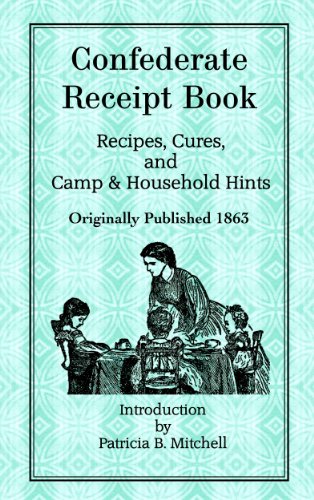
In 1863, the only cookbook compiled and published in Confederacy during the Civil War was entitled, aptly enough, The Confederate Receipt Book. The book included more than 100 receipts (or recipes), but recipes adapted for war-time conditions for soldiers and the home front alike. The book also included recipes for homemade ink and other necessities, cures for various ailments for which traditional medicines were not available, and homemade toothpaste (it’s difficult for me to imagine brushing my teeth with charcoal, but the procedure is included).

Food writer Patricia Mitchell unearthed the recipe book and provided an introduction to a contemporary edition. 

You can find instructions for raising bread without yeast and making your own yeast; how to used potatoes for pie crusts; apple pies without the apples; using corn to create fried oysters without the oysters; making tomato catsup; producing your own soap; and making a “Confederate candle.” Several entries in an appendix explain how to use rice flour instead of wheat flour for various breads and bakery items.

Remedies and cures covered instructions for dealing with dysentery (particularly useful in military camps), chills, asthma, croup, scarlet fever, headache and toothache, burns, camp itch, and even warts and corns. The book also provided instructions for preserving meat without salt, curing bacon and bad butter, clarifying molasses, and using acorns to brew coffee.

Do-it-yourself home repairs covered preserving steel pens, cementing home china or glass, purifying water, charcoal tooth powder, sealing wax, preventing rust, and drying herbs. 

Patricia Mitchell

Patricia Mitchell’s in food and food history began when she was a writer for the Community Standard magazine in New Orleans. Back home in Virginia, she and her husband operated a bed-and-breakfast inn, and guests asked her to compile some of her recipes in a book, which she produced as a pamphlet. A museum director asked for copies to sell in his museum shop, and the rest, as they say, is food history. She’s written and compiled more than a hundred titles, selling hundreds of thousands of copies in bookstores, museums, historic sites, and shops. 

We can’t fully know how well received the book was in 1863, but many must have welcomed its instructions and advice. Common foods and household necessities taken for granted before the war had almost disappeared, and the use of substitutes was widespread. The book provides a window on home life and camp life, and how people adapted to shortages. 

Top illustration: The Richmond Bread Riot, April 2, 1863.

“God Rest Ye Merry, Soldiers” by James McIvor

January 24, 2024 By Glynn Young Leave a Comment

In 1861, the first year of the Civil War, soldiers on both sides still felt some sense of momentum. Overly optimistic, many believed the war would over by Christmas. As the war stretched into 1862, the initial optimism was giving way to something else – a sense of failure and despair. And that sense affected both sides. 

The South was beginning to feel the bite of the Union blockade of Southern ports. The North was watching a series of what seemed like only Confederate victories on the battlefield. Soldiers were becoming demoralized. It didn’t help the Union’s cause that so many senior officers were “political generals” and appeared sorely lacking in experience and common sense. The sense of failure and isolation was especially acute around Christmas, when soldiers would have ordinarily been home with their families.

Using books, articles, letters (both published and unpublished), archival papers, and diaries, author James McIvor has written God Rest Ye Merry, Soldiers: A True Civil War Christmas Story. He’s provided a snapshot of what the Christmas season was like during the four years of the Civil War. His focus is the soldiers, what they thought, what they experienced, and often why they wanted to be anyplace other than where they were. The book was first published in 2006. 

Sometimes the Christmas season and holiday coincided with battles, and soldiers found themselves marching to battle when they would have preferred to be at home, or at worst sitting around a campfire and enjoying a good meal. More often, Christmas was quiet, leaving too much time to think and reflect, and miss fallen colleagues and the family at home.

He points out that the Civil War changed perceptions of the holiday. The suffering on both sides had been great, and the feelings about Christmas that had been growing for decades before the war became something much stronger with the end of the way. “The Civil War, in fact,” McIvor writes, “made Christmas a truly American holiday in a way it had never entirely been before.”

McIvor is a longtime Civil War enthusiast and freelance writer. He lives in Virginia. 

God, Rest Ye Merry, Soldiers is a poignant narrative, but it avoids sentimentalism. Soldiers who served before and after the Civil War would likely find some of their own story here.

Top illustration: Christmas Eve 1863 by Thomas Nast, the German-born Civil War cartoonist who is credited with creating the image of Santa Claus.

  • « Go to Previous Page
  • Page 1
  • Interim pages omitted …
  • Page 4
  • Page 5
  • Page 6
  • Page 7
  • Page 8
  • Interim pages omitted …
  • Page 17
  • Go to Next Page »

Footer

GY


Meet the Man

An award-winning speechwriter and communications professional, Glynn Young is the author of six novels and the non-fiction book Poetry at Work.


 01_facebook 02_twitter 26_googleplus 07_GG Talk

Copyright © 2026 Glynn Young · Site by The Willingham Enterprise · Log in | Managed by Fistbump Media LLC