• Skip to primary navigation
  • Skip to main content
  • Skip to footer

Dancing Priest

Author and Novelist Glynn Young

  • HOME
  • BLOG
  • BOOKS
    • Brookhaven
    • Dancing Prince
    • Dancing Prophet
    • Dancing Priest
    • A Light Shining
    • Dancing King
    • Poetry at Work
  • ABOUT
  • CONTACT

Writing

Dancing King Stories: Researching a Novel

July 16, 2018 By Glynn Young 2 Comments

I’m looking at a web site called English Historical Fiction Authors. Its audience is authors who write period historical novels. The various posts are written by the authors themselves. So, you can learn about how ice cream was made in the 18thcentury, what pieces of furniture would have been found in an upper-class hoe in the 16thcentury, who the Lord Proprietors of Carolina were in the 17thcentury, the friendship between the British Saxon Osulf and one of Charlemagne’s sons; and similar kinds of really detailed information. If you want your period novel to show authenticity, you need authentic historical details.

I don’t write historical novels. Mine fall into the more contemporary genre; actually, they’re set a few years ahead of our own times. So, I don’t have to be concerned with a lot of historical detail, like what Osulf really thought of his friend Charles a thousand years ago.

But it doesn’t mean I’ve escaped the research yoke. Far from it.

I do two kinds of research for my novels. The first is the reading kind – books, articles, web sites, blogs, even social media. The second is the foot-power kind – research by walking around.

A section of A Light Shining is set in Tuscany and Umbria; I’ve never been but I almost went in 2007, and had read so much and studied so much that I had the map of Florence memorized. For Dancing Priest, I had so many books and travel guides on Edinburgh and the University of Edinburgh that I could have opened a travel library. That’s the reading and study kind of research.

bookshelf Dancing King
The bookshelf above my computer

And then a crucial scene in Dancing King happens in Southwark Cathedral; I’ve been there three times, walked around, bought and read the guidebook, took pictures, and talked with the nice lady in the gift shop. I stood in the pulpit and looked at where people would be sitting in the nave. And that hill in downtown San Francisco where Michael Kent rides his bike in Dancing Priest? I’ve walked up that hill.

Walking-around research is extremely valuable. You see and feel what the streets look like, you peer into windows, you see a barrister’s gown and wig on sale for 550 pounds, you notice how Essex Street slopes toward the Thames River. A pub in London may superficially resemble a pub in St. Louis, but if you sit long enough, you begin to notice the differences.

Both kinds of research are critical, even for a contemporary novel.

On the bookshelf above my computer sit the guidebook to Buckingham Palace; four volumes of Peter Ackroyd’s history of England (the fifth is to be published later this year), a guidebook to London, a book entitled Crown, Orb & Sceptre which will tell you everything you want to know about every coronation in English history, a history of St. Martin-in-the-Fields Church, a booklet on the royal line of succession, a guide to Southwark Cathedral, a brochure about the guards associated with Buckingham Palace, and related books. I turn to them often.

I been to England five times in the last six years, and every trip has been both vacation and research. Whatever place we visit – the British Museum, Canterbury Cathedral, the Museum of London, All Hallow’s by the Tower Church, the Imperial War Museum – I buy the official guidebook, which is always packed with information. I see art exhibitions to enjoy the exhibitions and to imagine what they would be like in a novel. I take photos of favorite paintings.

And I take walks. I’ve walked London’s South Bank countless times, along with Piccadilly, the City, Westminster, Hampstead, Pimlico, Belgravia, Mayfair, the Temple, Lambeth, Covent Garden, Charing Cross Road, the West End, and Spitalfields. I’ve walked Oxford, Cambridge, Salisbury, and Windsor. Every walk is research.

I pay attention to contemporary British artists and writers. I read novelists like Paul Kingsnorth (Beast) and Mark Haddon (The Curious Incident of the Dog in the Night-Time). I read contemporary British plays. Contemporary literary culture provides a take on the pulse of the country and insights you can’t get from non-fiction.

It’s not just the historical or period novels that demand research. Contemporary ones do, too. And I think I’d rather eat ice cream in 21stcentury England than what the Georgians considered ice cream in the 18thcentury.

Top photograph by Gaelle Marcel viaUnsplash. Used with permission.

Dancing King Stories: Unexpectedly Writing a Series

July 9, 2018 By Glynn Young 1 Comment

DK Stories writing a series

I never intended to write a series of novels. In fact, I never really thought about publishing what I was doing, first in my head and later on paper. Dancing Priest existed only in my head for almost five years. It began with an image and gradually progressed to a story.

You can tell a story in your mind much faster than you can write it down.

But I did eventually push it on to a computer screen, all 250,000 words of it. It was too big for a novel, too unwieldy, shooting off in too many directions. Metaphorically speaking, I took an ax to the manuscript at about the 110,000-word mark. And then I spent the next two years culling those 110,000 words down to about 90,000. I rewrote the story at least once. And that was what was eventually published as Dancing Priest.

Dancing PriestThe manuscript carcass – what was left over – had piled up. The publisher suggested a sequel. Out came the metaphorical ax again and chopped off about 65,000 words. Because of changes in Dancing Priest during the rewriting and editing process, those 65,000 words had to be reworked even more than the first manuscript. The story grew.

The editor suggested an additional villain And he was right. He didn’t suggest what kind of villain, only that one was needed. I created an assassin. Thinking I would come back and give him a name. After trying out various possibilities, I saw something else. Leaving him nameless actually heightened the tension of the story, and my nameless assassin carried that tension right to the end of the story. And the story was published as A Light Shining.

A Light ShiningAnd there I stopped. My day job became crazy. I actually published a non-fiction book (Poetry at Work) the year after A Light Shining. At first it seemed easy. It was much shorter than the novels, but on top of the day job and my mother’s growing infirmities, it became increasingly difficult. And I was writing to a deadline. I made it, but I nearly collapsed from the effort.

Four years passed. And then at a lunch with the publisher of my novels, I mentioned I was trying to sort through a possible third novel. The manuscript was something of a jumbled 50,000 words, the last part of that original 250,000 words that came pouring out of my in the fall and winter of 2005. I had to reread Dancing Priest and A Light Shining – twice – to see how to shape and reshape, write and rewrite those 50,000 words. And this wasn’t the book I wanted to be working; the one I wanted to be writing would fall fourth in the series. But I couldn’t get to the fourth because too much would be missing after A Light Shining.

Dancing KingSo Dancing King eventually saw the light of day. It started off as a kind of orphan; it ended up being my favorite of the three.

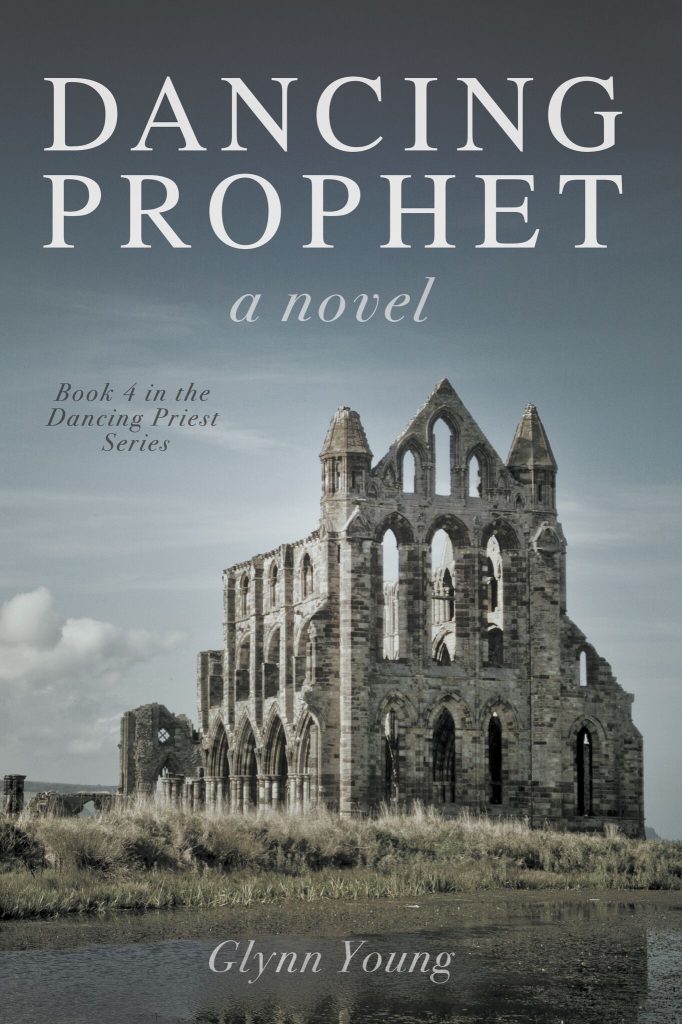
Now I’m deep into the fourth in the series. I have a working title in my head but I don’t know if it will stick or not. The manuscript is somewhere in the vicinity of 70,000 words at the moment, heading toward 90,000. It’s in two pieces – the new, rewritten and revised version, and the old manuscript (or what’s left of it). I’m reading and revising, reading and discarding, reading and adding something new.

I didn’t intend to develop a series of related novels, but there was simply too much story that I needed to tell. And so, there it is. A story about a priest dancing on a beach because a story about priest who was also a cyclist with a jumbled family and who eventually became a king.

And now he’s on his way to become a reformer, but not in the way he expected. And not in the way I expected.

Top photograph by Patrick Tomasso via Unsplash. Used with permission.

Have You Tried Writing by Hand?

June 29, 2018 By Glynn Young Leave a Comment

Writing by hand

In the summer between my freshman and sophomore years in college, I taught myself to type, and for a very good reason. I was starting my introductory journalism classes in the fall, and typing was a requirement. So, in whatever free time I had that summer (I was also working a summer job), I could be found sitting at my desk in my bedroom, following a self-instruction manual, pecking away on an electric typewriter my parents had bought for me.

I took my electric with me when I returned to college. My first day in my basic news reporting course, I discovered we had typewriters at every seat – old Royal manualtypewriters. My fingers, used to the needed light touch on an electric machine, had to learn how to pound on a manual.

Gradually, I got used to typing on a manual for journalism writing. All other writing – papers, research texts, history and English assignments – were typed on my electric in my room. At times I felt I had a bit of a split personality, but I made do.

I graduated, and my first job was as a newspaper copy editor. The copy desk used IBM Selectric typewriters, which, fortunately, I was familiar with from my father’s printing and mailing business. For the next decade, the IBM Selectric was my friend, first at the newspaper and then my work in corporate communications.

In 1984, my IBM Selectric was replaced by an IBM 286 computer, with a floppy-disk drive. In the days before email and networked computers, I could copy a document to the dick, hand the disk to a secretary, and watch her print what I had written. For someone like me, with speechwriting and regular revision of texts was standard operating procedure, that IBM 286 was something close to miraculous. We bought our first home computer, an Apple IIGS, in 1988.

In the late 1980s, I was working on a speech. It wasn’t just any speech; it was one of those groundbreaking speeches that would likely change a lot of things. (It would eventually turn an industry upside down and become known as “the speech that refused to die.”) And I was having trouble – how was I going to bring the speech to a close? Up to the last two pages, the text moved and soared – and then went completely flat.

I had seen a program on PBS whose subject related to the subject of the speech. We obtained a copy of the program, and I brought it to the television and cassette player in our conference room. My desktop computer stayed where it was – on the desktop (this was before laptops had appeared). I watched the program, and I suddenly knew how to end the speech. With nothing to type with, I started writing by hand.

And I learned something. I wrote differently when I wrote by hand as opposed to typing on a typewriter or computer keyboard. The revelation startled me. Could technology affect how I wrote?

After typing the new conclusion to the speech and sending it off to the executive for review, I took a hard look at the text. And, yes, I could see the difference. The most emotional part of the speech – the part that packed the biggest wallop – was the part I had written by hand.

I tried this with other speeches and other kinds of writing. And it held true. From then on, if I needed an emotional section, I would write it first by hand.

I still do that. Virtually every poem I write is written first by hand. Several sections of my three novels were first written by hand. Even parts of my non-fiction on poetry at work were written by hand.

I can’t explain it, but writing by hand connects me far more emotionally to what I’m writing than simply typing the text. I’ve also found that writing by hand helps when I hit a wall or dead end.

It’s one reason I carry a journal with me wherever I go, including church.

Have you tried writing by hand, or using writing by hand to help you through difficult parts of a text?

Photograph by Adolfo Felix via Unsplash, Used with permission.

Writing: Follow Your Passion?

June 22, 2018 By Glynn Young Leave a Comment

writing follow your passion

We see a lot of advice these days about following your passion. Determine what your passion is, pursue it, and you will find happiness. Huffington Post even has a whole section on the subject. It’s a subject usually but not always associated with “Gen Y” or millennials – those who were born roughly between 1980 and 1995. Yet I’ve heard Gen X-rs and Baby Boomers embrace the same idea. It’s usually tied in with the idea of quitting your existing job and pursing that desire or dream that’s been rattling around in your head.

However the idea got started, the inevitable pushback has followed. “Follow Your Passion is Not a Career Plan,” says Business Week. George Washington University professor Cal Newport says it’s bad advice. Mashable reposted the Cal Newport video and then elaborated on why it’s bad advice. So did the Minimalists. So did Fast Company. (That Cal Newport fellow has had a considerable influence.)

The appeal of the idea of following your passion is understandable. You find yourself in a boring job, or a job that’s taken turns you didn’t expect, or the organization reorganized itself three months after you walked in the door, or that great new boss you were working for suddenly quit, or the company was acquired and layoffs are coming. Or perhaps the layoffs have started. None of this leads to happiness, and it is happiness that has come to be the main goal of life in Western culture.

What I think we do is confuse passion with desire, or even dreams.

I have a great desire to spend more time in London, seeing cool stuff, like we did on our recent vacation, and preferably staying at the hotel we stayed at. It’s a desire – and a quick way to spend a lot of money.

I have a dream of being a full-time writer, writing what I would like to write. It’s been a dream since I was in my 20s (it’s an old dream). I didn’t begin getting really serious about it until about 10 years ago. Yes, I’ve published three novels and a book about the poetry of work. I won’t be living off the royalties any time soon. The dream is still a dream, and one that I believe I’ll be closer to realizing in a few short months, when I retire from the day job.

Ideally though, you never quite realize the dream. You keep reaching for it. The reality of the dream is in the reaching.

And then, say John Lynch, Bruce McNichol and Bill Thrall, the authors of The Cure: What if God Isn’t Who You Think He Is and Neither Are You, there is destiny.

Their definition isn’t what you might expect. Most of us today would define destiny as fate or perhaps providence. What The Cure suggests, however, is that we typically look at this from the wrong end of the telescope.

“Destiny,” the authors write, “is the ordained intention God has sacredly prepared with your name on it.”

That’s the desire we should have, the dream we should reach for, and even the passion we should follow.

Yes, it’s about you, but it doesn’t start with you.

And it won’t end with you.

But you do have a destiny.

Photograph by Tim Marshall via Unsplash. Used with permission.

Dancing King Stories: Michael Kent-Hughes

June 18, 2018 By Glynn Young Leave a Comment

DK Stories Michael Kent Hughes

Michael Kent (married name, Kent-Hughes) started out fictional life as an unnamed priest dancing on a beach in Italy. He was inspired by a song, “Luna Rossa,” sung by Mario Frangoulis. I first heard the song on an airplane flight to San Francisco in 2002. The image of a dancing priest stuck in my head and wouldn’t let go.

The priest stayed in my head for the next three years. He moved off the beach and into a tourist group. He changed religions, from Roman Catholic to Anglican. He had a mild flirtation with a young American woman who was part of the tour group. The beach, Italy, and the tour group were left behind, and the priest was moved to Scotland. He was finishing his theology studies at the University of Edinburgh. He gained a named, Michael Kent. He gained a reason for being English but living in Scotland – he was raised by guardians.

DK Stories cyclistIn August 2004 I started biking, which meant Michael started biking, too. Except he was training for the Olympics. Michael and I had a lot of conversations on various biking trails around St. Louis, the Lachine Canal Trail in Montreal, the Katy Trail in Missouri, and the Yorktown-Jamestown Colonial Parkway in Virginia.

From 2002 to 2005, the story arc of Michael Kent was laid out – in my imagination. Nowhere else. I said nothing about the story to anyone, including my wife, because I wasn’t sure what I was going to do with it. In the fall of 2005, inspired by Hurricane Katrina, I began to type it. It took two months, and when I finally stopped, three months later, I had a 250,000 word manuscript and the entire story line that would eventually become Dancing Priest, A Light Shining, and Dancing King.

For the next five years, the manuscript was rewritten, edited, split into three pieces, re-edited, re-rewritten, and continually worked over. More pieces of the story, extending beyond Dancing King, were added. Query letters went out to agents and publishers, with the net result of zero interest. An editor and an agent read a chunk at a writers’ conference; they offered enough encouragement that I kept working on it. Dancing Priestfinally found a publishing home in 2011.

The three novels tell the story of Michael Kent-Hughes. Through the three books, he’s moved from a priest-in-training to Buckingham Palace. He’s now 27, married, with two adopted sons and a young baby. Instead of being a priest, he finds himself the head of the Church of England, in conflict with the church hierarchy.

DK Stories Michael Kent-HughesMichael Kent-Hughes had serious doubts. He occupies a leadership role that he’s not sure he’s at all qualified for. He knows what he’s been called to do, and it’s daunting. He finds himself the object of personal and institutional attacks. And he learns he has to depend upon people, and how much of his success depends upon finding good people to work for him.

He adores his wife Sarah and his family. The importance of his family begins to reshape how he undertakes his royal duties. Not being raised among Britain’s elites means his orientation, values, and priorities are very different.

Although born in southern England, Michael considers Scotland, and the McLarens’ farm, as home. He still rides his bike, even if he’s not competing professionally. In spite of the wealth and royal trappings surrounding them, the Kent-Hughes family will maintain something of a middle- to-upper-middle-class lifestyle.

Michael has been positioned and is being prepared for something much larger than he has yet imagined.

Top photograph by Justin Chenand cyclist photo by Max Libertine, both via Unsplash. Photograph of baby and dad sleeping by Vera Kratochvil via Public Domain Pictures. All used with permission.

Inspired by a Horror: Because It Matters

June 15, 2018 By Glynn Young 1 Comment

Inspiried by a horror

Grant’s Trail, a biking-walking-jogging-rollerblading trail in St. Louis some 10 miles long, begins about a mile-and-a-half from my house in Kirkwood, officially the oldest incorporated suburb of St. Louis. The trail is a converted railroad track bed, and I’ve been biking it for years now. Counting the round trip and an occasional side meander, it’s a good 20-mile ride.

Just before the trail begins, there’s a brick apartment complex of some 40 to 50 units in five or six buildings. Rather nondescript, it’s neither at the luxury end of residential living nor the housing-of-last-resort end. Nondescript, and rather anonymous, sufficiently describes it.

Each time I’d go to Grant’s Trail, I’d bike past the complex, barely giving it a thought except to watch for doors suddenly opening from cars parked on the street (bikers have to watch for these things). But it wasn’t the kind of building or complex that you’d pay much attention to.

Until January of 2007.

One cold, icy day (I remember because we eventually lost power from the ice coating the trees), police made a startling discovery. Inside one of the apartments was a 13-year-old boy, kidnapped a few days before as he rode his bike home from school in rural Franklin County, near St. Louis. And with him was a 15-year old boy, kidnapped when he was 11. The good news was that both boys had been found alive. The bad news was what they had endured, one during a short few days and the other for several years. Police arrested Michael Devlin, 41 at the time. He later pleaded guilty and is now serving 74 life sentences in a Missouri prison.

The story became international news. During the next few weeks, news media from all over the United States and several other countries converged on the complex, the local pizza parlor where Devlin worked, his family’s home in neighboring Webster Groves, the police department and everywhere else in Kirkwood. To see it shook Kirkwood residents’ perceptions, including mine, of our rather self-idealized community is an understatement. A year later, the murders of several council members and police officers by a disgruntled resident shattered whatever images of our community we had left.

The news cycle eventually turned and went on to other things. But I can’t ride or drive by that apartment complex now without thinking about Michael Devlin and those two boys. What happened there horrified all of us who live in Kirkwood and anyone who read or learned about the story.

For me, the horror went deeper. I don’t really understand why it did – there’s nothing repressed or anything that happened to me when I was young that would trigger such a reaction. But I was profoundly affected. For a considerable time, I biked a different route, simply to avoid the association.

Many people asked why or how this had happened. Why didn’t the older boy try to escape when he had so many opportunities? How did neighbors ignore screams coming from the apartment? Why did the police ignore tips? Why didn’t Devlin’s family question some of his odd behaviors?

I didn’t ask how or why. I understood. For some unknown reason, I knew the answers to all the questions. Instead, I focused on the shock, the fear, the horror, the desolation, the pain, the hopelessness, the desire to survive that became part of these boys’ experiences. I said little to anyone about this.

I finally knew what I had to do to deal with it. I wrote it out. More than 44,000 words poured out of me until I knew it was time to stop. I wrote it as fiction, far removed from Kirkwood and the events of February 2007. And then I set it aside. Anyone reading what I wrote today wouldn’t recognize the original inspiration.

In The Right to Write, author Julia Cameron says that “when we commit our thoughts to paper, we send a strong and clear message that what we are writing about and whom we are writing to matters.”

In my head and in my heart, I became a conduit, what Cameron refers to as “becoming a channel.” I don’t understand why this happened, only that it did. No one except me has seen the manuscript, but it’s now becoming the fourth novel in the Dancing Priest series.

Because I finally realized the story needed to be told. It mattered.

Photograph by Aaron Mello via Unsplash. Used with permission.

  • « Go to Previous Page
  • Page 1
  • Interim pages omitted …
  • Page 36
  • Page 37
  • Page 38
  • Page 39
  • Page 40
  • Interim pages omitted …
  • Page 44
  • Go to Next Page »

Footer

GY


Meet the Man

An award-winning speechwriter and communications professional, Glynn Young is the author of six novels and the non-fiction book Poetry at Work.


 01_facebook 02_twitter 26_googleplus 07_GG Talk

Copyright © 2026 Glynn Young · Site by The Willingham Enterprise · Log in | Managed by Fistbump Media LLC