• Skip to primary navigation
  • Skip to main content
  • Skip to footer

Dancing Priest

Author and Novelist Glynn Young

  • HOME
  • BLOG
  • BOOKS
    • Brookhaven
    • Dancing Prince
    • Dancing Prophet
    • Dancing Priest
    • A Light Shining
    • Dancing King
    • Poetry at Work
  • ABOUT
  • CONTACT

Writing

“The Limits of Loyalty” by Jarret Ruminski

October 31, 2022 By Glynn Young Leave a Comment

We often get images, based on stereotypes, stuck in our heads about history. The antebellum and Civil War periods are no exceptions. We think the South was nothing but large plantations with thousands of slaves. We also might think that every Southerner tightly embraced secession and the war and retained that embrace until surrender in 1865.

These images are two-dimensional cartoons, with more or less an element of truth. The reality was considerably different. Most Southerners were small farmers, not big plantation owners, who did have an outsized presence in issues of the days. Likely most white Southerners did support secession, but that support began to wane as early as 1862. Fewer than half of white Southerners were slaveowners. And the state of Mississippi is a good example.

In The Limits of Loyalty: Ordinary People in Civil War in Mississippi, Jarret Ruminski takes a deep look at what happened in the state over the period 1861-1865. The time in which people’s nationalist sentiments and actions were most closely tied to the Confederacy was, unsurprisingly, early on. By 1862, as parts of the state began to experience invasion and destruction (and Mississippi experienced considerable amounts of both over the course of the war), sentiment shifted. Other loyalties, like to community and family, began to take precedence over feelings about the Confederacy and even the war. For many, and especially for women left at home with children and small farms and businesses, family survival became the overriding issue.

Ruminski draws upon letters, published reports and editorials in newspapers, journals, and official records. He considers early nationalist sentiment; how Union, Confederate, and private citizens defined oaths of allegiance; the contraband trade that occurred across all socio-economic levels; the role that deserters and gangs of thieves and robbers played; the breakdown in loyalty between slaves and masters; and how all of this upheaval not only tore at the fabric of law and society but reverberated for decades after the war.

In short, in the state of Mississippi at least, and likely many other Southern states, the idea of the Confederacy, support for the war, and afterward the “Lost Cause” might have more basis in fiction and myth than in actual fact. It was one thing to support the Jefferson Davis national government. But families had to eat and survive, and if it was a choice between loyalty to the cause and the war and seeing your children starve, it wasn’t much of a contest.

Jarret Ruminski

Ruminski received his B.A. degree in English and his M.A. degree in American history at Youngstown State University, and his Ph.D. degree in 19th century American history from the University of Calgary. His Ph.D. dissertation, which likely furnished a considerable portion of the research for The Limits of Loyalty, was entitled “Southern Pride and Yankee Presence: The Limits of Confederate Loyalty in Civil War Mississippi, 1860-1865.” A freelance writer and researcher, he’s published articles in Civil War History, The Journal of the Civil War Era, Journal of Southern History, American Nineteenth Century History, Ohio Valley History, Ohio History, and a variety of other historical and popular publications.

The Limits of Loyalty focuses on the lives and experiences of ordinary people during the Civil War, the people who tilled the farms, harvested the crops, operated the small stores and sawmills, and had to feed their families. It was a society coming apart at the seams in a variety of ways, and as Ruminski demonstrates in his highly readable and extensively researched account, the loyalty people felt was multifaceted, with loyalty to family and community taking increasing priority as society collapsed.

Top Photograph: Women of the Civil War, drawing by Winslow Homer.

“Presidential Reconstruction in Mississippi” by William C. Harris

October 24, 2022 By Glynn Young Leave a Comment

It’s barely mentioned in the standard school history textbooks, but the Southern states experienced two Reconstructions after the Civil War. The second is the best known, lasting from 1867 to 1876, and generally known as Radical Reconstruction (for the Radical Republicans in Congress who controlled it). The first is Presidential Reconstruction, between 1865 and 1867, directed by President Andrew Johnson, who believed he was carrying out the desires and plans of the assassinated Abraham Lincoln, who wanted a speedy reunion.

The Radical Republicans wanted punishment, and they wanted civil rights for the former slaves.

Mississippi was the second state to secede after South Carolina and the first to seek reunion. But reunion was anything but simple. The state was devastated economically; much of its large agricultural and small industrial infrastructure has been destroyed, and its social infrastructure was in upheaval. Law and order had broken down, railroads destroyed, and planters and farmers were desperate for a labor force to plant and harvest cotton.

Historian William C. Harris explains what happened during these roughly two years in Presidential Reconstruction in Mississippi, originally published by LSU Press in 1967. The state faced what looked to be insurmountable difficulties – a huge debt, a collapsed currency and economy, the disappearance of the slave system that underpinned cotton and agriculture, cities and towns that had been destroyed, the deaths of so many men in the war, and the breakdown of law and order across the state. 

Both the provisional government and the restoration government struggled with what to do about the former slaves. Planters wanted to keep them tied to the land; the slaves themselves flocked to the cities and towns, looking for work. There were the questions of civil rights, including land and property ownership, education, and voting. And the state faced the enormous problem of trying to revive agriculture and especially cotton production, which seemed to offer the best way for the state economy to recover.

Harris explains that the state leaders trying to manage the restoration were largely men who had been pro-Union or anti-secessionist and associated with the old Whig Party. They were aware of congressional sentiment, but they were also considering what would have been at one time unthinkable – former slaves having the right to vote. A few understood that Congress was unlikely to accept anything short of the full rights of citizenship. 

William C. Harris

He pays special attention to efforts aimed at reviving the state’s economy – agriculture, levee reconstruction, the railroads, towns, commerce, and industry. And he explains the Black Codes, tentative steps toward rights for the former slaves but also an attempt to regulate them in Mississippi society. It was these activities which put a national spotlight on presidential reconstruction across the South, outraging newspapers and many in the North who saw the codes as a kind of slavery in disguise. 

Harris is a prominent Civil War historian, educator, and author. His published books include The Day of the Carpetbagger: Republican Reconstruction in Mississippi, William Woods Holden: Firebrand of North Carolina Politics, With Charity for All: Lincoln and the Restoration of the Union, Lincoln’s Last Months, Lincoln’s Rise to the Presidency, Lincoln and the Border States: Preserving the Union, and Lincoln and the Union Governors. He received his B.A., M.A., and Ph.D. degrees from the University of Alabama, and he taught at Millsaps College and North Carolina State University, from which he retired as professor emeritus in 2004.

Presidential Reconstruction in Mississippi, 55 years after its publication, remains a valuable resource for understanding how the state tried to manage its emergence from the chaos of the Civil War, where it succeeded, and where it fell woefully short. 

Top photograph: Oxford, Mississippi, in August, 1864, after its destruction by Union troops.

“The Battle of Jackson, Mississippi” by Chris Mackowski

October 17, 2022 By Glynn Young Leave a Comment

As many times as I’ve driven through or visited Jackson, Mississippi, I never knew that two Civil War battles were fought within days of each other right here at Mississippi’s capital city. The first, the Battle of Jackson, happened May 14, 1863. The second, at nearby Champion Hill. happened two days later. Champion Hill was the pivotal action in guaranteeing the eventual fall of Vicksburg, giving the Union control of the Mississippi River and dividing the Confederacy in half.

Chris Mackowski, in The Battle of Jackson, Mississippi, tells the story of that battle, one that ended in the city’s capture and eventual large-scale destruction. It was something of a pincers battle, with Ulysses Grant directing General James McPherson to lead his troops from the northwest and General William Sherman to lead his troops from the southwest. After the diversionary tactic of Major Benjamin Grierson’s raid through Mississippi from mid-April to early May of 1863, Grant successfully moved his army across the Mississippi River at three places as part one of the capture of Vicksburg.

Part two was critical – capture the disable the railroad (and supply chain) from Jackson to Vicksburg – and that meant an attack on Jackson. Facing him in Jackson was a very reluctant Confederate general, Joseph Johnston – reluctant in that he didn’t want to be in Jackson to begin with and was only there because Confederate President Jefferson Davis ordered him to go. He no sooner arrived than he ordered the troops to retreat eastward.

Mackowski tells an enthralling story, placing the reader in the middle of the action on both sides. You experience the determination of the Union troops and their generals, and you experience the panic felt of the citizens of Jackson as those troops approached the city. Jackson’s fall was not the worst thing to happen to the Confederacy, but it made a significant impact on the people of Mississippi and elsewhere in the South. The city would later be re-occupied by the Confederates, only to be abandoned again on July 14 as Grant marched east from the surrendered Vicksburg. The city was largely a ruin; its destruction earned it the nickname “Chimneyville.”

The book is filled with small but telling details. The Bowman Hotel, where Johnston’s short stay was cut even shorter by the approaching federal, is the same place where Grant sets up his headquarters. Sherman ordered the hotel and other private properties to be protected as the army left for Vicksburg, but fires were set in spite of those orders, and the hotel was destroyed. And also fascinating is the brief account of Grant’s 12-year-old son Fred, racing up the state capital stairs to reach the Confederate flag flying on the flagpole, only to be met by a jubilant federal soldier coming down the stairs, the flag in his arms. 

Chris Makowski

Mackowski is the author or editor of almost 30 books on the Civil War. He’s the editor-in-chief for the Emerging Civil War web site and the editor for the Emerging Civil War Series of books. He is a writing professor and associate dean for undergraduate programs at St. Bonaventure University in New York. He also serves as historian-in-residence at Stevenson Ridge on the Spotsylvania battlefield in Virginia. He’s worked as a historian for the National Park Service, and he gives tours at four major Civil War battlefields – Fredericksburg, Chancellorsville, Wilderness, and Spotsylvania. 

The Battle of Jackson, Mississippi is a concise, highly readable account of the battle, filled with maps and photographs and supported by extensive research. It was a relatively small battle in the context of the Civil War, but it was a critical action that helped lead to the fall of Vicksburg two months later.

Top photograph: The Bowman House Hotel in Jackson about 1863, prior to its destruction by fire. Photo courtesy of the Mississippi Department of Archives & History. 

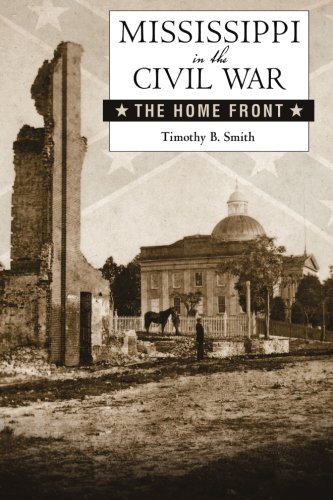
“Mississippi in the Civil War: The Home Front” by Timothy Smith

October 10, 2022 By Glynn Young Leave a Comment

In high school and college, when we read about or study the American Civil War, we learn primarily about the political and military figures and the battles and campaigns. When I attended LSU, the school’s history department had a national reputation, with professors like T. Harry Williams, who was not only a highly regarded Civil War historian but also wrote the Pulitzer Prize-winning biography of Huey Long. Williams published several books on Abraham Lincoln, P.G.T. Beauregard, Civil War generals, and related topics.

In recent years, more attention has been paid to the war and how it affected civilians. When Union armies invaded the Southern states, they civilians they encountered were largely women, children, and older men beyond military age. And it is this group, and their lives in towns, cities, and farms, that Timothy Smith considers in Mississippi in the Civil War: The Home Front.

Smith divides his story in two pieces. First is how the state of Mississippi dealt with the military conflict from secession through the end of the war. The second is how the civilian population experienced the war. He pays particular attention to the belief among historians that the South was defeated not only by Northern industrial might but also by the people losing the will to fight. He finds some of that may be true, but that the “losing the will to fight” sentiment may have played a smaller role than previously thought.

Mississippi’s surely had more than sufficient reason to lose heart. From early in the war, the state was devastated economically, militarily, and socially. Agriculture was disrupted, cities burned, and railroads destroyed. What little there was industrial infrastructure also suffered severely. Deserters and criminals freed from jails roamed the countryside. Cotton, which had been the state’s primary crop, became almost useless with the federal blockade of ports. Inflation soared. Foodstuffs became scarce. The state had to sequester food for the military. Many people fled the state during the war for less affected places like Texas. (My own Mississippi ancestors did precisely that, returning only after the war was over.)

Particularly interesting is Smith’s discussion of the anti-secession sentiment in the state, which was surprisingly strong. Not everyone wanted to leave the Union; not everyone owned slaves. But everyone would largely suffer equally.

Timothy Smith

Smith provides an overview of what people experienced. Military battles aside, it was a dark time for many people in the South, free and slave, and the effects would be felt for decades. Some say the effects are still being felt. 

Smith’s numerous books on the Civil War include accounts of the battles of Vicksburg, Corinth, Champion Hill, Shiloh, Forts Henry and Donelson, and Chickamauga; the Mississippi secession convention; U.S. Grant’s invasion of Tennessee; and the Grierson Raid in Mississippi. A professor of history at the University of Tennessee at Martin, he’s won numerous awards for his books, including the Fletcher Pratt Award, the McLemore Prize, the Richard Harwell Award, the Tennessee History Book Award, the Emerging Civil War Book Award, and the Douglas Southall Freeman Award. He lives with his family in Tennessee.

Mississippi in the Civil War: The Home Front is a sobering story. Mississippi and the other Southern states may have brought the war upon themselves, but its people endured and survived, Smith explains how that happened.  

Related:

“The Real Horse Soldiers” by Timothy Smith. 

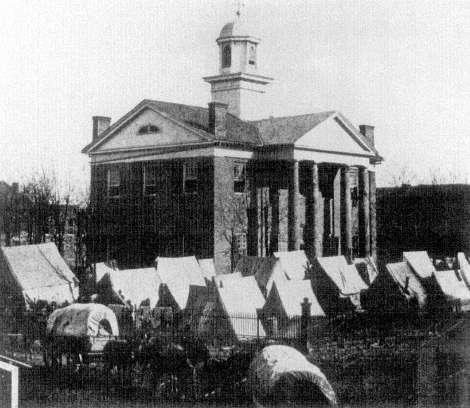
Top photograph: The original Oxford, Miss., courthouse, with a Union army encampment on its grounds. 

“The Civil War in Mississippi: Major Campaigns and Battles” by Michael Ballard

October 3, 2022 By Glynn Young Leave a Comment

If there is a state we most associate with the American Civil War, it is Virginia. Numerous battles occurred there; the federal and confederate armies faced each other for four years, most often in a stalemate; and the two enemy capitals ensured that Virginia was a major theater of the war. And it was in Virginia that Robert E. Lee ultimately surrendered to Ulysses S. Grant. 

Some have argued that the United States really won the war farther west – the fall of New Orleans and Vicksburg, the battles around Nashville and Chattanooga, the capture of Atlanta in 1864, and Sherman’s March to the Sea. 

And then there was Mississippi, the second state (after South Carolina) to secede from the Union. The Civil War in Mississippi was more – far more – than Vicksburg. Historian Michael Ballard (1946-2016) tells the story in The Civil War in Mississippi: Major Campaigns and Battles (2011). The book is volume 5 of the Heritage of Mississippi published by the University Press of Mississippi for the Mississippi Historical Society and the Mississippi Department of Archives and History.

Vicksburg (1863) may have been the most important battle in the state; its surrender solidified control of the Mississippi River by the United States and severed the Confederacy in half. But the northern part of the experienced numerous battles. The town of Holly Springs changed hands 57 times. The town of Oxford was burned. The state capital of Jackson fell twice to the federals; Grant took the city and then attacked Vicksburg from the east. Before he marched to the sea in Georgia, Sherman marched from Jackson to Meridian in similar fashion, destroying anything that might be of value to the Confederates. Major Benjamin Grierson led a three-week-long raid with 1,700 cavalry troops from the Tennessee line south, eventually arriving in federally held Baton Rouge in Louisiana. 

The destruction through the years of war was large-scale – plantations, factories, warehouses full of supplies, railroad deports and track, and whole towns in some cases. In his well-written and highly readable account, Ballard succinctly tells the story of all of what happened. 

Michael Ballard

During his lifetime, Ballard published numerous books about the Civil War, including A Long Shadow: Jefferson Davis and the Final Days of the Confederacy (1986); Landscapes of Battle: The Civil War (1988); Pemberton: The General Who Lost Vicksburg (1999); A Mississippi Rebel in the Army of Northern Virginia: The Memoirs of Private David Holt (1995); Grant at Vicksburg: The General and the Siege (2003); U.S. Grant: The Making of a General 1861-1863 (2005); and several others. He received his B.A., M.A., and Ph.D. degrees from Mississippi State University, where he also worked as archivist and director of the Congressional and Political Collection. 

The Civil War in Mississippi is a fine history and a sobering one. By the end of Civil War, the state’s economy was in ruins, its towns and cities had experienced widespread destruction, thousands of its men had died on battlefields across the state and the South, and its social order was turned upside down. Recovery would be a long time coming. 

Top photograph: Artist’s rendering of the Battle of Corinth, Miss.; Mississippi Department of Archives and History.

“Eyewitness to the Civil War” by Stephen Hyslop

September 26, 2022 By Glynn Young 1 Comment

Sometimes I’m a sucker for coffee table books. And sometimes they turn out to be more than coffee table books. 

In 2006, National Geographic published Eyewitness to the Civil War: The Complete History of the Civil War from Secession to Reconstruction. Written by Stephen Hyslop and edited by Neil Kagan, the book appears to be a classic book meant for the coffee table. And it could certainly find a home there. But it turns out to be a lot more.

The book is like a documentary in print. It provides a basic (and well-written) account of the war from beginning to end, highlighting the major battles, developments, home fronts, and international repercussions. It tells the stories of generals and soldiers, slaveowners and slaves, and farmers and townspeople who lived the war. It shows how an increasingly split nation finally erupted into the violence of civil war.

An example of a sidebar in the book.

You discover what soldiers ate, like hardtack (biggest problem with this army staple: bugs). You learn about what passed for medical science. You read letters and journal entries. You see what soldiers’ apparel looked like. You see how newspapers North and South reported the war. You see paintings of battles, and study wonderful maps drawn at the time. You see the experiences former slaves had as soldiers. You experience the war in its glory and its horror. And you learn about what civilians thought and did, and how the war affected them, and how the war seemed to inhale immigrants, and especially the Irish. 

Colorful and well-researched sidebars to the book’s main narrative include eyewitness accounts, mapping the war, and picture essays. The book’s major strength is how it draws upon relics, diaries, journals, letters, memoirs, photographs, and sketches. It’s carefully curated history, to be sure, but it’s history in the raw.

Hyslop’s published works include Eyewitness to World War II, The Old West, Atlas of World War II, The Secret History of World War II, Bound for Santa Fe, and Almanac of World History. Several of these titled were published by National Geographic. He worked as a staff writer and text editor at Time-Life Books, and he’s written for numerous magazines, including American History, Kansas History, California History, World War II, and the History Channel Magazine.

I’m not sure when I bought the book; it’s been sitting on my bookshelf for some years. But when I finally got around to reading it, I discovered the pleasure of a solid, well-thought-out, and well-constructed text that tells a straightforward and vitally important story.

  • « Go to Previous Page
  • Page 1
  • Interim pages omitted …
  • Page 25
  • Page 26
  • Page 27
  • Page 28
  • Page 29
  • Interim pages omitted …
  • Page 46
  • Go to Next Page »

Footer

GY


Meet the Man

An award-winning speechwriter and communications professional, Glynn Young is the author of six novels and the non-fiction book Poetry at Work.


 01_facebook 02_twitter 26_googleplus 07_GG Talk

Copyright © 2026 Glynn Young · Site by The Willingham Enterprise · Log in | Managed by Fistbump Media LLC