• Skip to primary navigation
  • Skip to main content
  • Skip to footer

Dancing Priest

Author and Novelist Glynn Young

  • HOME
  • BLOG
  • BOOKS
    • Brookhaven
    • Dancing Prince
    • Dancing Prophet
    • Dancing Priest
    • A Light Shining
    • Dancing King
    • Poetry at Work
  • ABOUT
  • CONTACT

Fiction

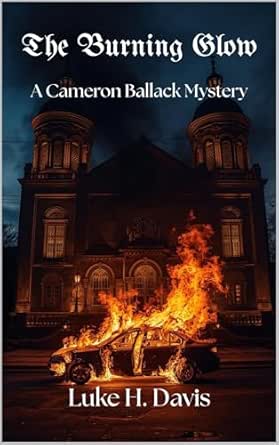
“The Burning Glow” by Luke H. Davis

May 6, 2026 By Glynn Young 1 Comment

Cameron Ballack is back. And he’s traipsing all over where I used to bike.

Ballack is the fictional wheelchair-bound police detective created by St. Louis-based writer Luke H. Davis. In previous books (and there’s been a gap of some years), he and his team were based in St. Charles County, Missouri, part of metropolitan St. Louis. In his new outing, entitled The Burning Glow, Ballack is now the lead detective for the Special Investigating Department, which operates across the metro St. Louis region. (St. Louis actually does have something similar that operates across jurisdictional lines called the Major Case Squad.)

What Ballack and his team are pulled into is a car bombing in the part of the city of St. Louis known as “Little Bosnia,” home to numerous immigrants who fled the war in the 1990s. The victim is a teenager, who had arrived at a spot behind an apartment complex to show his friends a body in a dumpster. The friends run off; the teenager dies when he returns to his car. The teen was Bosnian and Muslim.

The next day, another car bombing occurs – one in the parking lot of a synagogue in west St. Louis County. A Jewish couple is killed. The male victim happened to be the business partner of the man whose body was in the dumpster. Then a third car bombing is narrowly avoided, when the intended victim, another Bosnian in south St. Louis, happens to step outside his home for a cigarette after midnight and notices someone checking underneath a car. 
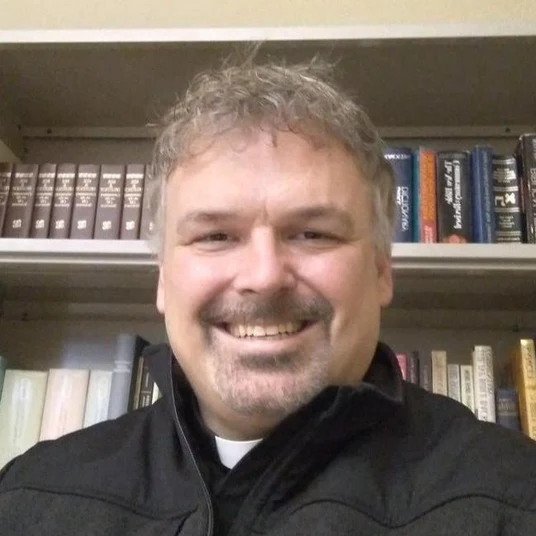
Luke H. Davis

And from there, the mayhem gets even wilder. Ballack is racing not only to find the killer or killers but also to solve the crimes before the FBI arrives. It culminates in a wild chase across south St. Louis. (By this time, I’m yelling at Davis to leave Ted Drewes ice cream store alone.)

Davis tells a nail-biting story. He also gets the geography exactly right. I know because I’ve biked those very same streets, and biked them a lot, including those in Little Bosnia. And I’m still trying to recover from the scene at the intersection of Chippewa and Hampton. 

Davis teaches at Westminster Christian Academy in St. Louis and chairs the Bible Department there. He’s also taught at schools in Louisiana, Florida, and Virginia. He describes himself as “Presbyterian body, Lutheran heart, Anglican blood, Orthodox spirit,” all of which have served him well in writing the Cameron Ballack mysteries. He has published three Ballack mysteries, Litany of Secrets (2013), The Broken Cross (2015), and A Shattered Peace (2017), and Joel: The Merivalkan Chronicles Book 1 (2017). He blogs at For Grace and Kingdom.

So, Ballack is back, and his fans are thrilled. The Burning Glow takes the detective into new territory, deep into eastern European history and its transplant located in St. Louis. It’s a fast-paced, gripping tale, and here’s hoping we don’t have to wait long for the next one.

Related: 

Redemption: The Church in Ancient Times by Luke H. Davis.

Reign: The Church in the Middle Ages by Luke H. Davis.

Reform: The Church at the Birth of Protestantism by Luke H. Davis.

Renewal: The Church That Expands Outward by Luke H. Davis.

Reading a Novel that Stars Your Hometown.

My review of Litany of Secrets.

My review of The Broken Cross.

My review of A Shattered Peace.

My review of Tough Issues, True Hope by Luke Davis.
Tides of Death by Luke H. Davis.

Island Games by Luke H. Davis.

The Christmas Solo – my new story at Cultivating Oaks Press

April 22, 2026 By Glynn Young Leave a Comment

I have a new story at Cultivating Oaks Press. Entitled “The Christmas Solo,” it’s a tale of a man floundering after a marriage disaster who finds his way back with a Christmas song. 

It’s inspired by a song that has a short but strange history on YouTube, of all places. Early last October, a suggested video showed up on my YouTube page. Because it used a photo of the singer Josh Groban, I thought it was a new song by him. It was called “Light of Heaven,” and after listening to it a couple of times, I realized it sounded like Groban singing but wasn’t. Then I ask myself, what is this? Something done with an AI program? Identity theft? But if it was on YouTube, shouldn’t it have been vetted or approved with a new channel?

There were a number of similar videos, most using Groban’s picture and the voice sounding like Groban’s, but not quite his. A few other videos used other well-known singers like Rihanna. 

But I liked “Light of Heaven.” I’d listen to it while I did my periodic walks. Slowly, as I listened, a story began to shape itself in my mind. A song about the Nativity could become a way of redemption for a broken man. 

That’s the story I wrote for Cultivating Oaks Press. 

I had continued to listen to “Light of Heaven” on YouTube until this past weekend. It was still available on Saturday. On Sunday, clicking on the link brought this message: “Video unavailable. This video has been removed due to a contractual obligation with a music licensor.” Not only had the video vanished, but its channel, along with all the other songs, was gone as well.

It’s a story based on a song that became a ghost. All that’s really left of the song is this story. 

Photograph by Tom Allport via Unsplash. Used with permission.

When I Discovered Latin American Literature

February 25, 2026 By Glynn Young Leave a Comment

Yesterday, I received I Gave You My Silence, the new novel by Nobel Prizewinner Mario Vargas Llosa. Vargas Llosa died last year; this is his final work, published posthumously.

When I saw the notice that it was being published. My mind moved back in time, some 40 years, to 1986. I was in a master of liberal arts program at Washington University in St. Louis, and I signed up for a fall seminar – The Latin American Novel. We would be reading novels by Garcia Marquez, Vargas Llosa, Manuel Puig (Kiss of the Spider Woman), and Carlos Fuentes, among others. The reading syllabus was challenging.

Vargas Llosa in 1986.

I don’t recall why I signed up for that particular course; others were available. My total reading experience in the Latin American novel was limited to one book – One Hundred Years of Solitude by Gabriel Garcia Marquez. Perhaps that was the reason; Latin America has a vast literature, and I’d read very little of it.

We started with One Hundred Years of Solitude. Then we turned to a Peruvian writer, Vargas Llosa. The book we read was The Green House, which I found myself fascinated by. A few weeks later, I was in Kansas City for a conference related to work, and one night I found myself in a bookstore, where I spotted Vargas Llosa’s The War of the End of the World. I was more than fascinated; it’s an incredible story based on historical fact, an Amazonian rebellion in Brazil. 

That same fall, our professor hosted Garcia Marquez and Vargas Llosa for campus visits and speeches. Our class got to see both writers up close and personal. By 1986, the writers, who both had started out on the political left, had diverged. Garcia Marquez remained on the left. Vargas Llosa had moved to a more conservative position; he would later run for president of Peru. (He lost.)

Our research paper for the course involved a literary analysis of any Latin American novel. We had a considerable number of writers and works to choose from. For some unknown reason, I decided to tackle Vargas Llosa’s Conversation in the Cathedral. It’s likely his most difficult and least accessible work. It’s a big story – 600+ pages. Set in Peru in the 1950s, it’s a story of people and relationships set against the dictatorship of the time.

I read the first 125 pages and thought I would die if I had to finish it. The most pressing problem was that I couldn’t follow it. Was this one story? Four stories? It seemed to move all over the place. I almost gave it up to work on another book when something clicked. I remembered how deeply structured Vargas Llosa’s books are. I knew if I could figure out the structure, I might grasp the novel.

I did, finally. When I saw it, I couldn’t believe how obvious it was. 

We had to present our papers in class. When I finished my presentation, the professor smiled. “You got it,” he said. “You got exactly what this book is about.” 

Vargas Llosa in 2019.

I still rate it as one of the most difficult books I’ve read. I also rate as one of the best books I’ve read. Once you figure out the structure, it’s an amazing story. (I think Vargas Llosa, like many of the Latin American “Magic Realism” authors, tried to out-Faulkner William Faulkner; Faulkner was certainly a major influence on them.)

The books Vargas Llosa published after Conversation in the Cathedral were almost all generally shorter. He definitely wrote shorter books as he got older. This new one is 246 pages. 

He changed my understanding of literature. He showed what imagination could do. The structure of my novel Brookhaven, if not a literal descendant of Conversation in the Cathedral, was certainly influenced by it. 

Yeah, I’m a fan.

In Praise of Art Museums as Sources of Inspiration

February 11, 2026 By Glynn Young Leave a Comment

I’d heard that, as you age, you often become more interested in art. What I didn’t expect was to discover how that growing interest in art would affect my fiction writing.

I wasn’t a stranger to art, but I can’t say it was a major preoccupation, either. I had two semesters of art history in college; I took two, because the same textbook was used for both, and it was more expensive than the tuition. I’m also not an artist.

I know when my connection of art to writing fiction started. It was some 50 years ago. We were young twenty-somethings living in Houston, and we saw two exhibitions at the Museum of Fine Arts. One was the works of Paul Cezanne, and it was stunning. But the one that captured me was “Master Paintings from the Hermitage and the State Russian Museum, Leningrad.” Houston was one of five cities hosting it. 

To continue reading, please see my post today at the ACFW blog.

Painting: Lumpeguin, Cigwe, Animiki, by Anselm Kiefer, from collection of the artist on display at the St. Louis Art Museum.

Some Reviews of “Brookhaven”

February 4, 2026 By Glynn Young Leave a Comment

Reviewers have had kind things to say about my novel Brookhaven. Here are a few of them.

Outstanding novel about the Civil War

“Though this is a novel, the author has included a lot of historical information about the Civil War times that amplifies the horror and destruction of this brutal war and its aftermath. The reader will find inspiration in the determination of the main characters. The book offers something for almost every reader– historical insights, a bit of romance, family dynamics but, most of all, the book highlights the indomitable human spirit to survive the tragedy and almost unimaginable hardship brought on by the Civil War.”

Beautifully written. Impossible to put down.

“This wonder of a Civil War novel captivated me from the first page. Set ostensibly in 1915 when the only female reporter for the NEW YORK WORLD is sent south to learn details about a mysterious Confederate spy, author Glynn Young spins a family saga that details the heartache and loss not only of the war specifically but the broken relationships and twisted lives that came out of those devastating years.

“What begins as a mystery to solve quickly evolves into an elderly man’s own story of the nation’s worst war. Set primarily in the town of Brookhaven, Mississippi, and the homes of a family still caught in the grasp of the war’s aftermath, the story moves back and forth between 1915 and the 1860s, taking readers on a personal tour of troop movement in the eastern border states, battles of Gettysburg and Wilderness, General Lee’s surrender, and ultimately, a very satisfying finale.

“As I read, the book and its characters felt very real. Not my ancestors, certainly, but people I learned to cheer for and care about as the ways of war and the world had their effect. That turned out to be not too surprising, as the author wrote an end-of-the-book note that BROOKHAVEN was inspired by tales he heard from his own family as he was growing up.

Finally, marvel of marvels for people like me who always “want to know more” after I’ve finished a historical novel, author Young provides readers with a comprehensive bibliography at the end of the book that ranges from general Civil War books, to books about the war in Mississippi, to letters and memoirs that offer personal insights into those years.”

Beautifully told, fascinating in historical detail

Glynn Young has crafted a beautiful, engrossing story that shines with historical details. I’ve always loved historical fiction and Brookhaven does not disappoint. The many twists and turns in the story made this one a page-turner for me. The author’s note at the end of the book relates how the book was inspired by an old family story, which I found to be so interesting. I could tell by the way the author handled the characters with such integrity that this story holds a special place in his heart. This book kept me company over the holidays and through a winter snowstorm. It was a very good companion.

“The Prodigal of Leningrad” by Daniel Taylor

January 28, 2026 By Glynn Young Leave a Comment

I’m trying to remember when I first became interested in Russian history. Most likely, when I was 10, and one of my Christmas presents (my mother knew me) was a Horizon Caravel book entitled Russia Under the Czars. I must have read it a dozen times. And I still have it.

My senior year in high school, I discovered Aleksandr Solzhenitsyn and his One Day in the Life of Ivan Denisovich, Cancer Ward, and The First Circle. In college, I took two semesters of Russian history, and I was glad I knew more about Russia’s past than most people. The professor was a great lecturer; he was also an unapologetic defender of the Soviet regime.

In my first job as a newspaper copy, I still remember editing the front page to include the announcement about the publication of Solzhenitsyn’s The Gulag Archipelago, Part 1. It was first published in French in Paris, and that publication led to the Soviet Union expelling Solzhenitsyn from the country. As soon as the English version was announced, I placed my pre-order at the Cokesbury Bookstore in downtown Houston, Texas. I read it almost immediately, and the next two volumes that followed.

Fast forward 40 years. I had read two novels by Daniel Taylor, Death Comes for the Deconstructionist and Do We Not Bleed?. I liked them both. I was surprised when I saw the title of his upcoming new novel, The Prodigal of Leningrad. It was a decided shift from his previous works to a story about a docent at The Hermitage museum in Leningrad during the German siege of World War II. 

I knew the basic historical facts – how German and Finnish troops essentially encircled the city for nearly 900 days, with German planes bombing at will and all supplies cut off. Some 650,000 Leningraders died, many from starvation. The siege began in 1941 and lasted until 1943.

I wondered what would Daniel Taylor do with that setting. Far more than I expected, as it turns out. It may be one of the most Russian novels written by a non-Russian that I’ve read. It is a story of war and deprivation. But it is also a story about the Soviet Gulag, art, fith, and one of the most extraordinary paintings in the Hermitage – “The Return of the Prodigal” by Rembrandt.

Leningrader Daniil Aslanov works as a docent at The Hermitage. He’s an outstanding tour guide, and his favorite painting is “The Return of the Prodigal.” But all of the valuable art orks, including his beloved Rembrandt, have been removed and stored in safety, in case the Germans break through. What is left are empty frames, but Daniil can still talk about the missing paintings. He talks with his friends as well, which can be a dangerous thing in Stalin’s Russia. For at least two of them, he is in danger simply for not reporting what they talk about – criticism of the beloved ruler, the Soviet system, and anything that might be considered disloyal. Which would be anything at all.

Daniil’s story is paralleled by the story of his grandfather, whom Daniil believes is dead but is still very much alive in the Gulag. The grandfather was an Orthodox priest, and that was his crime; the Soviet regime has murdered thousands of them. But in the camps, even atheists come to appreciate this aging man who doesn’t judge, who sits with the dying, and who gives final blessings to the dwindling few who still believe. 

The siege, the mass starvation, the bombing, and the corruption of the Soviet system will lead Daniil to a particular end. Like depicted in the Rembrandt painting, the prodigal will return.

Daniel Taylor

Taylor is the author of The Skeptical Believer, Tell Me a Story, Creating a Spiritual Legacy, The Myth of Certainty and several other books. He’s contributed to Bible translations and is co-founder of The Legacy Center, created to help families and individuals find their stories, values and meaning. He’s also a contributing editor for Christianity Today’s Books and Culture Magazine. Taylor blogs at Neither/Nor: Ruminations of a Spiritual Traveler. Death Comes for the Deconstructionist won Christianity Today’s best novel award in its annual book awards and the Illumination Award for best fiction by an independent publisher.

The Prodigal of Leningrad connects art, faith, and a terrible time in Russian and human history to tell a story of how one man finds his soul. It’s a remarkable story.

Related:

My review of Death Comes for the Deconstructionist.

Do We Not Bleed? by Daniel Taylor.

Painting: The Return of the Prodigal Son by Rembrandt van Rijn, The Hermitage, St. Petersburg, Russia.

  • « Go to Previous Page
  • Page 1
  • Page 2

Footer

GY


Meet the Man

An award-winning speechwriter and communications professional, Glynn Young is the author of six novels and the non-fiction book Poetry at Work.


 01_facebook 02_twitter 26_googleplus 07_GG Talk

Copyright © 2026 Glynn Young · Site by The Willingham Enterprise · Log in | Managed by Fistbump Media LLC