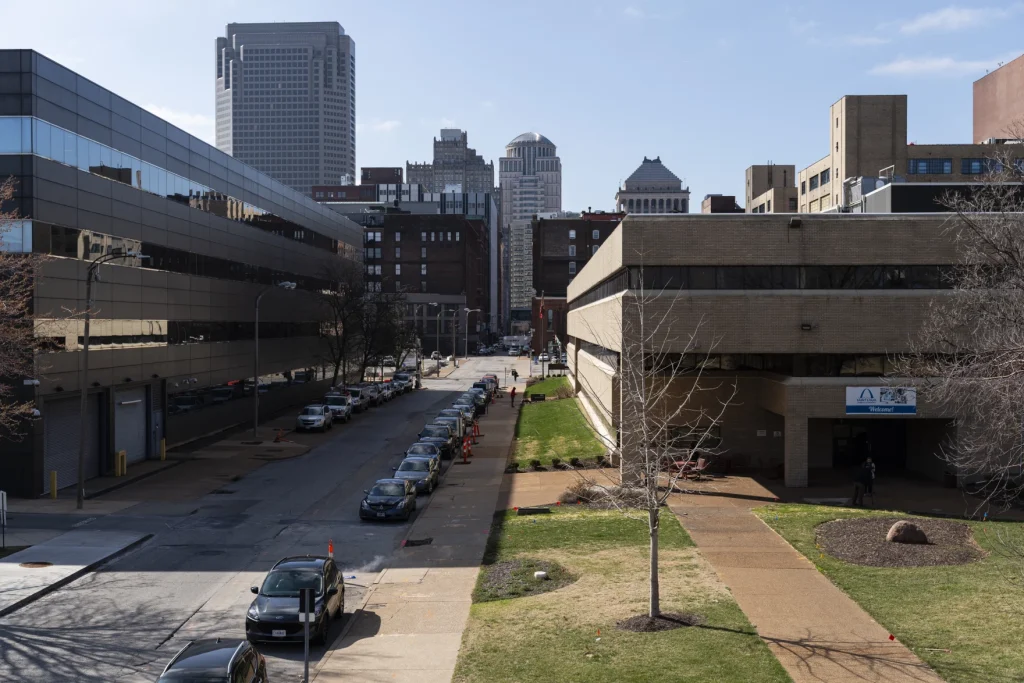
I worked as director of Communications for St. Louis Public Schools for eight months. It was the position I worked for the least amount of time in my entire career, the most chaotic job I ever held, and the one that likely remains the most vivid in my memory.
Perhaps it was the political battles inside the district, the arrests at school board meetings, the ongoing protests, my boss getting doused with a pitcher of water by a member of the school board, the typical chaotic day of an urban school district. It might have been the constat media exposure, starting my first day (eight separate interviews on a teacher sick-out) and continuing until my last day. I did more media meetings and discussions in those eight months than the rest of my career combined.
A lot of scenes have stuck with me; a few even got worked into my five Dancing Priest novels.
One came very early. I’d quickly gotten to be good friends with one of the three people from the outside management team hired to fix what had become a huge, and bankrupt, mess. This guy was brilliant, the kind of person who gives consultants a good name. One evening, he rode with me to my first School Board meeting (the one with only one arrest). And he said something that floored me. When the 10 candidates for the position were being evaluated, the people doing the evaluations came across my religious affiliation. At the time, I was attending an Evangelical Free Church in St. Louis County. They had looked into the church. We were still in the parking garage when he said it. I looked at him and said, “But that’s illegal. You can’t do that.”
He agreed. It turned out to be important, he said. The evaluators saw it as a positive, because there were so many practicing Christians at headquarters and in the individual school administrations, and they figured I would be better able to work with them.
It rankled, but it turned out to be true. The word was actually spread as a kind of rumor or gossip about the Christian guy in communications. People who might have kept me at arm’s length (“part of that horrible group wrecking everything!”) did give me the benefit of the doubt. People would talk to me when they wouldn’t be as forthcoming with Board members, the management team, or helpful advisors from the Mayor’s office.
Another scene concerned a single school. Someone had organized a site visit by administrators to an elementary school in north St. Louis. It was not an upscale area; in fact, the neighborhood included a considerable number of abandoned buildings.
The entrance was a steel door; entry required approval by video and the familiar buzzer sound of the door being unlocked. A tall fence surrounded the property. The first-floor windows were barred. The second-floor windows were blocked with barbed wire. The building looked like a prison, but it was more of a fortress against break-ins and vandalism.
The annual student turnover was 110 percent. The school served an area dominated by transients and the homeless, who would enroll children for a few months (or even weeks) and then move on. The student body was mixed, with no racial group predominating.
When the visit ended, I left shaken. How do you teach when your classroom was constantly in flux? And yet, for many of these children, this might be the best experience of their young lives, because they at least got to eat lunch.

A third scene involved another School Board meeting. I had been working at the district since October; this meeting was in March. I remember it because it was still cold. I don’t remember what the controversy of the day was, because there was always a controversy of the day. But for this meeting, it had attracted people who were angry. The members of the Board and ket staff people had been bused in, escorted by police and taken through a back door. The middle school auditorium where it was held could hold 400, and you had to pass through an x-ray check. The room was filled.
I didn’t rate police protection or the bus ride, so I drove and parked at the very back of the school’s parking lot. The lot itself was filled – about 2,000 angry, chanting people. I stopped for a moment, knowing that to reach the entrance, I was going to have to navigate that crowd. And it was almost entirely a Black crowd, and I was going to look more than obvious.
I stood at the back of that chanting, shouting crowd, and I decided to make my way through it. I might have been praying. As I said “Excuse me” and began to make my way through, something unexpected happened. People recognized me (thanks to all those media interviews). The chanting stopped, and the crowd literally parted to let me walk through. People nodded in recognition. No one smiled; there were no warm greetings. But they parted and nodded, a sign of respect.
I still don’t know how that happened. As I walked up the back steps to the door, I turned and looked back. The crowd was still watching. I nodded. The police officer at the door looked at me and simply said, “Wow.”
Wow was right. And I was over-wowed.
Related:
Communicating Through the Chaos.
The Job in Which No Day Was Like Any Other.
The Strangest First Day on the Job I Ever Had.
The Strangest Job Interview I Ever Had.
Top photograph, St. Louis Public Schools headquarters building by St. Louis Public Schools.



Leave a Reply