• Skip to primary navigation
  • Skip to main content
  • Skip to footer

Dancing Priest

Author and Novelist Glynn Young

  • HOME
  • BLOG
  • BOOKS
    • Brookhaven
    • Dancing Prince
    • Dancing Prophet
    • Dancing Priest
    • A Light Shining
    • Dancing King
    • Poetry at Work
  • ABOUT
  • CONTACT

book review

“Four Years with Morgan and Forrest” by Col. Thomas F. Berry

March 22, 2023 By Glynn Young 3 Comments

John Hunt Morgan (1825-1864) was a Confederate general whose operations seemed more guerilla-like than military. He’s known for attacking the supply lies of Union General William Rosecrans and famous for a raid into Indiana and Ohio that took hundreds of prisoners, before ending in Morgan’s capture and imprisonment (he did manage to escape prison and return to the war). 

Nathan Bedford Forrest (1821-1877) was a Confederate general who was the most feared cavalry commander on either side during the Civil War. He disrupted Ulysses Grant’s operations at Vicksburg, he broke out of Union encirclements, and he participated in the Battle of Chickamauga. He was also involved in what came to be known as the Massacre at Fort Pillow, where Black soldiers in Union uniforms were systematically killed.

Colonel Thomas F. Berry (1832-1917) rode with both Morgan and Forrest. In 1914, he published his memoir of the Civil War and shortly after, Four Years with Morgan and Forrest. Given the reputations of both Confederate commanders, it’s easy to see why he waited nearly 50 years after the end of the war. He kept a diary throughout the war, and the diary became the basis for the memoir.

The memoir surprises in two ways. 

First, Berry feels no remorse or regret for anything he or his commanders did during the war; the reader has the impression that Berry would it all over again if he had to and wouldn’t change a thing.  

Second is what Berry describes. Jack Ryan, Jack Reacher, and James Bond move over. You look like pikers compared to the real-life adventures of Thomas Berry. The memoir is full or raids, attacks, battles, and deaths (a lot of deaths), and even includes a tragic love story.

Berry was captured 13 times. He escaped all 13 times, including from the prison on Rock Island in the Quad Cities area of Iowa and Illinois – in the dead of winter, and by traveling on a chunk of ice. He was shot a total of 26 times, surviving all wounds. One bullet was so lodged that the surgeon refused to operate, so Berry, with the help of a nurse, operating on himself and removed the bullet. He was stitched himself up afterward. (He does thank the nurse for her assistance.)

His story doesn’t end with the end of the Civil War. Berry went on to fight in Mexico for the next two years, during the short-lived reign of the Emperor Maximilian.

It’s an amazing and often shocking story. You wonder if Berry invented some parts, like performing surgery on himself. But he describes it in such a matter of fact, non-sensational way that you tend to accept the account at face value. He doesn’t seem to exaggerate; he simply follows what he wrote in his diary.

What a story he tells!
“Contemners and Serpents: The James Wilson Family Civil War Correspondence”

March 15, 2023 By Glynn Young Leave a Comment

James and Eliza Wilson were Presbyterian missionaries to India, including what is now Pakistan, from 1834 to 1852. Their five children, four sons and a daughter, were born there. Both James and Eliza were from Pennsylvania, and most of their families were in Ohio and Indiana. Eliza’s sister married a man who became a successful planter in Georgia and occupied a place at the top of the social hierarchy there.

When they left for mission service, partisan feeling in the United States could run high – for example, the 1824 presidential election between John Quincy Adams and Andrew Jackson was bitterly contested and controversial. But what had not yet emerged was what would become the defining, and intractably dividing, issue of the 1850s and 1860s – slavery. When they returned in 1852, the United States seemed a very different place, one that was increasingly not united. 

Their older sons had been educated in the United States, a common practice for missionary families. When the family came back in 1852, they settled in eastern Tennessee, not far from Knoxville. This area was not a bastion of pro-slavery sentiment, unlike the cotton-growing areas of western Tennessee. 

When the time came to choose sides, all four of the Wilson sons would enlist in the Confederate Army. The father, James, was pro-Union, at least in the early period of the war. He eventually became a chaplain with the Confederate army. The Wilson’s daughter Bessie was an ardent Confederate sympathizer. The influence of their mother’s family seems to have been a factor but not a complete explanation. The oldest son, Luther, for example, was educated at Princeton Seminary in New Jersey, although some of his observations suggest a pro-Southern perspective.

That we know what we do about the James Wilson family is because of their letters, and each of the family members wrote a considerable number of them. The letters have been collected and published under the title of Contemners and Serpents: The James Wilson Family Civil War Correspondence. The “contemners and serpents” comes from the lyrics of “Battle Hymn of the Republic.”

How the letters were preserved and found is a story in itself. Theodore Albert Fuller (1909-1990) operated a retreat in North Carolina. A daughter of the Wilson’s oldest son Luther would come each summer, and she would always bring her most prized possessions with her. She happened to die at the retreat one summer, and her executor decided her prized old documents were worthless, so he threw them out. Fuller, who had published books on local history, saw their value and bought them from the estate. He researched the family and developed a manuscript based on the letters, but never published it. 

In the late 1990s, Thomas Daniel Knight was a graduate student at Oxford studying American history. He met Fuller’s daughter, who mentioned the manuscript. Years later, after receiving his doctorate, Knight was offered the opportunity to edit and annotate the manuscript. The result was this book.

The volume is extraordinarily well done. The letters appear in their entirety, with all names footnoted and identified. The letters are also placed in their historical context of battles fought and other developments (Eliza and Bessie, for example, were expelled from Knoxville after it fell to the Union Army). The father and all four sons would survive the war, although two of the sons were captured at the end of the war and spent time in prison camps.

What Contemners and Serpents provides is an inside look at the Civil War from the perspective of four sons fighting the war, a daughter and mother supporting the South, and a father who was something of a reluctant participant. They were writing to and for each other, of course, and not for publication. We are the beneficiaries of Col. Fuller’s saving of the letters and Dr. Knight’s careful and informative treatment and further development of what he was given. (Knight himself found additional letters of the family.)

Knight is an associate professor in the Department of History at the University of Texas – Rio Grande Valley. He received his B.A. in history and classics from Washington & Lee University; his M. St. in 18th Century English History and his M. Litt. In American History from the University of Oxford; and his doctorate in Philosophy from the University of Oxford. In addition to numerous awards for his work, he is a member of Phi Beta Kappa and the Oxford debating Society.  

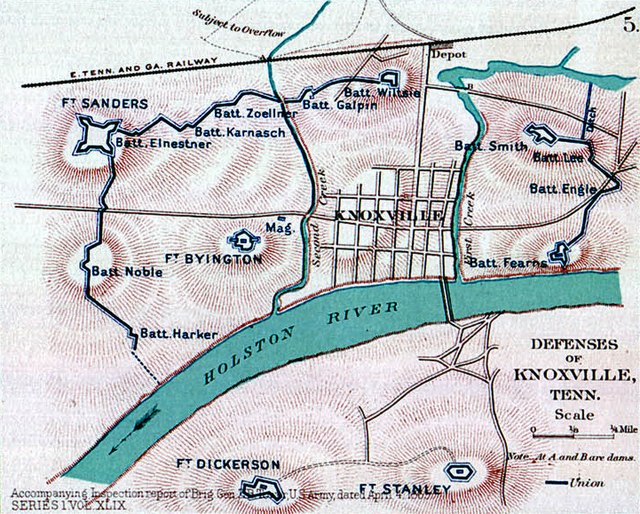
Top photograph: Both Eliza Wilson and daughter Bessie were in Knoxville during the occupation by Gen. Burnside’s Union army, Confederate Gen. Longstreet’s siege to retake the city, and the eventual rival of Gen. Sherman’s Union forces which forced a retreat by the Confederates. Both women were expelled from the city and eventually ended up with relatives.

“Of Age: Boy Soldiers and Military Power in the Civil War Era” by Frances Clarke and Rebecca Jo Plant

February 15, 2023 By Glynn Young Leave a Comment

It doesn’t happen very often, but when it does, you know. You’re reading a book, and you sense that what you have in your hands is a game-changer.

This happened as I read the authors’ introduction to Of Age: Boy Soldiers and Military Power in the Civil War Era. Co-authors Frances Clarke and Rebecca Jo Plant studied what many had long believed to be an exaggeration at best and mythical propaganda at worst – the number of underaged boys who fought in the Civil War – and discovered something startingly different. The result is a work that changes our understanding of the Civil War, arguably the most powerful event in the history of the United States.

During the war itself, the myth of the “drummer boy” almost propagated itself, especially in the Union states. On both sides, the official minimum enlistment or conscription age was 18. With a parent’s consent, it could be less than that. In practice, and again especially on the Union side, the minimum age was widely disregarded.

For evidence, Clarke and Plant turn to memoirs, histories, periodicals, and especially both pension records and legal proceedings, whereby parents sought to have their underaged sons discharged. The military tended to be in the driver’s seat, however, and particularly so with the suspension of habeus corpus by President Lincoln (in 1863, Congress codified what Lincoln had done by executive order in 1861). 

Clarke and Plant carefully sift through the data and conclude that about 10 percent of the soldiers in both the Union and Confederate armies were under the age of 18 – teenaged boys, and sometimes younger. Numerically, that’s about 180,000 on the Union side and 20,000 on the Confederate side. Parents discovered their rights over their children seriously eroded by the demands of war and found themselves more often than not on the losing side in courtroom battles. Confederate parents appear to have had an easier time of reclaiming their underaged sons.

Frances Clarke

The authors tell the stories of some of the more famous children and teens fighting in the war, many as musicians in drum and bugle corps. The stories, of course, are what capture our attention and what captured the attention of readers during the war (see “Young Fred Grant Takes the Mississippi Capital, Almost” at Emerging Civil War). But they spend most of their tome looking at records, data, reports, and court records. It’s no surprise that the book was 10 years in the making.

The authors examine the history of underaged enlistment, going back to the War of 1812 and some of the legal disputes prior to the Civil War. They describe the social and cultural background that supported underaged enlistment, including the belief that war inspired courage in young minds and the propaganda benefits of depicting young boys fighting for their country. They show the various paths to enlistment included work, politics, and schools.

Rebecca Jo Plant

The subject of underaged soldiers was widely debated. While it tended to be more of a one-way outcome on the Union side, Confederate authorities (and parents) were concerned about what was called “preserving the seed corn” – making sure that the war didn’t devastate the region demographically. This was much less of a concern in the Union, with its much higher population. And one of the most moving chapters in the book is the account of enslaved and free youth who were forced into military and supporting service on both sides. 

Clarke is an associate professor of history at the University of Sydney in Australia and the author of War Stories: Suffering and Sacrifice in the Civil War North. Plant is a professor of history at the University of California at San Diego and the author of Mom: The Transformation of Motherhood in Modern America.

Of Age is more than a significant contribution to our understanding of the Civil War. It changes our perception and understanding of the war itself, through the lens of how both the Union and the Confederacy used some of the most vulnerable members of society to fight. These children, and that’s what they were, children – were more than musicians and helpers. They picked up rifles and fought alongside men of legal age. Clarke and Plant make sure their rightful story is told and their contribution recognized.

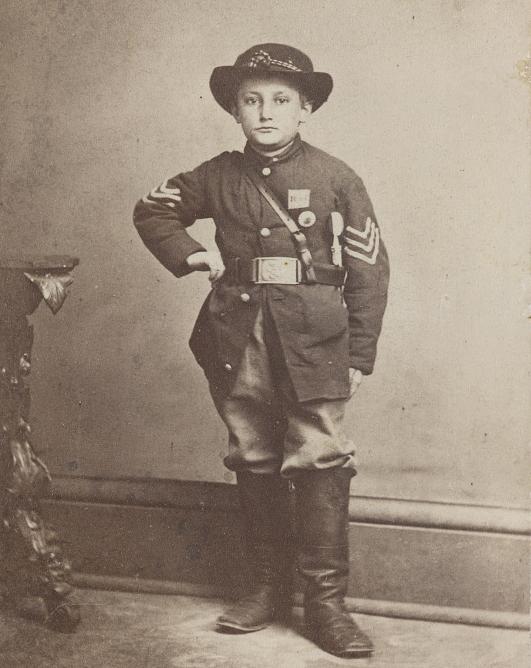
Top photograph: Johnny Clem, one of the most famous child soldiers of the Civil War. He joined a Michigan regiment at age 9 and was officially enrolled at age 12. Photo: Library of Congress.

“Irish American Civil War Songs” by Catherine Bateson

February 1, 2023 By Glynn Young Leave a Comment

My thoughts, lately, have been turning toward the green. Not environmental green, but Irish green.

A couple of years ago, my brother did one of those “Spit in a tube and mail it in” DNA tests. We’d always understood our heritage to be (in this order) English, Irish, French, and German. The results mostly corroborated that, except in the order: Irish (County Cork, Irish, in fact) led the blood pack, with 38 percent of our DNA. English (Midlands) was in second place at about 18 percent, followed by English (London) at about 10 percent. French (Alsace Lorraine) was there, to be sure, and so was German (Saxon). We even had a surprising 7 percent Scandinavian, which I suspect went back to the Vikings conquering England and Ireland. 

The Irish, as it turns out came from our father’s side of the family, through both of his parents. On his father’s side, it likely came sometime in the 18th and early 19th centuries, on his mother’s, mostly the 19th century.

The Irish had been emigrating to North America for a considerable period of time, likely as long as European emigration has existed. But it was in the 1840s that Irish emigration became a flood to America, following the Potato Famine. By the time of the Civil War, Irish immigrants accounted for 1.5 million of the total U.S. population (slave and free) of 31.5 million. The U.S. population had increased 35 percent from 1850 to 1860, and a considerable portion of that increase was due to immigration.

Some 200,000 Irishmen / Irish Americans fought in the Civil War. Most fought on the Union side, but about 20,000 signed on as Confederate soldiers. They brought with them their history, their political leanings, and their experiences with the famine and immigration. And they brought their songs.

Catherine Bateson, a lecturer in American history at the University of Kent in England, has documented the importance of Irish music, ballads, and songs in Irish American Civil War Songs: Identity, Loyalty, and Nationhood. I knew that music was important for both sides during the Civil War; it was used for marching, ceremonial activities, rest periods, and even for propaganda purposes with both soldiers and civilians. Thousands of songs and hymns were written and sung during the war years.

As Bateson makes clear, the Irish brought with them their longstanding love of ballads and music. They told stories with their songs and ballads, tales of victories and defeats. They expressed their political leanings (and desire for independence from Britain). And their music made its way into general overall American music, including to provide the music (and some of the lyrics) for “The Bonnie Blue Flag,” the Confederate anthem, and “The Fighting 69th,” the song of the famed Irish brigade from New York that provided the basis for so many other songs then and afterward.

Catherine Bateson

Bateson describes the background of Irish music and songs in mid-19thcentury America; how Irish American Civil War songs were produced; the ballads of the battlefield; how lyrics reinforced Irish cultural identity and Irish nationalism; how the songs and ballads expressed wartime politics; and how their music provided Irish Americans with identity and expressions of loyalty. Irish American music celebrated their military leaders, like Thomas Francis Meagher and Michael Corcoran, and their music provided solace after devastating defeats like the Battle of Chancellorsville in 1863. 

Bateson received her undergraduate degree in history from University College London and spent a year abroad studying at the University of Pennsylvania. She received an M.A. degree in American Studies from King’s College, London and her Ph.D. in history from the University of Edinburgh. She’s also an associate editor in the Irish in the American Civil War project and a former vice-chair of the Scottish Association for the Study of America. 

Irish American Civil War Songs provides a detailed study of some of the important music associated with the Civil War. It also opens a window into what some 200,000 soldiers sang during the war, and how their music provided very specific meanings. 

Top photograph: Soldiers of the Fighting 69th (Irish) Brigade. Michael Corcoran is standing at left, his hand on the gun carriage wheel. Thomas Francis Meagher is standing behind the gun. Photo courtesy of the Library of Congress.

William’s Faulkner’s Civil War

January 11, 2023 By Glynn Young 2 Comments

If there is one writer who cast the largest shadow upon southern U.S. literature in the 20th century, it’s William Faulkner. He also cast one of the largest shadows over all American literature in the 20th century. At my university, few escaped the required courses in American literature without reading the short stories “Barn Burning” and/or “The Bear.” I’d read “Barn Burning in high school, but, taking English rather than American literature in college, I didn’t read Faulkner until years later. It was Flannery O’Connor who led me to Faulkner, and then I read nearly everything he wrote.

Michael Gorra has studied and taught Faulkner, Faulkner’s works, and literature for more than 40 years. The Mary Augusta Jordan Professor of English Language and Literature at Smith College, he’s also served as editor of the Norton Critical Editions of Faulkner’s As I Lay Dying and The Sound and the Fury. The man knows his Faulkner.

William Faulkner as a young man

And to know Faulkner, you have to know the Civil War. The war, its aftermath, the “Lost Cause,” and the memory of the war – even by those who didn’t experience it – is a major theme, perhaps the major theme, in the history and literature of the South. Gorra knows his Civil War, too, and he’s a Connecticut-born Yankee who teaches at a Yankee university in Massachusetts.

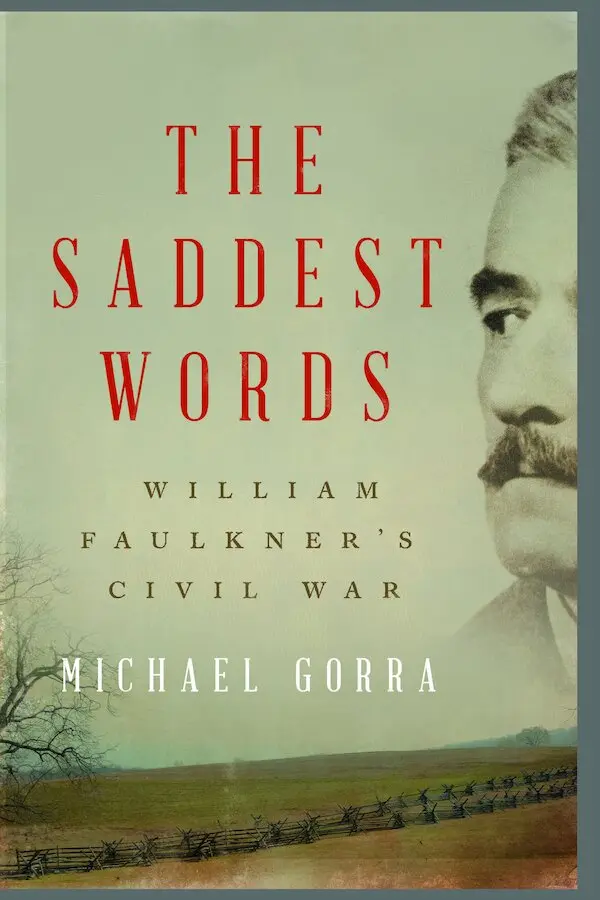
Gorra’s The Saddest Words: William Faulkner’s Civil War is a remarkable work of literary criticism. It’s about the themes of the war in Faulkner’s writings, but to understand those themes, you have to grasp the story of the war and its significant details. Gorra does that, but he does more. He’s read the letters and memoirs of people who fought and lived the war. He’s studied the major battles, especially the ones that play even a small role in Faulkner’s novels and stories. He’s walked the terrain of the war, and he’s studied how the war was fought in Faulkner’s home state of Mississippi. 

All of this permeates Faulkner’s novels and short stories. Sometimes it’s an overt influence; sometimes, it’s very subtle. Reading Faulkner years after university might have been the best thing that happened to me in understanding his works, because I recognized how much he was talking about had permeated my own family.

Michael Gorra

Literary criticism is often tedious and difficult. Gorra’s work on Faulkner here is anything but that. His writing is accessible, and he tells Civil War stories that amplify and expand upon what Faulkner did. He makes the writer understandable in a way few critics can. And he doesn’t shy away from the controversial aspects of Faulkner’s works, and there are plenty of controversial aspects.

Gorra’s published works include Portrait of a Novel: Henry James and the Making of An American Masterpiece (2012), a finalist for the Pulitzer Prize in Biography; The Bells in Their Silence: Travels through Germany (2004); After Empire: Scott, Naipaul, Rushdie (1997); and The English Novel at Mid-Century (1990). He’s also served as editor for volumes of stories by Joseph Conrad and Henry James for Penguin.  His awards and recognitions include a Guggenheim fellowship, two fellowships from the National Endowment for the Humanities, including a Public Scholar Award, and a National Book Critics Circle award for his work as a reviewer.

The Saddest Words tells a wonderful story of how one of the most important American writers used family history, family stories, and historical events to create what became some of the most significant literary works of the 20thcentury. The Civil War sits at the center of it all, much like it continues to sit at the center of American life.

“Hymns of the Republic” by S.C. Gwynne

December 28, 2022 By Glynn Young Leave a Comment

During the last year of the Civil War, roughly April 1864-April 1865, everything changed. And “everything” includes more than the collapse of the Confederacy and the surrenders of the Confederate armies. At the beginning of that year, the eventual outcome was not a foregone conclusion. How the waging of the war itself changed made the outcome inevitable.

Popular historian, author, and journalists S.C. Gwynne explains what changed in Hymns of the Republic: The Story of the Final Year of the American Civil War. This is popular history at its best, with an account filled with anecdotes, written in a broad sweep og events, and written so well that the book sweeps the reader up and places him right in the middle of the narrative.

Gwynne doesn’t attempt a day-by-day diary of the last year. Instead, he’s selected key events and personalities, and then he elaborates upon his subjects. We read about Ulysses S. Grant’s arrival in Washington to receive his commission as head of the Union armies – and his hasty departure. We stand with Robert E. Lee as he watches the arrival of the Union armies across the Rapidan River. We experience the Battle of the Wilderness in all its horror. We read about why shovels were so important, and how Clara Barton fundamentally changed battlefield medicine forever. We ride with Confederate Commander John Mosby and his Rangers, borderline terrorists who operated as comfortably behind Union lines as in front of them. 

The central characters of the book are Grant and William Tecumseh Sherman. Neither Union general would have been marked to become military success stories, and Gwynne explains how they did it. 

Grant changed how the war was fought, adopting a “keep pounding them and throwing men at them until they relent” approach. It eventually worked, but the cost in human life and suffering – on the Union side as much or more than the Confederate – was staggering. 

S. C. Gwynne

Sherman was one of the first more modern generals who advocated total war. It wasn’t enough to defeat an army; you had to destroy that army’s ability to function, and that meant destroying the crops that fed the army, the cotton that helped pay for its weapons, and the civilian morale that kept up support for the army. While his march across Georgia was vilified as a heinous crime by Southerners, it wasn’t as bad as they made it out to be, and least in most places. What did live up to the vilification was the looting and destruction by Sherman’s army of Columbia, South Carolina’s capital.

On both sides, and it was likely more marked on the Union side, the last year of the war became a war of revenge and retribution, paving the way for Radical Reconstruction, especially after President Lincoln’s assassination.

Gwynne is the author of Empire of the Summer Moon: Quanah Parker and the Rise and Fall of the Comanches, the Most Powerful Indian Tribe in American History, Rebel Yell; The Violence, Passion, and Redemption of Stonewall Jackson, and The Perfect Pass: American Genius and the Reinvention of Football. His journalism work has been published in Time, Texas Monthly, The New York Times, Harper’s, and The Wall Street Journal. He lives in Austin, Texas.

Hymns of the Republic is a stirring, marvelous work, explaining how a war that had already cost so much became even more vicious, more ruthless, and more punitive.

Top illustration: The burning of Columbia, South Carolina, on Feb. 17, 1865, as depicted in Harper’s Weekly.

  • « Go to Previous Page
  • Page 1
  • Interim pages omitted …
  • Page 10
  • Page 11
  • Page 12
  • Page 13
  • Page 14
  • Interim pages omitted …
  • Page 17
  • Go to Next Page »

Footer

GY


Meet the Man

An award-winning speechwriter and communications professional, Glynn Young is the author of six novels and the non-fiction book Poetry at Work.


 01_facebook 02_twitter 26_googleplus 07_GG Talk

Copyright © 2026 Glynn Young · Site by The Willingham Enterprise · Log in | Managed by Fistbump Media LLC