• Skip to primary navigation
  • Skip to main content
  • Skip to footer

Dancing Priest

Author and Novelist Glynn Young

  • HOME
  • BLOG
  • BOOKS
    • Brookhaven
    • Dancing Prince
    • Dancing Prophet
    • Dancing Priest
    • A Light Shining
    • Dancing King
    • Poetry at Work
  • ABOUT
  • CONTACT

Writing

Meet a Dancing Novels Reader

October 27, 2020 By Glynn Young 1 Comment

He won’t remember, but I first met Randy Mayfield in the gymnasium of Central Christian School in the early 1990s, located across the street from Central Presbyterian Church, where Randy was on staff. I was a part of a non-denominational program called the Salt & Light Fellowship, and Randy was one of the movers behind it. With his guitar, he led us in songs, including one called “Lord, Don’t Send Me to Africa.” And I thought, who knew Presbyterians could be funny?

Ten years or so later, I was attending Central Presbyterian (still my church now), and Randy was still on staff, leading one of the church’s most successful outreaches – missions. The program involved a host of countries, an outreach to the St. Louis County Jail and a prison outside of St. Louis, schools and universities, a seminary, and more. 

Randy believed in hands-on ministry, and he maintained a travel schedule that was exhausting just to read: Honduras, India, Philippines, Iraq, Ukraine, Russia, France, Italy, Hungary, Albania, Israel, Guatemala, Haiti, Cuba, Kenya, Sweden, Albania, Argentina, Mexico, Indonesia, Portugal, South Africa, Poland, Thailand, Tanzania, and a few places that can’t be mentioned because it would jeopardize people’s safety. He also led numerous vision trips for church members, for them to see first-hand what was happening. 

Randy Mayfield performing

At some point, Randy heard about Dancing Priest. He bought the Kindle version and read it while flying to some far-flung mission field (I think it was Iraq). He came a fan of the series, and the five novels about Michael Kent-Hughes have traveled all over the globe. He talked the series up with other church members, and others began to read it, creating still more fans.

Authors know what that does. Yes, it sells some books. But it also touches an author’s heart. 

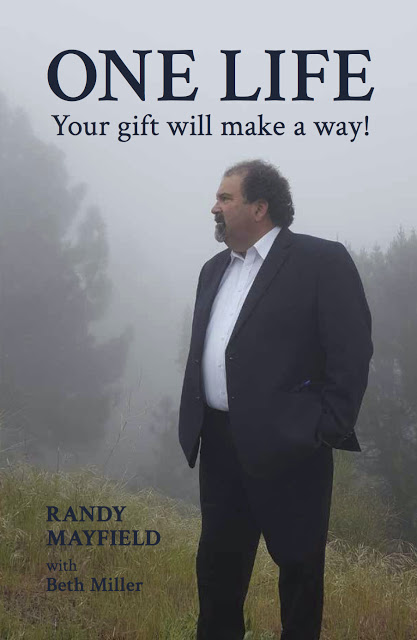
Randy has now published his own book, One Life, and I’ve reviewed it on my Faith, Fiction, Friends blog. It’s part autobiography and part stories about some remarkable things that have happened with church missions. He’s also a husband to Sharon, a father to Amanda and Justin, and a grandfather to a little girl named Afton who owns him and soon to be a grandfather again to Afton’s brother. 

Randy does concerts; he can sing rock, country, and just about anything else, including Nessun Dorma. He’s had a band, called the All-Star Band, that’s performed in St. Louis and all over the world (my tenuous claim to fame with it is that my next-door neighbor is the band’s saxophonist). He’s performed at the Grand Ole Opry, and he’s opened concerts for Stephen Curtis Chapman, Jaci Valesquez, and the Imperials. 

He’s been a chaplain to the St. Louis Cardinals. He’s come under military gunfire while on mission trips. He’s met with presidents and paupers, and if you know Randy, you know he treats them exactly the same – with a handshake, a smile, a laugh, a hug, and a song.

Randy’s retiring as Missions & Outreach pastor at Central Presbyterian; he gave an official farewell sermon this past Sunday (it won’t be his last sermon; Randy doesn’t retire from ministry). But it’s gratifying and encouraging to know him, and it’s been encouraging to know how much he’s liked the stories of Michael Kent-Hughes. 

Top photograph by Paola Chaaya via Unsplash. Used with permission.

Giving a Minor Character a Bigger Role

October 20, 2020 By Glynn Young 3 Comments

The character of David Hughes, twin brother of Sarah Hughes, has been a part of the Dancing Priest series from the beginning. In Dancing Priest, the first novel, it was David who had decided to do a study year abroad in Scotland, dragging his sister along with him. David was the scholar in the family, and at the University of Edinburgh he was studying Scottish history. Because of a fire at his dormitory, David ends up rooming with Michael Kent and Tommy McFarland, even though they’re two years older. And it’s Tommy’s girlfriend Ellen who fixes David up on a blind date with Betsy, whom he’d eventually marry.

The character of David Hughes served as something of a counterpoint to Michael and Tommy. They’ve been friends since they were six years old and have roomed together at St. Andrews during their entire time at university. David is the quiet American, the scholarly outsider, contrasting with the outgoing McFarland and the self-confident and often-quite-candid Michael. McFarland is an outspoken champion of Scotland and Scottish independence; David is the young man who’s been in love with Scotland from afar and is now living exactly where he wants to live.

David and Sarah experience family upheaval when their father turns his back and cuts off all communication with them and their older brother Scott, a doctor in San Francisco. As a result, the Hughes twins spend Christmas at McLarens, the home of Ian and Iris McLaren, the guardians for Michael. While there, David helps Ian, an equine veterinarian, deliver a foal.

David has very small roles in the next three books in the series, but I always felt he deserved something more. The opportunity for that arrived with Dancing Prince. 

Some 30 years have passed since the first novel. David is a history professor at the University of St. Andrews. He and Betsy have two now-grown children. Over the years, it is David who has become a key figure in the life of Thomas Kent-Hughes, the youngest of Michael and Sarah’s children. 

As Michael grows more estranged from Tommy, David unintentionally helps to fill the gap, to the point where Tommy feels closer to his uncle than to his own father. Early in the story, Tommy and his father experience one of the many crises in their relationship, and it’s to David in St. Andrews to whom Tommy flees from London. When it’s time for college, Tommy will select St. Andrews, and a large part of the reason is that David teaches there. 

In many significant ways, Tommy becomes part of the Hughes family, and he clearly feels more comfortable with his uncle than with his father. Tommy looks more like his uncle than he does Michael, and he’s often mistaken for David’s son. They share a love of scholarship, and early on David is guiding Tommy in his pursuit of Norse and Icelandic languages. And it’s a reciprocal relationship. When David’s own son experiences a breakdown, it’s Tommy to whom David turns for help. 

The character of David was a quiet, stabilizing one from the beginning. Those characters rarely get center stage in stories and novels. Dancing Prince offered the opportunity to bring David out of the background and give him a significant part in the story. And, as it turns out, it will be a crucial part that he plays. Michael will eventually tell Tommy that he owes David a debt he can never repay, “for being there for you when I wasn’t.” David is something of an unsung hero of the Dancing Priest stories, and it was gratifying to give him his due. 

Top photograph by Shipman Northcutt via Unsplash. Used with permission.

Did “Dancing Prophet” Become Prophetic?

October 13, 2020 By Glynn Young 5 Comments

In 2012, I had a conversation with my publisher about the future novels planned in the Dancing Priest series. Dancing Priest had been published in late 2011, and the publication of A Light Shining was imminent. I walked him through what I saw as the main subjects and themes of several additional books (another six, if I remember correctly, which eventually became another three). 

The fourth book was to focus on the conflict between Michael Kent-Hughes and the Church of England hierarchy, which would eventually lead to a reformation. The catalyst would be a child sexual abuse scandal, happening over decades and facilitated (as in, covered up) by the church. The inspiration for this was the scandal in the Roman Catholic Church; what I did was to transfer the Catholic scandal to the Church of England. Or so I thought.

Two weeks after that conversation, my publisher sent me an article that had just been published in Britain. It looked like the Church of England had its own, homegrown child abuse scandal, and didn’t need any fictional help from the Catholic church. 

Dancing Prophet, the fourth novel in the Dancing Priest series, was published in 2018. That year, more revelations were unfolding about the Church of England. In 2019, an independent inquiry was established to look at what had happened and why. Last week, the inquiry panel released its study. 

It sounded like the story line in Dancing Prophet. My wife says I need to stop writing about things that become true.

It gives me no particular joy that real events seem to follow several of the key events in the Dancing Priest stories. (Sometimes, the correlations aren’t horrific, like the DNA study made of Vikings that sounded a lot like what happens in Dancing Prince.) But it does seem uncanny at times. I don’t have the gift of prophecy, but I’ve asked myself, how do real events happen that mirror the stories I wrote in my five novels?

I don’t have a solid answer. I have an idea of what happens, and it has to do with the research I do for the stories and the work experience I’ve had.

The Dancing Priest novels are not historical novels in the strict sense. They’re not about the past. They are more futurehistorical novels, because they’re set in the soon-to-happen future. (One reviewer has called them alternative historical novels.) But they are based on considerable reading and research and first-hand experiences on visits to London and England.

The streets Sarah’s car has to take from Buckingham Palace to the Tate Britain (Dancing Prophet)? I’ve walked them. The visit Michael makes with the two boys to the Imperial War Museum and the Guards Museum Shop (Dancing Prince)? I’ve done both. Taking a train from King’s Cross Station (Dancing Prince)? Been there, done that. A tube ride from South Kensington to the Tower of London (Dancing King)? Yep. And the books I’ve read have ranged from Peter Ackroyd’s multi-volume History of England and a history of coronations to a domestic history of the British royal household and a history of the Church of England.

My work experience has also served as a resource. Working for two Fortune 500 companies, a Fortune 1000 company, a public institution, a newspaper, and my own business has taught me a lot about how organizations respond to crises. Almost by default, the initial response is self-protection. The ongoing response tends to be self-protection. And that response can put public relations people in very difficult positions. The fact that the Church of England responded to its child sex abuse crisis almost exactly like the Roman Catholic Church did is no surprise.

You don’t have to be a prophet when basic human nature never changes. 

Top photograph by Cajeo Zhang via Unsplash. Used with permission.

A Tale of Two Paintings

October 6, 2020 By Glynn Young Leave a Comment

I’ve talked about how an exhibition at the Tate Modern plays a critical role in Dancing Prince. In turn, two paintings in the exhibition play a critical role in the narrative of the novel. 

Jason Kent-Hughes, the adopted son of Michael and Sarah, is working as an assistant curator at the Tate Modern. Sarah describes him as their “San Francisco street child with a gift for painting and art administration.” After graduating from school in London, he did a year of military and then enrolled at the Slade School of Fine Art, part of University College London. After receiving his degree, he joined the Tate Modern.

As he explains to Michael, he gave a talk at the museum about the paintings done by Sarah that are in the Tate’s collection. It’s part of a regular weekly feature, he says, in which a staff member speaks about their choice of topic – something they’re working on, something in the collection, an upcoming exhibition, a research project, and so on. 

The lectures are open to the public and generally draw anywhere from 30 to 300 people, apart from the staff attending. Jason’s talk on Sarah’s paintings brings 2,000, forcing the museum to move the event to Power Hall (the Tate Modern’s huge interior space). It’s also videotaped and posted for sale on the museum’s web site, resulting in 30,000 orders during the first day. The museum suspects there’s a huge financial and artistic potential here, and it asks Jason to curate a major exhibition of Sarah’s work. Assembling the exhibition becomes his full-time job for the next 18 months.

Jason uses a journal of works kept by Sarah, starting with the paintings she did for her senior university project (described in Dancing Priest). Through some fairly intense work, he’s able to track 99 of her 101 listed paintings. The two that he can’t locate are the last ones, and they’re described in the journal with rather puzzling letters. What he knows is that these two paintings are likely important, because Sarah had been evolving her style and clearly reaching for something more.

Jim Kent-Hughes, the other adopted son of Michael and Sarah, accidentally comes across painting #100. It is their youngest child, Tommy, who holds the key to painting #101. All of Sarah’s paintings, and even her studio, become flashpoints in the relationship between Michael and Tommy. But those two paintings will be the most serious tension points. 

I’d like to say I understood exactly what I was doing when I developed the story of the two paintings. Perhaps I did, subconsciously. But it was only after the book was published, and I had reread it (twice), that I realized the story of the two paintings are the bookends for the entire series of five novels. Sarah’s paintings and art play an important role in the first book, Dancing Priest. And they play a critical role in the final book, Dancing Prince.

The story of the two paintings also speaks to something else – the meaning of art in our lives. We can look at a painting say “I like it” or “I don’t like it” or “They call that art? I could have painted that.” Or we can be so struck by a painting that words fail us. The first time that happened to me was in London, and (surprise) it was at the Tate Modern. It was a portrait of Marguerite Kelsey by Meredith Frampton. That one painting brought me back three times to the museum during a 2012 visit, and I still don’t know if I can adequately describe the impression it made on me. Another annual exhibition in London that we’ve seen all five times we’ve visited is the BP Portrait Awards, which has a similar effect on me. 

In Dancing Prince, those last two paintings will affect virtually every character who sees them in a very similar way that those paintings in London affected me. For Michael and Tommy, the impact will be far greater. 

Top photograph by Abbie Bernet, and middle photograph by Zalfa Imani, via Unsplash. Used with permission. 

The Uses of a Novella

August 18, 2020 By Glynn Young Leave a Comment

On July 1, with the publication of my fifth novel, I brought a five-book series to a conclusion. Each of the five was about 93,000 words in length, except for the last one. The last one has an additional 20,000 words, included as an epilogue but actually a freestanding novella.

It’s related on a minor way to the main novel; it’s mentioned as a manuscript one of the characters is writing. The idea for it predates the novel it’s part of; its genesis was years earlier from an article in Discover Britain magazine on the Celtic and Viking history that saturates the Orkney Islands.

I wrote it as part of a break from writing the novel. My novels are contemporary fiction; this novella is historical fiction, set a thousand years before the contemporary story. I wrote it without actually knowing what to do with it. What was likely in the back of my mind was an understanding of all the various ways authors use novellas.

To continue reading, please see my post today at the American Christian Fiction Writers blog. 

The Poet at Work

August 4, 2020 By Glynn Young Leave a Comment

I was working in communications for a Fortune 500 company. A large portion of the day-to-day work was meetings. We had a team-based culture, and to our work, our teams had to meet. 

The teams, and the meetings, proliferated. We had departmental meetings. We had cross-functional meetings. We had committee and subcommittee meetings. We had telephone meetings, video meetings, and online chat session meetings. We had one-on-one meetings. We had staff meetings. We had briefing sessions, strategy discussions, and crisis planning meetings. We often had meetings to plan meeting agendas.

I often wondered if the curse placed upon Adam and his work for eating of the Tree of Knowledge possibly included meetings.

One day, sitting in yet another meeting, I heard what sounded like repetition. People around the table were having a discussion, and I realized I had heard the same discussion before, with the same arguments, the same supporting evidence, the same objections. I kept hearing the discussion as a refrain, or a chorus for a song or hymn. 

Poetry at Work

Just like that, I walked into the poetry of the workplace. I didn’t even know poetry existed in the workplace, and yet there it was. How had I not seen this before, me, a speechwriter who often read poetry while writing a speech? That question surprised me as well, because it was clear that I had been unknowingly or unwittingly employing poetry to do my work. It wasn’t a work tool; it was the actual music that made the workplace work.

Another way to say it is, the workplace has a literary life. 

I was in my 30s before I discovered the poetry in work, and in my 50s before I understood it. Others saw the poet in me long before I did; perhaps it was my habit of walking around, soundlessly mouthing words, phrases, sentences, and paragraphs, as I was writing speeches. Some executives did management by walking around; I did speechwriting by walking around. More than once I was stopped and asked if I was feeling okay.

Poets at work always tend to be oddities. They’re introverts in a business culture that worships teamwork. They point out the things that everyone sees but no one else will say. They can often be politically incorrect. They see the flaw, or flaws, in the grand project the entire organization has embraced as its reason for existence (at least the one for this week). When feeling charitable, colleagues think of poets as conscientious objectors. It’s better than the terrible and career-suffocating judgment of “not a team player.”

But the poets at work are also the ones who articulate the higher aspirations we have buried within us, who speak to the everyday but lift us to the heavens. They speak to the nobility of work, why it’s important, and why it is good. The workplace becomes dreary and gray without them.

Have you met the poet at work? He or she is there, even if they’re not particularly obvious; not all of them wander around mouthing words to themselves. They are usually the people who make you realize that what you do is worthwhile and that you yourself have intrinsic value because you were made that way.

It’s right there on the table,
a piece of skunky roadkill,
and we go to great lengths
not to talk about it,
not to acknowledge it,
to act in spite of it,
to plan and decide,
pretending it’s not there.
But it is, isn’t it, safely
ignored until the poet
wanders in, mumbling,
and spots it.

From Poetry at Work: “The poetry of William Carlos Williams, for example, cannot really be separated from his work as a physician. I suspect that his work as a physician cannot be separated from his poetry, either. Both are faces of the same person, a whole person—a man who wrote poetry with a doctor’s eye and practiced medicine with the compassion of a poet.”

This article was prepared for the Literary Life group on Facebook.

Top photograph by Matthew LeJune via Unsplash. Used with permission.

  • « Go to Previous Page
  • Page 1
  • Interim pages omitted …
  • Page 30
  • Page 31
  • Page 32
  • Page 33
  • Page 34
  • Interim pages omitted …
  • Page 46
  • Go to Next Page »

Footer

GY


Meet the Man

An award-winning speechwriter and communications professional, Glynn Young is the author of six novels and the non-fiction book Poetry at Work.


 01_facebook 02_twitter 26_googleplus 07_GG Talk

Copyright © 2026 Glynn Young · Site by The Willingham Enterprise · Log in | Managed by Fistbump Media LLC