• Skip to primary navigation
  • Skip to main content
  • Skip to footer

Dancing Priest

Author and Novelist Glynn Young

  • HOME
  • BLOG
  • BOOKS
    • Brookhaven
    • Dancing Prince
    • Dancing Prophet
    • Dancing Priest
    • A Light Shining
    • Dancing King
    • Poetry at Work
  • ABOUT
  • CONTACT

Poetry

The Random Act of (Finding) Poetry on the Web

September 18, 2024 By Glynn Young 1 Comment

My love for poetry developed in three critical times. First was discovering T.S. Eliot in high school, introduced by a wild and larger-than-life English teacher who wore turbans and proclaimed that Valley of the Dolls by Jacqueline Susann was the greatest work of American literature. Well, no, but she was right about T.S. Eliot.

The second critical period was through a friend in the early 1980s, who said I couldn’t be a “real speechwriter” unless I read Eliot, William Butler Yeats, and Wallace Stevens. I don’t know whether he was right or wrong, but I took his advice to heart and started reading them.

T.S. Eliot

Third was the year 2009. Idly searching on the web for something unrelated, I found The High Calling Blog, which mostly focused on the daily practice of faith in our work but also had a regular poetry feature, “Random Acts of Poetry.” This Friday feature involved poems on a stated topic with links to others writing on the same topic. One thing led to another, and not too long after that, I was participating in Random Acts of Poetry and eventually The High Calling itself. 

The faith-in-work site came to an end in 2015, but the idea of Random Acts of Poetry lived on at Tweetspeak Poetry. It’s become an annual event, and it’s focused on painting poetry in the public square. It’s held on the first Wednesday of October, which this year will be October 2.

Tweetspeak Poetry has several resources to help – a handbook you can download for free, poetry prompts, ideas for how to bring poetry into the public square, examples, and more.

In 2017, Random Acts of Poetry Day coincided with a vacation in London. I planned ahead of time and printed out several poems by different authors already and cut down to size for suitable abandonment in different places, like our breakfast table in the hotel, a London double-decker bus, a display table at the National Theatre, and on the tube or underground. You don’t know what happens to the poems, and that’s the fun in the randomness – imaging how a poem by Eliot or Emily Dickinson or William Carlos Williams or even you might be read and understood by a stranger.

I rediscovered this poem I wrote back in May 2010. It wasn’t left randomly somewhere; it was linked from the High Calling site. The prompt that day was to go to an ancient place and relive the moment. I went back to ancient Greece. The subject is one of the handful of people who heard the Apostle Paul in the marketplace in Athens and followed him; most of his listeners that day thought he was insane. But a few didn’t.

St. Paul in the Areopagus by Raphael (1515)

Dionysus

Yet another day in this ancient place, this Romanized sepulcher,
this urbanized temple to worship what never was, this sacrifice
of marbled skin and stone life-blood, paleness of what was.

Yet another span of hours, sameness and tedium; another day
of listening to the new ideas that are neither new nor ideas,
because of the baneful and prideful duty of an archon.

Today a respite from legalities – a babbler commending us for
our gods, known and unknown. What an impudent fellow, as if
our gods known and unknown actually cared for him and for us.

Although he speaks socratically, with both passion and calm,
like a voice of iron in the forge, does he know the fate of Socrates?
We kill our prophets; assassinate our heroes; poison our truthsayers.

I half-listen until I see Damaris, seated at the front of the crowd in
rapt attention, hearing the babbler’s siren song. Damaris, my soul
mate, my consolation and affirmation that I am not wholly mad.

She is transfixed. The others murmur, laugh and snicker. I turn to
face the babbler, with his thorned flesh. And in that flash of time I
first listen, my soul is seared, torn, shattered like smashed stone.

My heart is pierced; my heart so dead in sameness and tedium, is
stabbed, consumed with the same words that force the crowd’s
laugh and sneer to rise in an illusion of levitation and levity.

The babbler’s piercing look silences the crowd. He leaves with his
few close behind him. I stand to see my white robes now stained
with spilled red from my fingernailed palms, an archon’s stigmata.

Silence gives way to sardonic sneers of those who cultivate minds
of emptiness, the intellectualism of the void. I run to catch the
babbler with the thorn and piercing look, Damaris at my side.

I am broken, she says.
I am not mad, I say,
and run faster.

Consider joining in the fun and celebrating Random Acts of Poetry on Oct. 2. And leave a comment at the Tweetspeak Poetry site with a link or a report.

Top photograph by Jon Tyson for Random Acts of Poetry Day at Tweetspeak Poetry.

It’s Take Your Poet to Work Day

July 17, 2024 By Glynn Young Leave a Comment

Today is Take Your Poet to Work Day at Tweetspeak Poetry, and the site has a raft of resources to help you do that. The celebration of poetry and work has been going strong for more than a decade, and I’ve been an enthusiastic participant from the get-go. I even wrote a small book, Poetry at Work, on finding poetry in all aspects of work.

When I still had an office (or a cubicle), I’d pick a poet and bring him or her to work on the designated day in July. Typically, I’d bring my longstanding favorite poet, T.S. Eliot.

Ten years ago, I was preparing to give notice of my intended retirement from work, which I did in September of 2014. I officially retired in May of 2015. It was early, but it was time. Enough said.

I did some freelance work for a time and was even called back to the company for a three-month assignment in 2018. But “work,” if you define it as something like an eight-hour-a-day job, was over in 2015. 

But I still work, mostly with my own writing. And I still bring my poet to work.

For the last three to four years, that poet has been Henry Wadsworth Longfellow (see lower right-hand corner of photo). Longfellow has accompanied me on a writing project, serving as guide, resource, break from the pace, and sometimes even reality check. I read his works in three different editions – an 1898 “complete poems” edition by Houghton Mifflin, a 1944 edition published by Illustrated Modern Library, and a 2000 edition of his poems published by Library of America. I also used Nicholas Basbanes biography, Cross of Snow: A Life of Henry Wadsworth Longfellow (2020) as a resource.

As I read, researched, and wrote, Longfellow was along for the ride, so much so that, while he didn’t become a character in my story, he did become a presence and an influence on one of the principal characters. If the character recited The Courtship of Miles Standish or Poems on Slavery, I’d stand and read them aloud as well.

I was not only taking Longfellow to work, I was also putting Longfellow to work and working alongside him. I’ll have some news about the final result in some weeks, but Mr. Longfellow may be getting his due.

You don’t have to write a novel to take your poet to work. You can read a poem aloud to yourself or others. You can stick a poem on your bulletin board. You can memorize poem or recite one while you’re doing garden work. Over the years, some have gotten rather elaborate in their efforts, including doing poetry readings at work.

What I discovered was that, even simply reading a poem in the office to myself, my understanding changed because the place provided a different context. 

For resources, tips, and background on poets (including ones you can color like Longfellow), head on over to Tweetspeak Poetry and take your poet to work.

Top photograph: Henry Wadsworth Longfellow in old age.

Literary and Other Kinds of Fiction

March 20, 2024 By Glynn Young Leave a Comment

Wiseblood Books, which leans in the direction of being a Catholic publisher, has been issuing a series of novels and poetry collections that that interesting, thought-provoking, and broader than the idea of “Catholic publisher” might imply. Its novelists and poets include Dana Gioia, Marly Youmans, James Matthew Wilson, Samuel Hazo, Charles Hughes, Katy Carl, Sally Thomas, Glenn Arbery, R.R. Reno, and others.

What these writers have in common is that they write perceptively and unapologetically about faith, although it’s usually not that obvious. The fiction is serious, literary fiction; the poetry is just as serious, and just as literary. Both compare favorably to anything produced by mainstream, “secular” publishers. Wiseblood’s books aren’t out to score political points and tick the boxes of the latest social and cultural mania to seize the imaginations of what passes for America’s literary elites. 

Instead, they tell stories. They wrestle with what people wrestle with, including holding on to faith in a world growing more indifferent and more hostile.

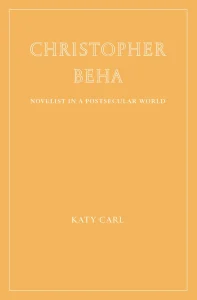
I was reminded of this when I read a Wiseblood monograph, Christopher Beha: Novelist in a Postsecular World by Katy Carl. I’ve heard of Beha, a writer and novelist who served as editor of Harper’s Magazine from 2019 to 2023. He stepped down from the position for the best of reasons; he couldn’t balance his editorial duties with his writing.

Carl’s 32-page monograph explores Beha’s novels – The Whole Five Feet (2010), What Happened to Sophie Wilder(2012), Arts & Entertainments (2014), and The Index of Self-Destructive Acts (2020). And what she finds is that, in what describes as a “postsecular” world, raising the possibility of faith and belief is, well, okay. You can do it in serious fiction, and Beha does it very well, indeed. 

Carl is the editor in chief of Dappled Things Magazine. Her stories and articles have appeared in numerous literary publications, and she previously published the novel As Earth Without Water (2021) and a short story collection, Fragile Objects (2023). She was chosen as Wiseblood Books first writer in residence in 2020, and she is pursuing an MFA degree in creative writing at the University of St. Thomas in Houston., whose founding faculty were James Matthew Wilson and Joshua Hren.  

Katy Carl

Her essay on Beha’s novels repeatedly made me think about my own writing, and how I would describe it. I don’t write literary fiction. I can’t say I write “popular” fiction, or mass market fiction, either. When asked, I’ve said “contemporary fiction.” A few people have suggested “alternative history” or even “alternative future history.” More recently, it’s been historical fiction – no doubts about what to call a novel set during the Civil War and 1915. And now a new one is underway, and it’s definitely contemporary fiction. 

It may be a copout of sorts, but, setting labels aside, all authors have to write the story that’s asking to be written, because it’s a story that the author has to tell. 

I’ve gradually learned the importance of trusting my characters and writing like the writer Harvey Stanbrough describes – WITD, or “writing into the dark.” That means writing with no set outline but trusting your characters enough because they know what they’re doing. I learned that lesson with my last novel, Dancing Prince. One character refused to stay in the minor role I planned for him. I finally surrendered and gave him his head, and he took over. 

And it worked.

Related:

Fragile Objects: Short Stories by Katy Carl.

Wiseblood Books monographs.

Top photograph by Aman Upadhyay via Unsplash. Used with permission.

“John Brown’s Body” by Stephen Vincent Benet

December 6, 2023 By Glynn Young 3 Comments

It’s likely the most successful poem in American literary history, selling more than 130,000 copies. And it’s epic in length.

In 1925, the highly regarded poet Stephen Vincent Benet (1898-1943) applied for a Guggenheim Foundation grant to write a long historical poem about the Civil War. The foundation came through with a $2,500 grant that supported Benet and his family. Along with a bit of freelance writing, while he researched and wrote. They moved to Paris for him to write; it was cheaper than living in the United States. He thought the effort would take seven years; in fact, it took only two. John Brown’s Body was published in 1928, catapulting Benet into literary stardom.

John Brown

The poem contributed to Benet being the most read American poet between 1918 and his death in 1943. His other poems and short stories were widely popular as well, including the short story “The Devil and Daniel Webster.” Book One of a planned nine-volume narrative of the settlement of America, entitled Western Star, was published after his death and received the Pulitzer Prize for Poetry.

The epic of John Brown’s Body, or “cyclorama,” as Benet called it, begins with John Brown’s raid on Harper’s Ferry. Even more than the Dred Scott decision, this is the event that the poet indicates was the point of no return. The raid horrified the South and electrified the North; in Benet’s hands, national unity was not possible without a war. In the poem, this first section includes some of the most vivid and dramatic imagery of the entire poem. (And I didn’t know that Brown took hostages, including the great-grandson of George Washington.)

John Brown’s Body seems rather curious today, curious in that it isn’t a rant or filled with pious superiority and virtue signaling. It’s almost scrupulously fair to both sides in the war, depicting both historical and fictional characters as they themselves would have seen and experienced the war. His main fictional characters, Jack Ellyat of Connecticut and Clay Wingate of Georgia, are drawn to popular type, Ellyat being a yeoman Connecticut farmer and Wingate being the son of a large plantation owner in Georgia.  They and their families will experience the war in radically different ways.

Benet moves the story from the Harper Ferry’s raid to the firing on Fort Sumter, battles like Bull Run and Antietam, Gettysburg, and finally the surrender at Appomattox. In addition to the fictional characters living the story, historical characters like Abraham Lincoln, Robert E. Lee, Jefferson Davis and his cabinet, Ulysses Grant and others describe what is happening. Most of the poem covers the period up to an including Gettysburg; the last two years are rather abbreviated, focusing on Appomattox. But Benet does devote a section to Sherman’s march through Georgia to the sea.

Stephen Vincent Benet

It’s rather astonishing that Benet completed the poem in two years. It still makes for an enthralling read as he tells the story of what is (the present moment notwithstanding) the most divisive period in American history, a time when America was torn apart over four years. 

Writing years after the poet’s death, historian Bruce Catton said that if you wanted to understand the Civil War, you could read the 120 volumes of the Official Records of the War of the Rebellion, or you could read John Brown’s Bodyby Benet. Benet makes for much more concise and entertaining read.

Top illustration: A drawing of U.S. Marines storming the engine house at the Harper’s Ferry federal arsenal (National Park Service). 

What My History Books Left Out

January 4, 2023 By Glynn Young Leave a Comment

In early November, we visited friends and family in the New Orleans area. On a sunny Sunday afternoon, we found ourselves with some of our oldest friends wandering the French Quarter. For a break, we stopped at the small café operated by the Historic New Orleans Collection, a museum that is all about the history of the city. In the shop (all museums everywhere have shops), our friend pointed me toward a book called Afro-Creole Poetry by Clint Bruce.

The work is a collection of 79 poems that were published between 1862 and 1870 in two newspapers in New Orleans – L’Union and La Tribune Nouvelle-Orleans. As the names employ, they were published in French: La Tribune also had an English edition. L’Union began publication a few months after the city fell to the ships of Union Admiral David Farragut. The paper lasted about two years, and it was almost immediately replaced by La Tribune.

Louis Charles Roudanez, a founder of both newspapers

Many newspapers published poetry in the 19th century; a few continued doing that in the early years of the 20th century before the practice died out. These two French newspapers were unusual and unique for the Civil War and Reconstruction periods. They were owned, operated, and almost entirely written by Blacks. Specifically, the newspapers were owned and written by Free Blacks.

Clint Bruce, who assembled this collection of Afro-Creole poetry (with the poems displayed in both French and English), provides considerable background about the publishers and writers. They came from an elite class of Blacks in the city. Many of the families had been there for generations; many came as refuges of the revolution in Haiti or from French-speaking families expelled from Cuba by the Spanish governor after Napoleon invaded Spain in Europe. While vastly outnumbered by enslaved Blacks in Louisiana, their small numbers belied their influence. When the Union occupied the city in 1862, this group of Free Blacks rose to almost immediate prominence, and their members played a significant role in Reconstruction in both the city and the state.

Before I read Afro-Creole Poetry, I was largely ignorant of any of this. I was born and raised in New Orleans. I took a year of required state history in middle school. We studied the Civil War and Reconstruction in high school and college. I attended LSU, which had at the time some of the top Civil War historians in the country. My junior year in college, I took a semester of Louisiana history. What I came out of all that with was a very different picture of Reconstruction in Louisiana and almost complete ignorance of Free Blacks.

I tend to look suspiciously at, and discount, efforts to rewrite American history to suit current political narratives. There’s a lot of that going on. But I have to ask myself why this group pf people, and all they accomplished, had disappeared from the history I studied in school. The answer I’ve come up with, mostly through other reading, is that Civil War historians for a long time focused on the major players, like Abraham Lincoln, Jefferson, Davis, and generals on both sides, and on a barebones account of Reconstruction that focused primarily on how it ended with the election of 1876 and the deal cut to make Rutherford Hayes the president. I think this is less a case of “systemic racism” and more a case of “this is how history was studied and understood.” What I never knew was that Reconstruction didn’t begin in 1865 with the defeat of the Confederacy, but in 1862 with the capture of my hometown.

Yesterday, I posted a review at Tweetspeak Poetry of Afro-Creole Poetry that focuses on the poems with a little of the background. But the book and what it represents needed a larger interpretation, a larger understanding. And it’s a reminder to me not to be so quick to judge all reinterpretations of historical events, especially those that are particularly close to home.

“Poets of the Civil War,” edited by J.D. McClatchy

November 15, 2022 By Glynn Young Leave a Comment

If I asked you to give me the name of an American Civil War poet, you would likely say “Walt Whitman.” His poems, like “O Captain! My Captain!,” “When Lilacs Last in the Dooryard Bloom’d,” and “The Wound Dresser,” certainly catapult him to the top of the Civil War poets list.  

But if I were asked to name another Civil War poet, I’d be rather stumped. Until, that is, I laid eyes on Poets of the Civil War, edited by J.D. McClatchy, published in 2005 as part of the Library of America’s American Poets Project. And I was in for a major surprise. Whitman doesn’t stand there by himself.

The list of Civil War poets includes some of the best-known writers and poets of the 19th century. William Cullen Bryant. Ralph Waldo Emerson. Henry Wadsworth Longfellow. John Greenleaf Whittier. Herman Melville. James Russell Lowell. Bret Harte. Ambrose Bierce. Sidney Lanier. 

To continue reading, please see my post today at Tweetspeak Poetry.

  • « Go to Previous Page
  • Page 1
  • Page 2
  • Page 3
  • Go to Next Page »

Footer

GY


Meet the Man

An award-winning speechwriter and communications professional, Glynn Young is the author of six novels and the non-fiction book Poetry at Work.


 01_facebook 02_twitter 26_googleplus 07_GG Talk

Copyright © 2026 Glynn Young · Site by The Willingham Enterprise · Log in | Managed by Fistbump Media LLC