• Skip to primary navigation
  • Skip to main content
  • Skip to footer

Dancing Priest

Author and Novelist Glynn Young

  • HOME
  • BLOG
  • BOOKS
    • Brookhaven
    • Dancing Prince
    • Dancing Prophet
    • Dancing Priest
    • A Light Shining
    • Dancing King
    • Poetry at Work
  • ABOUT
  • CONTACT

Literary Life

Heart of Darkness: All This Stuff Happens in the Middle

July 18, 2020 By Glynn Young Leave a Comment

Someone forgot to tell Joseph Conrad. 

When you write fiction, you’re supposed follow the rule of thirds. The first third is the introduction of the characters and the development of the conflict. The second third is the development of the narrative, providing a deeper understanding of the characters and conflict. And the last third is the heightened pace of action leading to the climax and resolution of the conflict.

In Heart of Darkness,, after the first third of the short novel, Conrad threw the rule book out the window. All this stuff happens in the second third, offering no respite for the reader.

Marlow has located his boat and fixed it, and he’s now sailing upstream. On board are pilgrims. Also on board are some interesting members of the crew. They’re cannibals. He thinks they’re exercising great restraint or perhaps they’re just not hungry. 

At one stop, he finds a ruined reed hut. Inside is a book, An Inquiry into Some Points of Seamanship, written by a master in the British Navy. The book is filled with marginal notes. To Marlow, the notes look like code. He takes the book with him.

He continues to learn more about Mister Kurtz, the object of his journey.

There’s an attack on the boat from shore. A key crew member is killed. It’s looking grim for all concerned when the pilgrims (the pilgrims!) open fire on the jungle, scattering the attackers. Amid all the chaos, Marlow becomes seriously worried that, if the local population has started attacking, then Kurtz must be dead. 

He reads a report written by Kurtz for the International Society for the Suppression of Savage Customs, finding the writing to be eloquent. He sees a small note written by Kurtz at the end: “Exterminate all the brutes!” So much for eloquence.

He meets a Russian dressed like a harlequin. The book found earlier turns out to belong to the Russian, and the “code” on the margins is actually notes written in Russian. Like everything else around him, the book and the notes contribute to the sense of unreality (Marlow uses the word “absurdity”).

Expecting at least some calm, the reader, like Marlow himself, is instead whipsawed at every turn of the river. The action does not stop, especially for the rules of writing fiction. There’s no nice, slow development of the narrative here; this is more like Raymond Chandler’s advice for writing: “When in doubt, have two men come in the door with guns.”

As he ponders Kurtz and the man’s writing, Marlow makes one of the most profound statements in Chapter 2 and in the entire book. Learning about Kurtz’s diverse family background, Marlow says, “All Europe contributed to the making of Kurtz.”

And there it is: Marlow’s statement about Kurtz, about Europe, and about Africa, all wrapped up in one concise sentence. He hasn’t even found or met Kurtz yet, but he already knows the meaning of Kurtz’s life.  Heart of Darkness isn’t a story about Africa; it is a story about European behavior in Africa.

Perhaps Chapter 3 will allow us to catch our breath.

This month at Literary Life on Facebook, we’re studying Joseph Conrad’s Heart of Darkness, in an edition that includes an extensive study guide by Karen Swallow Prior. 

Top photograph by Peter Oswald via Unsplash. Used with permission.

Heart of Darkness: “One of the Dark Places of the Earth”

July 11, 2020 By Glynn Young Leave a Comment

Five of you – friends, business colleagues, and the boss – are meandering your way down a river. It’s an early evening get-together, and you’re enjoying the company and the beverages. The sun has just set. It’s that early moment of dusk when the world becomes shades of gray. You’re feeling a bit mellow; it’s a bit of an escape from work and life in the city you just left behind.

Suddenly, you hear this: “And this also has been one the dark places of the earth.” No one responds, except perhaps for a raised eyebrow or a slight roll of the eyes. The one who said it is known for such things. He’s also known for telling long stories, and you suspect you’re in for one. 

You’re right; you are. It starts with a brief discussion of how the area you’re sailing through was first settled hundreds of years before, and what those first settlers – soldiers – experienced so far from home, right there on the edge of civilization. From that perspective, the area was a dark place. But from the perspective of the story you are about to hear, the real point of that sudden, startling, original comment, you will find yourself confronting the idea that it is still a dark place. This home you know so well, with its skyscrapers, museums, opera houses, art galleries, find neighborhoods, paved roads, medical facilities, and so much more is actually a dark place? 

And because you’re going to tell me a story about Africa? What?

I had the misfortune (or good fortune) of not reading Heart of Darkness by Joseph Conrad in high school or college. Instead, we read Lord Jim by the same author. The two books, originally published a year apart (1899 and 1900, respectively), have similar themes. But Lord Jim seems somewhat easier to read, and its narrative concerns the act of a disabled passenger ship by its crew. Heart of Darkness centers on the search for a man in the jungles of the Congo, Mister Kurtz, but it takes a while for the reader to figure that out, and a bit longer to learn that it’s about something else entirely. 

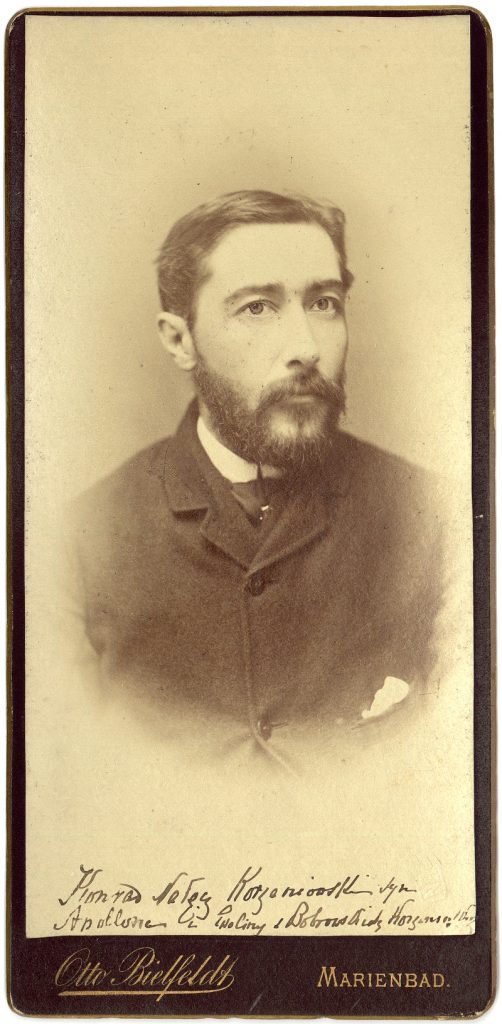
Joseph Conrad

Embedded in that first bit of dialogue, “one of the dark places of the earth,” is the theme of Heart of Darkness. As we read on, that statement seems to haunt the narrative. The narrator, a sea captain named Marlow, will describe how he had the desire to pursue such a career, how he gained the help of relatives, how he went to city that always reminded him of “whited sepulchers” (another kind of darkness), and how he gained a commission to captain a steamer on the Congo River, in that continent both stereotypically and forever known as “darkest Africa.” 

Arriving at his destination in the “dark continent,” Marlow discovers he will have to travel through the Congo to reach his boat. And he is struck of the sharp contrasts between the well-dressed Europeans and the Congolese people who are native to the region. Light, tailored clothes and rough, minimal clothes. Light skin and dark skin. Civilization and its seeming lack. 

The contrasts in Heart of Darkness are often so marked that the reader begins to understand something: Conrad might be suggesting that the contrasts may actually not exist. And if they don’t exist, the idea of darkness surely does, so where does it come from? And you go back to the first dialogue, “And this has also been one of the dark places of the earth.” Don’t forget the “has been” here; Marlow doesn’t say “was” but “has been,” implying that it still is. That the story of a jungle river journey is being told in the context of a leisurely sailing trip near London underscores that the darkness isn’t just in Africa.

And this is what Marlow is going to discover, as he begins his journey to find his boat and to find Mister Kurtz, the man whose name is on everyone’s lips, the European agent who seems to be the source of all wisdom and knowledge in this region of darkness. Marlow is going to learn that the darkness does not come from a place, a condition, or a situation, but that it resides in the human heart.

This month at Literary Life on Facebook, we’re studying Joseph Conrad’s Heart of Darkness, in an edition that includes an extensive study guide by Karen Swallow Prior. This post is a discussion of Part 1 of the short novel.

We All Know a Boo Radley

May 30, 2020 By Glynn Young Leave a Comment

I was all of 21, in my first job after college graduation. I’d been hired as a copy editor on the news desk of the Beaumont (Tex.) Enterprise. Production at the Enterprise was just becoming automated, at least in what we called the “backshop.” Reporters still used typewriters, typing up their copy, handing it to editors (including new ones like me) and hoping we didn’t slaughter their peerless prose when we edited.

Most reporters, like most writers, required editing. I quickly learned who the better reporters were – the ones whose copy didn’t need much editing. Some needed a lot. One rarely if ever needed any – and he was the newspaper’s staff mystery.

I’ll call him Joe. He was in his 50s, and he covered local government. When Joe turned in his stories, he would mumble, almost as if apologizing. I don’t think anyone understood the mumbles. The mystery was how he did his job – he was never seen at a city council or other government meeting, and yet his stories reported exactly what went on. No one knew how Joe did it. Even more mysteriously, no one knew where he lived. He received his mail at the newspaper, and that was his legal address. One staffer followed him in his car one night, and all Joe did was drive around Beaumont for more than an hour until his lost the tail. 

Joe was the stuff of legends at the newspaper. People had all kinds of stories about him, some of which might have been true. New staffers right out of college were especially gullible about the stories. Slightly feared and always a mystery, he was like the Boo Radley of the Beaumont Enterprise.

Bood Radley and Scout in the 1962 movie version of “To Kill a Mockingbird”

In Harper Lee’s To Kill a Mockingbird, Boo Radley is the character that stays mostly in the background but on whom a good portion of the story centers. He’s the bogeyman for the children of the town of Maycomb. He’s never seen, but the children know he’s there, in the Radley home. He’s the stuff of Maycomb legends, and the children try to think of all kinds of ways to lure him outside. The Radley house is the one you run past, or the one you’re dared by your friends to knock on the door.

Jem and Scout Finch live three houses down from the Radley residence, and Boo occupies the children’s minds. They try to draw him out. They play games, enacting stories about the Radley family. Then they begin to notice small items left in a tree, almost like breadcrumbs. The items could be gifts, or clues, or even invitations. But slowly the children’s understanding of Boo begins to change. 

Discovering who Boo is will ultimately save the Finch children’s lives. While the adults are dealing with all of the implications of the Tom Robinson trial, itself rocking long-held racial prejudices, the children are finding out about the real Boo. When the two narrative streams converge, in the wooded way home on Halloween night, it is Boo who intervenes to save the children from a murderous Robert Ewell. 

I was a young teen when I first saw the movie, but I still vividly remember the scene of Jem in bed with his broken arm, Scout sitting nearby, and behind the bedroom door is Boo (played by a young Robert Duvall), saying nothing, still watching over the children. Scout has a moment of utter realization when she recognizes who the man must be. “Hey, Boo,” she says. Atticus Finch tells his children to “meet Arthur Radley.” And he tells Boo that he owes him the lives of his children. 

Boo Radley is a legend, a legend comprised of mostly fearful or fanciful stories. Those who might know the truth won’t trouble themselves to tell it. The children retell and exaggerate the stories. But even after Boo emerges from the shadows as a real character, there is still much the children (and the readers) don’t know. As Matt Rawle points out in The Faith of a Mockingbird, “Harper Lee never lets the readers in on Boo’s true story, so we are left to make our own conclusions and opinions about Boo’s reclusive behavior.” 

You can make up your own mind about what, or who, Boo might represent, but he can be a God-like figure, the God we all hear stories and legends about, some awfully scary. We can’t say that we see him much, but he leaves little breadcrumbs for us to find. And when times are bad, he’s the mysterious figure carrying us through the woods, like Boo carried the injured Jem. And when the scales on our eyes fall off, and we finally recognize him and see him, suddenly we, too, say “Hey, Boo.”

I left the Enterprise before ever finding out if anyone solved the mystery of Joe. Perhaps it was sufficient that I learned that he was a good reporter and a good writer, even if he was never seen at events he wrote about. I can still see him shuffling into the newsroom, nodding at us at the copy desk, and finding his way to his desk and typewriter, typing yet another completely accurate story about what happened at the city council meeting. 

We all know a Boo Radley. 

Top photograph by Mads Schmidt Rasmussen via Unsplash. Used with permission.

The Sacredness of the Ordinary

April 18, 2020 By Glynn Young Leave a Comment

I’m reading Vintage Saints and Sinners: 25 Christians Who Transformed My Faith by Karen Wright Marsh, and I’m struck by how ordinary all these famous Christians actually were. I ponder the thought that perhaps it’s our celebrity culture than permeates my thinking about people known as heroes and heroines of the faith. 

Consider Christians like Mother Teresa, one of the most famous saints in our own lifetimes. She was a woman who dedicated her life to God, and then wondered why God had stopped speaking to her. For decades. She lived with constant doubt, because, as she often said, God doesn’t call us to success; He only calls us to faithfulness.

Brother Lawrence started adult life as a soldier, was eventually crippled, and had to find something else to do with his life. He washed up on the shores of faith. And it took him almost his entire life to realize that washing dishes was a way to practice the presence of God.

To continue reading, please see my post today at Literary Life.

When the Story is Not What You Think It Is

March 14, 2020 By Glynn Young Leave a Comment

I suppose you could call me a Les Mis fan. I’ve seen the stage version of Les Misérables twice. I’ve seen the movie twice. I’ve watched the anniversary specials on PBS (the ones they show during fundraising months). I know the words to the big songs. I am deeply enthralled with the character of Jean Valjean. My heart breaks for Fantine. I laugh at and secretly adore watching the comic and grasping Thenardiers.

What I haven’t done is read the book by Victor Hugo. Perhaps it was the size – 1,222 pages of the “complete and unabridged” edition we have. Perhaps it was my wife telling me, as she read it, “There must be 300 pages describing the sewers of Paris. It goes on for page after page about the sewers.” Eewww. She surprised me when she said she loved the book.

Last year, I spotted a book at the local bookstore, and only saw the title on the spine first: The Novel of the Century by David Bellos. Ah, I thought, a book about David Copperfield, or Great Expectations, or Vanity Fair. Uh, no. It was subtitled “The Extraordinary Adventure of Les Misérables.” That book about sewers. Perhaps watching the movie version yet again would suffice; the sewer scene in the movie is the vastly abbreviated version of what the book contains.

The Grace of Les Misérables by Matt Rawle has changed my mind. 

To continue reading, please see my post today at Literary Life.

Counting the Cost of Faith

February 15, 2020 By Glynn Young Leave a Comment

Years ago, more than 40 to be precise, I was reading The Habit of Being, the collection of selected letters by Flannery O’Connor that had been recently published. Checking now, I see that my copy was from the third printing. And the book in various forms is still available on Amazon.

It’s a marvelous book, filled with so many great quotations and observations that they’re difficult to keep track of. One that I memorized, and sometimes used in Sunday School classes, was something she said about faith: “What people don’t realize is how much religion costs. They think faith is a big electric blanket, when of course it is the cross.”

It is the cross. That observation keeps coming to mind over and over as I read William Wilberforce: A Hero for Humanityby Kevin Belmonte. Three chapters in particular demonstrate the truth of O’Connor’s statement – the three that describe the “two great objects” Wilberforce said God had set before him once he had experienced the “great change’ and became a believer.

To continue reading, please see my post today at Literary Life.

Painting: William Wilberforce by Karl Anton Hickel, about 1794.

  • « Go to Previous Page
  • Page 1
  • Page 2

Footer

GY


Meet the Man

An award-winning speechwriter and communications professional, Glynn Young is the author of three novels and the non-fiction book Poetry at Work.


 01_facebook 02_twitter 26_googleplus 07_GG Talk

Copyright © 2026 Glynn Young · Site by The Willingham Enterprise · Log in | Managed by Fistbump Media LLC