• Skip to primary navigation
  • Skip to main content
  • Skip to footer

Dancing Priest

Author and Novelist Glynn Young

  • HOME
  • BLOG
  • BOOKS
    • Brookhaven
    • Dancing Prince
    • Dancing Prophet
    • Dancing Priest
    • A Light Shining
    • Dancing King
    • Poetry at Work
  • ABOUT
  • CONTACT

Communications

A Conversation about Journalism

October 27, 2021 By Glynn Young 8 Comments

Paul CŽezanne (French, 1839 – 1906 ), The Artist’s Father, Reading “L’ƒEveŽnement”, 1866, oil on canvas, Collection of Mr. and Mrs. Paul Mellon.

We have to start talking about journalism in the United States, and specifically the decline of journalism. Newspapers, television programs, and online news sites have been talking for years about how to fix the problems of circulation, readership, viewership, and competition from social media platforms, but I don’t think they’re going deep enough.

I’ve been working on a new fiction manuscript for some months now. The story is rooted in a community and the people who live there. An event happens that attracts the news media, both local and national. While the event and the role of the media are only a small part of the story, I’ve spent time researching news media, news, and how (and often why) certain event are covered.

This wasn’t a big stretch; my B.A. degree is in journalism, and I worked with journalists for most of my professional career in corporate communications. For three decades after I graduated from college, journalism remained recognizable. In 2003-2004, I was the director of communications for St. Louis Public Schools, amid a highly controversial reorganization. I dealt with journalists daily. I was interviewed daily, and usually by multiple reporters. (My first interview occurred 15 minutes into my first day on the job, when a TV reporter wanted a statement on a teacher sickout. I hadn’t even filled out my HR paperwork when I was standing before a camera.) 

As crazy and hectic as it was, this was journalism, and particularly local journalism, that I knew and understood. The reporters were covering news that people in the community cared about. They may have liked it or hated it, but there was no question it was important to them. 

In 2004, I returned to corporate communications, responsible for a very specific slice of company issues. I was still dealing with journalism that I knew. My colleagues responsible for more general media issues, however, were dealing with a journalism that seemed almost alien. The reporters were less reporter and more activist. They asked questions like reporters, but their stories often reflected nothing of what the discussion had been about. Staff meetings often became brainstorm sessions on how to deal with this. 

The issue lasted for years. Ultimately, only one thing was going to work: calling out the reporter for a bad or misleading story – and publishing the reprimand on the company web site or blog. It’s difficult to imagine the internal opposition to this – embarrassing a reporter was something you simply did not do. It was resisted for years, but nothing else worked. What finally broke the opposition was a story that postured as news but was so obviously propaganda that even a publication widely read by journalists called the reporters out. The company published the reprimand on its blog site. The awful reporting subsided for a long time after that.

What was new in reporting back then seems to be standard operating procedure today. Newspapers like to think the internet has eaten their lunch. And it has – particularly in classified and other kinds of advertising. But reporting barely disguised as activist opinion has had its effect as well – I know a lot of people who stopped subscribing to the local newspaper because the bias was blatant. 

And there’s no question that the newspaper has a bias, but what’s interesting is that the bias occurs mostly in national news stories, obtained by the paper’s subscription to wire services like the Associated Press and syndicates like Washington Post. Local coverage has severely diminished over the years, but the paper generally does a credible job with local news. (That is, unless local news becomes national news, then it reports like everyone else.)

Where I live is increasingly unusual in that my suburb of St. Louis shares a weekly community newspaper with a few other adjacent communities. It covers what the St. Louis Post-Dispatch cannot – local council and school board meetings, local development proposals, sales and property tax issues, and other issues that affect and often deeply concern people in the community. It has a lively letters-to-the-editor page that usually has only letters about local issues, events, and concerns. What the newspaper does, sometimes well and sometimes imperfectly, is facilitate democracy and self-government. 

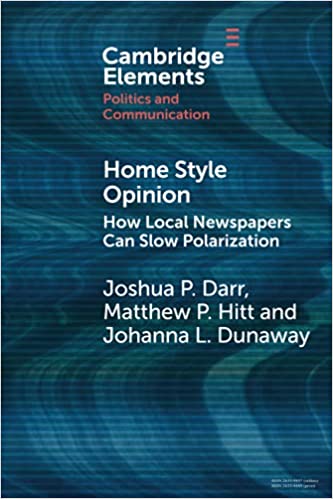
People are looking closely at the connection between newspapers, and the decline of newspapers, and the increasing inability of the United States to govern itself, except by crisis. Next week, I’ll have a post about a newspaper that tried some rather innovative – it dropped all references to national news and issues from its opinion pages. 

Photograph of The New York Times by Wan Chen via Unsplash. Used with permission.

“An Effort to Understand” by David Murray

March 3, 2021 By Glynn Young 1 Comment

It may be the most idealistic definition of communication I’ve ever seen: “With sincere intent and real imagination,” writes David Murray, “all human beings can understand one another.” 

Murray is the editor of Vital Speeches of the Day. He’s the force behind the Professional Speechwriters Association. He leads the Executive Communications Council. He blogs, usually daily, at Writing Boots. He’s spent more than three decades in the communications business; I first met him when he was editor of Speechwriter’s Newsletter, back in the dark ages before social media, web sites, smart phonies, Amazon, and Google. 

He’s also politically blue. But he’s an unusual blue, one who believes that the politically red might actually be worth talking with. And thus his new book, An Effort to Understand: Hearing One Another (and Ourselves) in a Nation Cracked in Half. It’s an optimistic book, reflecting the optimism and general good humor of its author. It’s a book about communications, comprised of short chapters ranging across the breadth of contemporary life – family, work, politics, change, culture, language, environment, leadership, friendship, and more. 

What links all of these things is the idea of communication. Life works because communication works. When communication doesn’t work, things unravel. Marriages fail. Friends stop speaking to each other. People suspect each of other of the most nefarious motives, simply because of what candidate they might for. Or, as Murray might say, communications fails when we stop acting like adults. 

It’s not about civility, he says; civility is not communication. Preaching to the choir and remaining safely inside our political bubbles isn’t communication, either. It’s not screaming names and labels at people to force people to back down and admit we’re right and they’re wrong. 

David Murray

Instead, communication is about understanding. We can have profound and fundamental disagreements about any subject or issue; the United States was founded in the context of profound and fundamental disagreements about government, people, and political philosophy, disagreements which still shape the nation today. But if we’re to hold this American experiment together, we have to make a sincere, sustained, and good-faith effort to understand each other. 

No one said it’s easy, least of all Murray. Coming from the moderately conservative (red) side of the political spectrum, I took him at his word, and I read his book to understand. I knew his politics; I knew we disagreed on a number of very basic things. But I also knew he would have something worthwhile to say, and something I could learn, because Murray is first a communicator. He’s not a political partisan seeking to convert me or any other reader to his way of political thinking. He’s a communicator seeking to understand others and himself, only asking for a similar understanding in return.

The 60 short essays of An Effort to Understand will make you laugh. They will make you think. Most importantly, they will make you look beyond the red and blue labels we use to objectify and categorize people. They will help you understand.

This may be the best book on communication I’ve ever read.

  • « Go to Previous Page
  • Page 1
  • Page 2
  • Page 3

Footer

GY


Meet the Man

An award-winning speechwriter and communications professional, Glynn Young is the author of six novels and the non-fiction book Poetry at Work.


 01_facebook 02_twitter 26_googleplus 07_GG Talk

Copyright © 2026 Glynn Young · Site by The Willingham Enterprise · Log in | Managed by Fistbump Media LLC