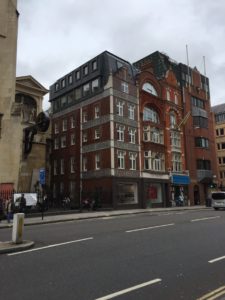
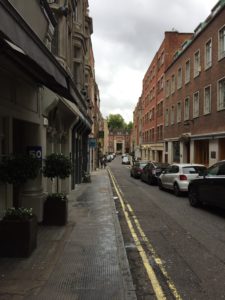
Fleet Street in London has been long associated with newspapers and journalists. But it’s been a long time since any newspapers were actually located there, since all moved to other part of the metropolitan area. In the fall of 2017, I walked Fleet Street and some of the side streets on a cloudy, rainy Sunday, and say only one vestige of the area’s newspaper past – fading letters on the side of a building. A few former newspaper buildings have been listed on the historic register and preserved, but no newspapers operate here today.
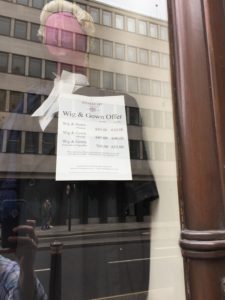
The area includes the Temple, still a part of the legal industry, notable buildings like St. Dunstan-in-the-West Church, the Samuel Johnson House, the Royal Courts of Justice at the western end of the street and the Old Bailey near the eastern end, and many more. On my visit that Sunday, I stopped long enough to take a photo of a lawyer’s gown and wig for sale at a shop.

The church long associated with Fleet Street, so much so that it’s still called the “journalists’ church,” is St. Bride’s. The site may be one of the oldest church sites in London, dating back to the 7th century. Seven church buildings have stood here; one was burned during the Great Fire of 1666 (and rebuilt by Sir Christopher Wren) and another was bombed during the German Blitz of World War II. After the war, it was rebuilt according to the Wren design.
The church contains considerable history. One of the first printing presses (and thus the origins of the newspaper business) was set up next door in 1500. The parents of Virginia Dare, the first English child born in North America, were married here. Author Samuel Richardson is buried here.
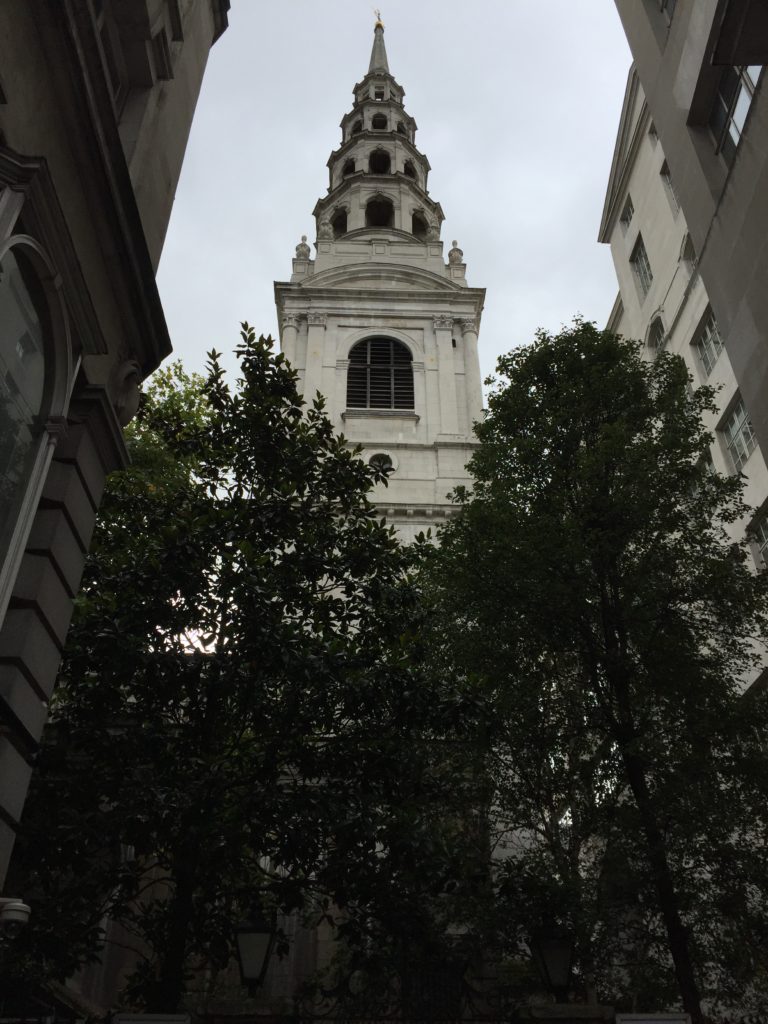
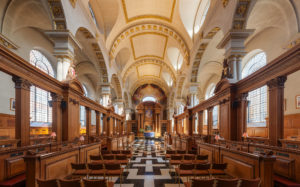
One of its distinctive features is the steeple, which looks exceedingly like a wedding cake (another connection to the church’s name). The interior is beautiful; the day and time I was there the church service had just ended and the parishioners were having a fellowship time and it was rather crowded and joyfully noisy.
The area of St. Bride’s and Fleet Street have a small role in Dancing King. St. Bride’s is one of the churches where Michael Kent-Hughes preaches a sermon. And Trevor Barry, who becomes a consulting attorney for Michael for the coronation, parliamentary law, and the history of the monarchy, has offices near the Royal Courts of Justice, between Fleet Street and the Thames, on a small street called Essex Street. Law offices actually exist on this street, which is close to the Temple tube station. Barry finds himself frequently taking the District or Circle line to the St. James’s Park station, about three blocks from Buckingham Palace.
After his sermon at St. Bride’s, Michael does have a short press conference in the side courtyard with reporters, but it’s mentioned in the book only in passing. There are a number of more extensive scenes involving the news media, but those are mostly set at or near the palace. They include the BBC interview, the media present at Michael’s meeting with protestors, and others.
The news media play an important role in Dancing King because they play an important role in British society and in the lives of the royal family. Michael’s experiences with the media reflect my own career background in communications and media relations, where I learned that your have good reporters, so-so reporters, and bad reporters, like every other profession.
Top photograph is the famous wedding-cake steeple of St. Bride’s. Photograph of the interior of St. Bride’s by Dilff via Wikimedia. Used with permission. Top photo and all other photos are by me and my trusty iPhone.



 Michael explains to the protestors what acceding to this demand would mean – that they would be acknowledging him as the head of all religions in Britain, including Islam, and their clergy would serve at his pleasure. They’re horrified – that isn’t what they thought their demand was about.
 Today, the palace has 775 rooms, including 19 State Rooms, 52 royal and guest bedrooms, 188 staff bedrooms, 92 offices, and 78 bathrooms.
 Michael and his wife Sarah find the palace generally sound (Michael’s childhood friend Tommy McFarland, will lead a team of architects and building experts to determine the condition of the various royal properties). A number of internal systems – heating, kitchen appliances, and basic systems – will need to be replaced or repaired. The chief gardener, Richard Brightwell, will be directed to begin a major renovation of the gardens. The art gallery will be renovated and plans made for an exhibition. The staff will begin planning to reopen the palace for summer tours.
 Michael and Sarah, overwhelmed by the size of the palace and trying to figure out how to call it “home,” will have a space on the upper floor of one of the wings renovated for the entire family, resembling their home in San Francisco.