• Skip to primary navigation
  • Skip to main content
  • Skip to footer

Dancing Priest

Author and Novelist Glynn Young

  • HOME
  • BLOG
  • BOOKS
    • Brookhaven
    • Dancing Prince
    • Dancing Prophet
    • Dancing Priest
    • A Light Shining
    • Dancing King
    • Poetry at Work
  • ABOUT
  • CONTACT

London

Dancing King Stories: Fleet Street and St. Bride’s Church

April 9, 2018 By Glynn Young 1 Comment

St Brides Church

Fleet Street in London has been long associated with newspapers and journalists. But it’s been a long time since any newspapers were actually located there, since all moved to other part of the metropolitan area. In the fall of 2017, I walked Fleet Street and some of the side streets on a cloudy, rainy Sunday, and say only one vestige of the area’s newspaper past – fading letters on the side of a building. A few former newspaper buildings have been listed on the historic register and preserved, but no newspapers operate here today.
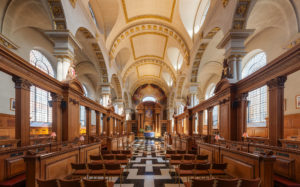
St Brides interior
The interior of St. Bride’s

The area includes the Temple, still a part of the legal industry, notable buildings like St. Dunstan-in-the-West Church, the Samuel Johnson House, the Royal Courts of Justice at the western end of the street and the Old Bailey near the eastern end, and many more. On my visit that Sunday, I stopped long enough to take a photo of a lawyer’s gown and wig for sale at a shop.

St Brides Courtyard
The side courtyard of St. Bride’s, where Michael has a press conference

The church long associated with Fleet Street, so much so that it’s still called the “journalists’ church,” is St. Bride’s. The site may be one of the oldest church sites in London, dating back to the 7th century. Seven church buildings have stood here; one was burned during the Great Fire of 1666 (and rebuilt by Sir Christopher Wren) and another was bombed during the German Blitz of World War II. After the war, it was rebuilt according to the Wren design.

The church contains considerable history. One of the first printing presses (and thus the origins of the newspaper business) was set up next door in 1500. The parents of Virginia Dare, the first English child born in North America, were married here. Author Samuel Richardson is buried here.
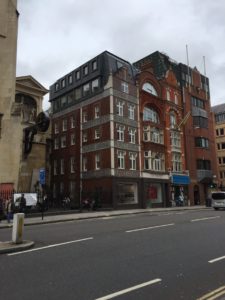
Fleet Street
A vestige of Fleet Street can be seen on the side of the building

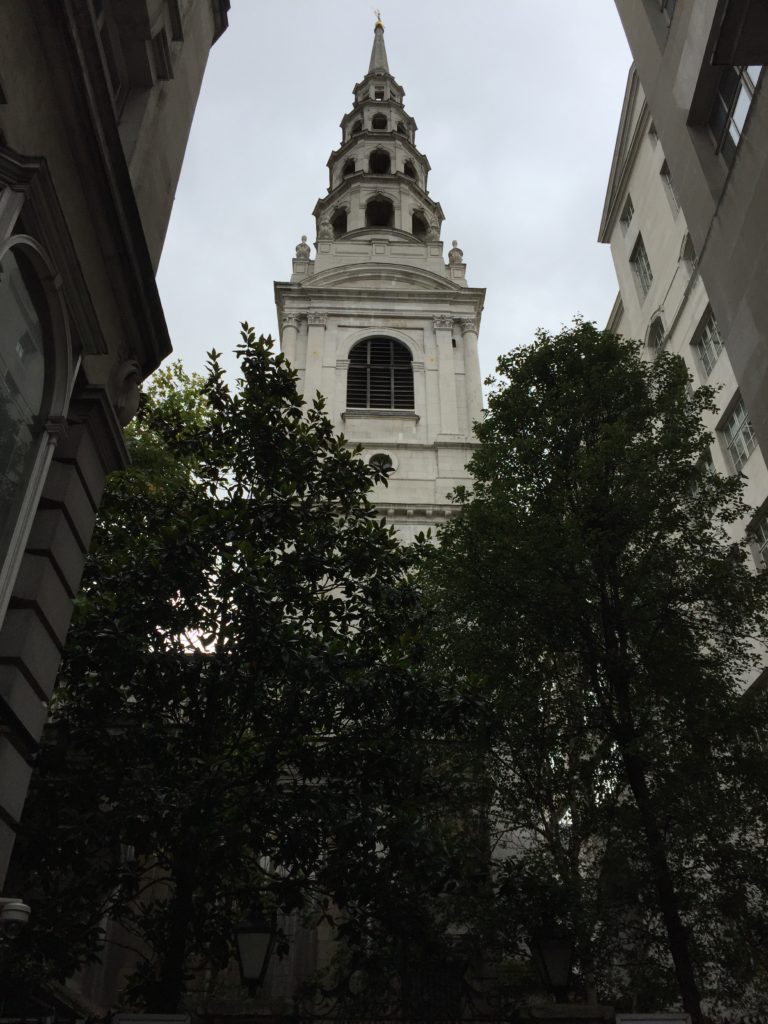
One of its distinctive features is the steeple, which looks exceedingly like a wedding cake (another connection to the church’s name). The interior is beautiful; the day and time I was there the church service had just ended and the parishioners were having a fellowship time and it was rather crowded and joyfully noisy.

The area of St. Bride’s and Fleet Street have a small role in Dancing King. St. Bride’s is one of the churches where Michael Kent-Hughes preaches a sermon. And Trevor Barry, who becomes a consulting attorney for Michael for the coronation, parliamentary law, and the history of the monarchy, has offices near the Royal Courts of Justice, between Fleet Street and the Thames, on a small street called Essex Street. Law offices actually exist on this street, which is close to the Temple tube station. Barry finds himself frequently taking the District or Circle line to the St. James’s Park station, about three blocks from Buckingham Palace.
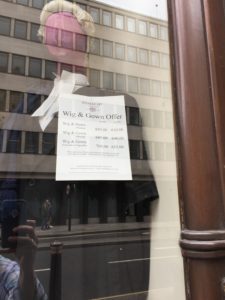
Fleet Street Temple
Gown and wig for sales in Fleet Street

After his sermon at St. Bride’s, Michael does have a short press conference in the side courtyard with reporters, but it’s mentioned in the book only in passing. There are a number of more extensive scenes involving the news media, but those are mostly set at or near the palace. They include the BBC interview, the media present at Michael’s meeting with protestors, and others.
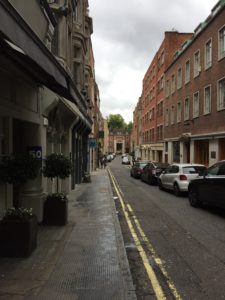
Essex Street Temple
Essex Street, where the attorney Trevor Barry has his law offices

The news media play an important role in Dancing King because they play an important role in British society and in the lives of the royal family. Michael’s experiences with the media reflect my own career background in communications and media relations, where I learned that your have good reporters, so-so reporters, and bad reporters, like every other profession.

Top photograph is the famous wedding-cake steeple of St. Bride’s. Photograph of the interior of St. Bride’s by Dilff via Wikimedia. Used with permission. Top photo and all other photos are by me and my trusty iPhone.
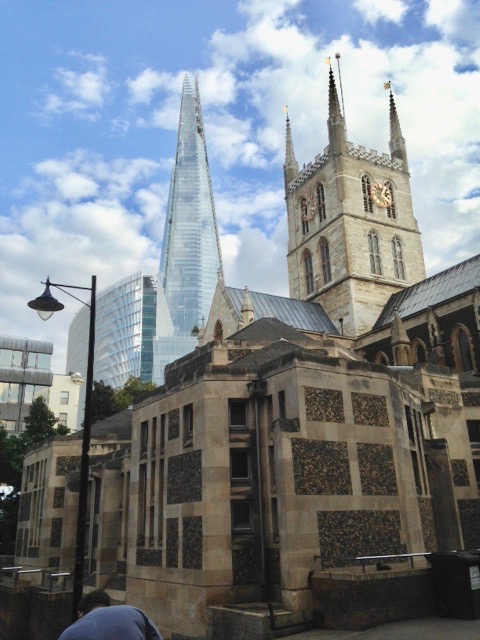
Dancing King Stories: Southwark, the Human-Scale Cathedral

April 2, 2018 By Glynn Young 3 Comments

Southwark Cathedral

When you visit London, especially for the first time or two, two great churches are on the must-see list – St. Paul’s Cathedral and Westminster Abbey. And with good reason. Both churches are known for their soaring architecture, structural beauty, and the fact they are filled with English and British history. Right down Victoria Street form Westminster Abbey is another monumental church – the Roman Catholic Westminster Cathedral. London is a big city with big cathedral churches.

Southwark Cathedral is another church, smaller than its more famous London relatives. But of all the churches and cathedrals I’ve seen in London and England, it may be my favorite. Size has something to do with it – it’s smaller, more human-scale, still impressive, but the human eye can take it in without being completely overwhelmed.

Southwark Cathedral
The pulpit from which Michael Kent-Hughes speaks in “Dancing King”

It’s not as well known for tourists. It’s partially location – on the South Bank near London Bridge tube and train station, it’s about a half-mile walk to the Globe Theatre and Tate Modern art museum. It’s only about two blocks from the London Bridge Experience, whose replicated blood and gore I’ve so far managed to miss. The cathedral is also adjacent (about as adjacent as you can get) to the Borough Market, full of produce, stands, food shops, and restaurants and also the site of a terrorist attack in June of 2017 (not to be confused with the Westminster Bridge attack in March of 2017).

Southwark’s official name is “the Cathedral and Collegiate Church of St. Saviour and St. Mary Overie,” the “overie” meaning “over the river.” A church has existed on the site since the 7th century; archaeologists have identified the foundations of an Anglo-Saxon church there. It’s believed to have first been connected to a community of nuns, and later a community of priests. The first written reference to it is in the Domesday Book of 1086, William the Conqueror’s detailed assessment of land and resources.

In 1106, the church was reestablished as a priory and followed the Rule of St. Augustine. It was then that the church was dedicated to St. Mary Over the River. A hospital was established as well, and it would eventually grow and be transferred to what is now St. Thomas Hospital near Westminster Bridge and across the Thames from Parliament. (Incorporated into St. Thomas Hospital was the old Guys Hospital near Southwark Cathedral, where the poet John Keats studied to be a doctor.)

Southwark was the staging area for pilgrimages to Canterbury, and it was in this area that Geoffrey Chaucer launched the pilgrimage made famous in The Canterbury Tales.

Southwark Cathedral
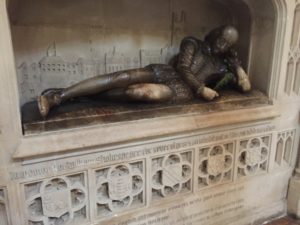
The tomb of Edmond Shakespeare

The order at Southwark was dissolved along with orders across England by Henry VIII in 1539, part of the English Reformation and likely inspired by Henry’s desire to get his hands on the churches’ and orders’ prodigious wealth. The building was rented to the congregation and called St. Saviour’s; in 1611, the congregation purchased the church from James I. One of the notables buried in the church is William Shakespeare’s younger brother Edmond (1607).

The church officially became “Southwark Cathedral” in 1905. Today, the Diocese of Southwark encompasses a rather large area (and includes Lambeth Palace, the home of the Archbishop of Canterbury). It covers 2.5 million people and more than 300 church parishes.

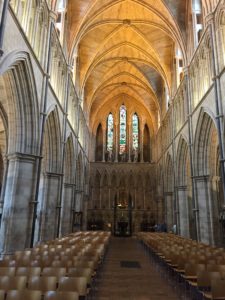
Southwark Cathedral nave
This would be Michael Kent-Hughes’ view as he speaks from the pulpit

In Dancing King, Southwark Cathedral is the place where Michael Kent-Hughes begins his series of sermons at London churches, two days before Christmas Eve. The photograph here of the nave is the view Michael would have as he’s speaking to a packed church. And it is here, the next night, where almost 1,200 people will show up for a Bible study, filling the church past overflowing, beginning what will become a religious revival in the Church of England. But it will be a revival matched by intense opposition from the senior church hierarchy.

If you visit the cathedral (and it’s well worth a visit), the entry fee is a pound (a bargain compared to the big churches). You pay your fee in the gift shop, where in return you’re given a cathedral guide. You also usually warned to make sure your guide is visible when you enter the church; one of the church wardens will politely ask to see it or send you to the shop to buy one if you don’t have it. The fee doesn’t apply during church services.

Top photograph: a view of Southwark Cathedral, with one of London’s tallest office buildings, known as “The Shard,” in the background.

  • « Go to Previous Page
  • Page 1
  • Page 2

Footer

GY


Meet the Man

An award-winning speechwriter and communications professional, Glynn Young is the author of six novels and the non-fiction book Poetry at Work.


 01_facebook 02_twitter 26_googleplus 07_GG Talk

Copyright © 2026 Glynn Young · Site by The Willingham Enterprise · Log in | Managed by Fistbump Media LLC