• Skip to primary navigation
  • Skip to main content
  • Skip to footer

Dancing Priest

Author and Novelist Glynn Young

  • HOME
  • BLOG
  • BOOKS
    • Brookhaven
    • Dancing Prince
    • Dancing Prophet
    • Dancing Priest
    • A Light Shining
    • Dancing King
    • Poetry at Work
  • ABOUT
  • CONTACT

history

Bruce Catton’s Civil War

November 21, 2022 By Glynn Young 1 Comment

Bruce Catton (1899-1978) grew up in Petoskey, Michigan, listening to the stories of old Civil War veterans. As a boy, he was enraptured by these first-hand accounts, but his own experiences in World War I led him to believe that those Civil War veterans didn’t really understand modern warfare. His memoir of growing up, which included his interactions with Civil War veterans, was published in 1972 and entitled Waiting for the Morning Train: An American Boyhood.

At some point, he realized how wrong he was. He became a journalist and worked for such newspapers as the Boston American, Cleveland News, and Cleveland Plain Dealer. He never lost interest in the Civil War, and Catton continued studying and researching the period before, during, and after the war. He read extensively on the subject, and what he noticed was how historians talked about battles and generals, without paying much attention to the experiences of soldiers.

And it wasn’t for lack of sources. Hundreds if not thousands of memoirs had been published by Civil War veterans on both sides of the conflict. Regimental histories had been written. But these accounts weren’t the Civil War most Americans were familiar with.

Catton focused on the federal Army of the Potomac and wrote three books which focused heavily on the experiences of the soldiers. The first volume in what became a trilogy was Mr. Lincoln’s Army, published in 1951. The second volume was Glory Road (1952), and the third was A Stillness at Appomattox (1954). Sales weren’t exactly robust; the nation’s appetite for Civil War history seemed to have waned.

Young Bruce Catton

And then A Stillness at Appomattox won the Pulitzer Prize for history, followed by a National Book Award. The resulting publicity encouraged new readers and buyers. Here was a journalist (of all things) doing what historians had paid scant attention to – the experiences of the soldier. This wasn’t reading about Robert E. Lee, Abraham Lincoln, Ulysses S. Grant, and Jefferson Davis; this was reading about the war fought by the boy next door, or your own son.

No one had written history like this before in America. Reading it gave people the impression they were firsthand witnesses, a result of its journalistic style. The series became popular and passed into publishing (and Civil War history) legend. Not only did it inspire Shelby Foote to write his multi-volume history of the Civil War, it also led to Ken Burns’ epic documentary for PBS. The series began airing in September of 1990 to 40 million television viewers. If you watched it (and I was one of those 40 million), you couldn’t forget David McCullough, the narrator, introducing the letters written by soldiers to their wives, sweethearts, and parents. Like Catton’s books, it made the Civil War profoundly personal. 

Bruce Catton

The Library of America, a national publishing treasure if ever there was one, has recently combined Catton’s three volumes into one, simply entitled Catton: The Army of the Potomac Trilogy. It’s edited by Gary Gallagher, the John L. Nau III Professor of History of the American Civil War Emeritus at the University of Virginia. Gallagher includes an exceptionally fine introduction to Catton and his writing. The volume also includes maps of the battles fought by the Army of the Potomac, drawn by Rafael Palacios. Its hefty content (more than 1,100 pages of texts, plus another 100 of notes, bibliography, and index) is packaged in a relatively compact yet easily readable volume. 

And it’s still a thrilling read, just like it was originally in the 1950s and through numerous editions, and just like the stories Catton heard when he was a boy in Petoskey, fascinated by the tales of Gettysburg, Chancellorsville, and so many more, all told by the now-grizzled old men who had fought them. 

Related:
Writer Patrick McMurfin has a delightful and rather thorough account of Catton, life fie, his work, and his books. 

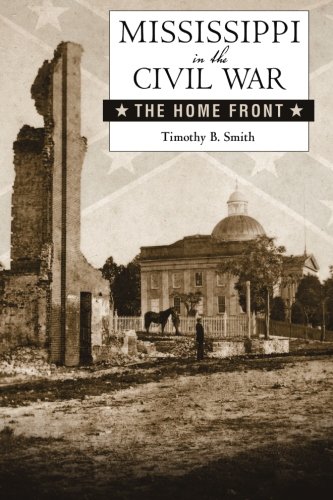
“Mississippi in the Civil War: The Home Front” by Timothy Smith

October 10, 2022 By Glynn Young Leave a Comment

In high school and college, when we read about or study the American Civil War, we learn primarily about the political and military figures and the battles and campaigns. When I attended LSU, the school’s history department had a national reputation, with professors like T. Harry Williams, who was not only a highly regarded Civil War historian but also wrote the Pulitzer Prize-winning biography of Huey Long. Williams published several books on Abraham Lincoln, P.G.T. Beauregard, Civil War generals, and related topics.

In recent years, more attention has been paid to the war and how it affected civilians. When Union armies invaded the Southern states, they civilians they encountered were largely women, children, and older men beyond military age. And it is this group, and their lives in towns, cities, and farms, that Timothy Smith considers in Mississippi in the Civil War: The Home Front.

Smith divides his story in two pieces. First is how the state of Mississippi dealt with the military conflict from secession through the end of the war. The second is how the civilian population experienced the war. He pays particular attention to the belief among historians that the South was defeated not only by Northern industrial might but also by the people losing the will to fight. He finds some of that may be true, but that the “losing the will to fight” sentiment may have played a smaller role than previously thought.

Mississippi’s surely had more than sufficient reason to lose heart. From early in the war, the state was devastated economically, militarily, and socially. Agriculture was disrupted, cities burned, and railroads destroyed. What little there was industrial infrastructure also suffered severely. Deserters and criminals freed from jails roamed the countryside. Cotton, which had been the state’s primary crop, became almost useless with the federal blockade of ports. Inflation soared. Foodstuffs became scarce. The state had to sequester food for the military. Many people fled the state during the war for less affected places like Texas. (My own Mississippi ancestors did precisely that, returning only after the war was over.)

Particularly interesting is Smith’s discussion of the anti-secession sentiment in the state, which was surprisingly strong. Not everyone wanted to leave the Union; not everyone owned slaves. But everyone would largely suffer equally.

Timothy Smith

Smith provides an overview of what people experienced. Military battles aside, it was a dark time for many people in the South, free and slave, and the effects would be felt for decades. Some say the effects are still being felt. 

Smith’s numerous books on the Civil War include accounts of the battles of Vicksburg, Corinth, Champion Hill, Shiloh, Forts Henry and Donelson, and Chickamauga; the Mississippi secession convention; U.S. Grant’s invasion of Tennessee; and the Grierson Raid in Mississippi. A professor of history at the University of Tennessee at Martin, he’s won numerous awards for his books, including the Fletcher Pratt Award, the McLemore Prize, the Richard Harwell Award, the Tennessee History Book Award, the Emerging Civil War Book Award, and the Douglas Southall Freeman Award. He lives with his family in Tennessee.

Mississippi in the Civil War: The Home Front is a sobering story. Mississippi and the other Southern states may have brought the war upon themselves, but its people endured and survived, Smith explains how that happened.  

Related:

“The Real Horse Soldiers” by Timothy Smith. 

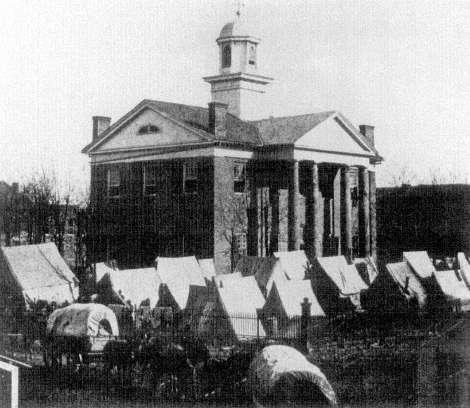
Top photograph: The original Oxford, Miss., courthouse, with a Union army encampment on its grounds. 

“The Civil War in Mississippi: Major Campaigns and Battles” by Michael Ballard

October 3, 2022 By Glynn Young Leave a Comment

If there is a state we most associate with the American Civil War, it is Virginia. Numerous battles occurred there; the federal and confederate armies faced each other for four years, most often in a stalemate; and the two enemy capitals ensured that Virginia was a major theater of the war. And it was in Virginia that Robert E. Lee ultimately surrendered to Ulysses S. Grant. 

Some have argued that the United States really won the war farther west – the fall of New Orleans and Vicksburg, the battles around Nashville and Chattanooga, the capture of Atlanta in 1864, and Sherman’s March to the Sea. 

And then there was Mississippi, the second state (after South Carolina) to secede from the Union. The Civil War in Mississippi was more – far more – than Vicksburg. Historian Michael Ballard (1946-2016) tells the story in The Civil War in Mississippi: Major Campaigns and Battles (2011). The book is volume 5 of the Heritage of Mississippi published by the University Press of Mississippi for the Mississippi Historical Society and the Mississippi Department of Archives and History.

Vicksburg (1863) may have been the most important battle in the state; its surrender solidified control of the Mississippi River by the United States and severed the Confederacy in half. But the northern part of the experienced numerous battles. The town of Holly Springs changed hands 57 times. The town of Oxford was burned. The state capital of Jackson fell twice to the federals; Grant took the city and then attacked Vicksburg from the east. Before he marched to the sea in Georgia, Sherman marched from Jackson to Meridian in similar fashion, destroying anything that might be of value to the Confederates. Major Benjamin Grierson led a three-week-long raid with 1,700 cavalry troops from the Tennessee line south, eventually arriving in federally held Baton Rouge in Louisiana. 

The destruction through the years of war was large-scale – plantations, factories, warehouses full of supplies, railroad deports and track, and whole towns in some cases. In his well-written and highly readable account, Ballard succinctly tells the story of all of what happened. 

Michael Ballard

During his lifetime, Ballard published numerous books about the Civil War, including A Long Shadow: Jefferson Davis and the Final Days of the Confederacy (1986); Landscapes of Battle: The Civil War (1988); Pemberton: The General Who Lost Vicksburg (1999); A Mississippi Rebel in the Army of Northern Virginia: The Memoirs of Private David Holt (1995); Grant at Vicksburg: The General and the Siege (2003); U.S. Grant: The Making of a General 1861-1863 (2005); and several others. He received his B.A., M.A., and Ph.D. degrees from Mississippi State University, where he also worked as archivist and director of the Congressional and Political Collection. 

The Civil War in Mississippi is a fine history and a sobering one. By the end of Civil War, the state’s economy was in ruins, its towns and cities had experienced widespread destruction, thousands of its men had died on battlefields across the state and the South, and its social order was turned upside down. Recovery would be a long time coming. 

Top photograph: Artist’s rendering of the Battle of Corinth, Miss.; Mississippi Department of Archives and History.

When a Book Won’t Let Go

August 10, 2022 By Glynn Young 1 Comment

Two weeks after finishing it, and I’m still thinking about Hearts Torn Asunder: Trauma in the Civil War’s Final Campaign in North Carolina by Ernest Dollar Jr. (See my review last week.) 

When I read it, I expected to read about the final convulsive moments of the surrender of the Confederate armies and the immediate aftermath. And that’s the thumbnail description. But it’s about a lot more.

It’s the story of the civilians in north central North Carolina, roughly Raleigh to Greensboro, who found themselves in the path of two defeated armies and one victorious one.

It’s the story of the soldiers in those armies, who had to live with what we know today as Post-Traumatic Stress Disorder. One thing you don’t read in the general histories of the Civil War period in the rather startling increase in soldier suicides and commitments to insane asylums in the years and decades after the war.

It’s the story of some of the atrocities inflicted on the civilian and military population. In generally, Confederate soldiers were focused on finding food, shoes, and clothes, and they didn’t care where they found them. Confederate soldiers and civilians alike were often desperate for food, and together they were raiding government warehouses and supplies. 

The Union soldiers had food. What they were looking for was loot and revenge. There were too many reports of pillaging and looting, and more than a few of rape. Women and often children were brutalized. Houses were burned. It wasn’t only soldiers who developed PTSD. Some of the federal soldiers were disciplined and a few executed for their crimes (especially after the armies surrendered; that meant the civilians were no longer members of a foreign and hostile country).

My great-grandfather was somewhere in that convulsion. Even at war’s end, he was (chronologically) a boy. Too young to take up arms officially, he had enlisted and became a messenger boy for the Confederate army.

What I don’t know is what did he do to stay alive. Did he participate in the looting of government warehouses? Did he steal from civilians? Those questions will never be answered. What we do know is that he had to walk home to southern Mississippi – hundreds of miles across a landscape destroyed in many places and in complete social upheaval everywhere. 

When he finally reached home, he learned his family had fled to Texas. So, his trek continued across Louisiana and into east Texas, where he found them. He also discovered that he was the sole surviving son, the youngest child in the family. When his father died four years later, my great-grandfather became the head of the family, which included a widowed sister, two widowed sisters-in-law, and a number of nieces and nephews. And his only family, too – he had married in 1867, and he and his wife had a little boy. He had to take care of that extended family through the rigors of Reconstruction.

My great-grandfather was made of some stern stuff, and that book, Hearts Torn Asunder, helped me understand just how stern it was.

Top photo: My great-grandfather, Samuel Franklin Young, and my great-grandmother, Octavia Montgomery Young. 

A History Lesson about Gettysburg, and More

June 22, 2022 By Glynn Young Leave a Comment

I’ve been reading some of the books in the battle series published by Emerging Civil War. So far, I’ve read about Shiloh (1862), Gettysburg (1863), and the Battle of the Wilderness (1864). It was while reading this third one that the author mentioned something as almost an offhand comment that threw me – and upended something I believed for 50 years.

The book was Hell Itself: The Battle of the Wilderness, May 5-7, 1864 by Chris Mackowski, but the comment was about Gettysburg. At the time of the battle in 1863, he said, “No one recognized Gettysburg as anything other than a setback, and certainly no one looked at it as the ‘High Water Mark of the Confederacy.’”

John and Elizabeth Bachelder at Gettysburg battlefield in 1888.

How it gained that reputation was due to a marketing-savvy photographer, lithographer, and Gettysburg historian named John Badger Bachelder, who was a tireless promoter of the Gettysburg Battlefield and worked to promote the site as a tourist destination.

In other words, the whole idea of Gettysburg as the turning point in the Civil War came from a promoter for the battlefield, decades after the battle was fought.

I can remember from my primary (and college) education how the Battle of Gettysburg was described – the turning point in the Civil War, the high-water mark of Robert E. Lee’s Army of Northern Virginia, and the beginning of the end of the Confederacy. And this wasn’t something that was taught and understood half a century ago, and we’ve all gotten a lot wiser since then. No, the belief still has considerable legs. See, for example, how the history site Battlefields.org describes it in the first sentence. The Wikipedia entry for the battle notes it that way as well, but includes a note about “turning points” – that there is widespread disagreement among historians. In fact, historians now point to 13 or 14 turning points in the Civil War, some of them being Confederate victories. Go figure.

Gettysburg was an important battle, to be sure. Coupled with the fall of Vicksburg at almost exactly the same time, it portended a change in the Union’s fortunes. But the war continued for almost two more years, and it still wasn’t finished until Lee surrendered at Appomattox in April 1865 and General William Johnston surrendered two weeks later in Greensboro, North Carolina.

The ”Gettysburg as turning point” story is a reminded that we should never automatically use one event as the critical one in a war, or (even worse) in a nation’s history. Our Constitution, for example, wasn’t invented from whole cloth in a room in Philadelphia one summer, but instead developed through the 1760s, 1770s, the American Revolution, and the 1780s. Elements of our Constitution can be traced back to the Magna Carta and the Roman Republic (especially the writings of Cicero). We have the First Amendment largely thanks to John Milton. 

History turns out to be more complicated than we realize, and certainly more complicated than battlefield promoters would have us believe.

Top illustration: Battle of Gettysburg by Thure de Thulstrap.

Family History as a Source for Stories

May 25, 2022 By Glynn Young Leave a Comment

A single comment by my father nearly six decades ago led to a story idea. 

“Your great-grandfather was too young to enlist in the Civil War,” he said. “So, he signed up as a messenger boy when he looked old enough to get away with it. And then he had to walk home when the war was over.” My father must have heard that from his father; he was four when his grandfather died, with no memories of him at all.

A year ago, when I decided I wanted to know more, any family member who might have known something was long buried. 

The records in the family Bible provided few clues. One of millions published by the American Bible Society in the 1870s, it included family records inserted between the Old and New Testaments. The earliest recorded date was 1803, the year of the Louisiana Purchase; it noted the birth of my great-great-grandfather. But almost all the entries, stretching from 1803 to the 1890s, were in the same hand, if different inks – my great-grandfather’s handwriting (my great-grandmother had died in the 1880s).

To continue reading, please see my post today at American Christian Fiction Writers.

  • « Go to Previous Page
  • Page 1
  • Page 2
  • Page 3
  • Go to Next Page »

Footer

GY


Meet the Man

An award-winning speechwriter and communications professional, Glynn Young is the author of six novels and the non-fiction book Poetry at Work.


 01_facebook 02_twitter 26_googleplus 07_GG Talk

Copyright © 2026 Glynn Young · Site by The Willingham Enterprise · Log in | Managed by Fistbump Media LLC