• Skip to primary navigation
  • Skip to main content
  • Skip to footer

Dancing Priest

Author and Novelist Glynn Young

  • HOME
  • BLOG
  • BOOKS
    • Brookhaven
    • Dancing Prince
    • Dancing Prophet
    • Dancing Priest
    • A Light Shining
    • Dancing King
    • Poetry at Work
  • ABOUT
  • CONTACT

Reviews

Belle Boyd: Cleopatra of the Secession

July 19, 2023 By Glynn Young 1 Comment

Belle Boyd (1844-1900) was 16 when the Civil War began. A member of a prominent family in Martinsburg, Virginia (it became part of WestVirginia), she’d been in boarding school in Baltimore when the Southern states began to secede. She made he way back home, and when the war began, she promptly decided to do whatever she could to help the South win.

She became a spy.

Her hometown afforded more than ample opportunity; like doe so many other towns in contested areas, control of the town changed hands several times. She made no secret of her sympathies; she did make secret her listening in on Union plans and army movements. In one particularly amazing incident, she braved gun and cannon fire in rushing across a large field to bring news of Union army reserves to Gen. Stonewall Jackson.

Union authorities were not ignorant of Belle Boyd’s activities. No less a person than Edwin Stanton, Secretary of War, in President Lincoln’s cabinet, ordered her arrest. She was arrested six times and imprisoned twice. At one point, Pinkerton detectives were hired to track her down. She was finally able to make her way to safety in England before the war ended; to support herself, she became an actress. 

Belle Boyd

She almost immediately began writing her memoirs, for which was a ready market in both North and South. She had locked a Northern reporter in his room during one Union army evacuation, and he was captured by the Confederates. He knew exactly who bore responsibility, and when he returned to the North, he wrote stories, many grossly exaggerated, that turned Belle Boyd into a notorious spy and femme fatale, at least as far as Northern readers were concerned. Belle shrugged off his lurid stories; what else should you expect from a Northern newspaper, she said. In the South, she was regarded as a great heroine, and Stonewall Jackson himself commended her patriotism and activities.

Her memoir, published in 1866, sold quite well. Entitled Belle Boyd in Camp and Prison: Cleopatra of the Secession, it detailed her activities from the beginning, her Southern patriotism, her captures and imprisonments, and her “in your face” attitude, including waving a small Confederate flag on the train bearing her to prison in Washington, D.C. 

She writes with passion and intelligence. She may have been a teenager, but she was determined to do her part for the South. She gave little thought to her own safety, unless her treatment by Union authorities might reflect badly on them. She was typically jailed without any explanation or formal charges (although I’m sure she could have guessed), as habeas corpus had been suspended by executive order.

Boyd married three times; her second husband was a British citizen who had fought for the Union. She had a daughter from her first marriage and four children from her second. She died of a heart attack in Wisconsin and was buried there. 

Her memoir, published in two volumes, is considered by many to be “highly fictionalized.” It is a rather breathless account, and it’s easy to see how she might have described some experiences and even invented others to put herself in a daring and positive light. But it is a highly entertaining account; Belle Boyd knew how to capture attention.

“Bloody Promenade” by Stephen Cushman

July 12, 2023 By Glynn Young 3 Comments

I found Stephen Cushman’s poetry first, and then I discovered he wrote about the Civil War as well.

Cushman is a professor of English at the University of Virginia. He’s known for his seven collections of poetry and two books of literary criticism, Fictions of Form in American Poetry and William Carlos Williams and the Meanings of Measure. 

But when he was a child, he was given a book about the American Civil War. It was The American Heritage Picture History of the Civil War (1960), with a narrative by noted Civil War historian Bruce Catton. The book became the key that unlocked a lifelong interest in the war, to the point where he’s published three books about it – The Generals’ Civil War: What Their Memoirs Can Teach Us Today, Belligerent Muse: Five Northern Writers and How They Shaped Our Understanding of the Civil War, and Bloody Promenade: Reflections on a Civil War Battle.

Cushman lives about 50 miles from the battle cited in that last work. It happened over two days, May 5 and May 6, in 1864, and it was one of the most horrific battles of a war known for its horrific battles. The Battle of the Wilderness was the first direct confrontation between Ulysses Grant and Robert E. Lee, and Grant proved he would be relentless even if he lost. Lee had not come upon an opponent like this before, an opponent determined to defeat Lee whatever it took in lives and material. 

Cushman explains that he’s not providing a history of the battle or an analysis of its strategies and tactics. Bloody Promenade doesn’t fit a precise literary genre. It’s not so much a story of the battle as it is a reflection of what that battle meant in the war, in American history, and to himself. I live more like 750 miles from that battle, but it is the one that has come to be something of a metaphor for the war to me. I understand Cushman’s preoccupation with it.

The book is about ancestors and people who engage in re-enactments. It’s about what eyewitnesses reported and how newspapers and magazines covered it. It’s about the battle as described in memoirs of the famous and not-so-famous. It’s about the battle and the war in histories and poetry. And it’s about the terrain itself, that dense thicket of trees, shrubs, tall weeds and scrubland that, given the dry weather, was almost waiting for something to set off a conflagration. Which is what happened.

Stephen Cushman

In addition to his own poetry and historical writing, Cushman serves as general editor of the fourth edition of Princeton Encyclopedia of Poetry and Poetics. He’s served as co-editor of Civil War Witnesses and Their Books: New Perspectives on Iconic Works and Civil War Writing 1866-1989: New Perspectives on Iconic Works. He’s also published numerous articles on both poetry and the Civil War. He received a B.A. degree from Cornell, an M.A. and D. Phil. Degrees from Yale, and a Ph.D. from Yale. 

Bloody Promenade fully resonates. It’s not an account of a battle (several other books are available with as much or as little detail as you could want). It’s a book about the meaning of a battle – how it was understood at the time, after decades had passed, and now. It’s a reminder that the past is never really past. 

Related:

Bear in the Wilderness by Donald Waldemer.

A Season of Slaughter by Chris Mackowski and Kristopher White.

Grant vs. Lee, edited by Chris Mackowski and Dan Welch.

The Battle of the Wilderness by Gordon Rhea.

Top photograph: What the Wilderness “battlefield” looked like.

“President Lincoln Assassinated!!” by Harold Holzer

July 5, 2023 By Glynn Young 2 Comments

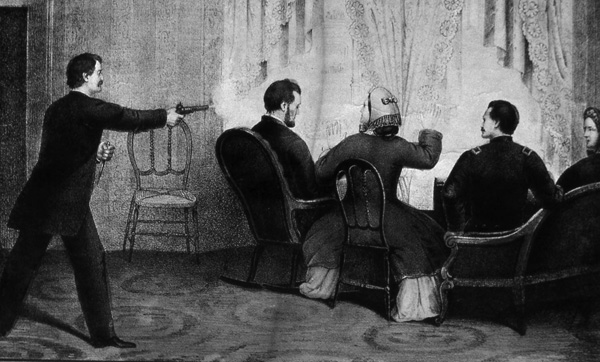
Depiction of Lincoln's assassination

Less than week after Robert E. Lee surrendered to Ulysses S Grant at Appomattox, President Abraham Lincoln was shot at Ford Theatre in Washington, D.C., and died at 7 a.m. the next morning. He and his wife Mary Todd Lincoln had been watching the play Our American Cousin, a lighthearted farce about an American rube visiting his aristocratic English relatives. 

The Civil War was not yet over, but the end was near. As the news of the assassination spread, jubilation in the North quickly gave way to shock and anger. In the South, the news was greeted by some with enthusiasm, but by other, more prescient people, with trepidation. Lincoln’s death would not bode well for the South.

Harold Holzer, one of the leading authorities in the United States on Lincoln and the era, considered the first-hand accounts – diaries, letters, newspaper editorials, official announcements, testimonies, affidavits, speeches, and more. (It surprises us today that the reports took weeks to reach the broad mass of people North and South). He then collected some of the best and assembled President Lincoln Assassinated!! The Firsthand Story of the Murder, Manhunt, Trial, and Mourning.

What a treasure this is. We can read the reactions and responses of people from all walks of life, North and South, to the news of the President’s murder. The first report by the Associated Press. Letters by Edwin Stanton, Secretary of War. Eyewitness accounts of what happened at the theater. Letters written to U.S. diplomats. Fanny Seward’s account of the attack on her father William Seward and her brother in their home. (The Secretary of State was recovering from a carriage accident; the neck brace he had to wear likely saved his life from the knife-wielding assailant.) Entries from John Wilkes Booth’s diary, written as the authorities closed in. 

We follow events from shortly before the attack in Ford’s Theatre, through the death and funeral procession to Springfield, Illinois, and then to how Lincoln and the assassination began in live in American memory. 

Harold Holzer

As the attack on Seward makes clear, the assassination was indeed a conspiracy. The idea was to kill leading figures in the federal government, throwing the government into chaos and gaining revenge for the South. Ulysses Grant and his wife Julia were supposed to have joined the Lincolns in the box at Ford’s theatre, but Grant knew full well that his wife and Mary Lincoln did not get along; Grant found an excuse to be absent. Booth was eventually found and shot; four others were convicted, including Mary Surratt, the first woman to be executed by the federal government.

Holzer has written, edited, or co-authored more than 40 books on Lincoln, the Civil War era, and related subjects. From 2010 to 2016, he served as chairman of the Lincoln Bicentennial Foundation, having previously co-chaired the U.S. Abraham Lincoln Bicentennial Commission. He received the National Humanities Medal in 2008. He is currently the chairman of The Lincoln Forum.

President Lincoln Assassinated!! is an excellent collection of first-hand accounts of Lincoln’s death and the aftermath. It provides the opportunity to go behind the historical summaries and see the emotion, the horror, and the shock expressed by Americans when they first heard the news, and what they saw and experienced first-hand. 

Top illustration: A depiction of the shooting at Ford’s Theatre.

“The Civil War: The First Year by Those Who Lived It”

June 28, 2023 By Glynn Young 1 Comment

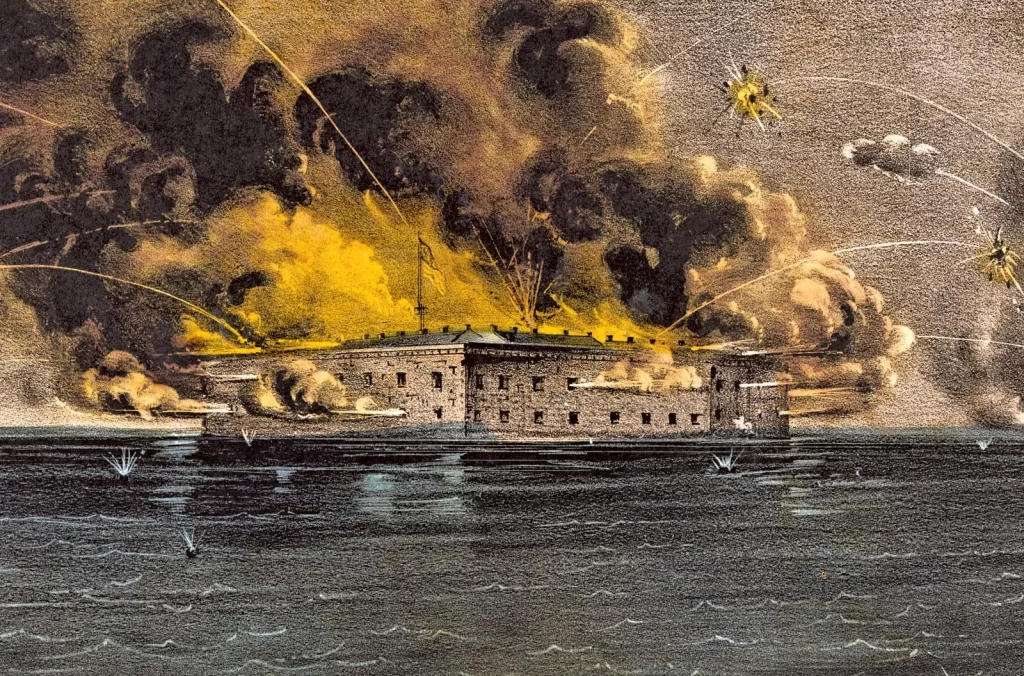
The refusal of Fort Sumter to surrender and the subsequent shelling by South Carolinian authorities might have been the immediate cause of the American Civil War, but it had been a long time coming. In retrospect, the Missouri Compromise of 1820, the Mexican War of the mid 1840s, which opened up vast new tracts of land for settlement; the Compromise of 1850; the Kansas-Nebraska Act; the Dred Scott decision in 1857; and John Brown’s Raid in 1859 all edged, pushed, or shoved the nation towards an internal military war. The spark that lit the fuse was the election of Abraham Lincoln in November 1860, followed by the secession of several Southern states. 

Documentation abounds. Few things occupied American minds in the 19th century like slavery. And Americans expressed their thoughts and deeds in diaries, letters, journals, newspapers, speeches, laws, and court decisions. Under the auspices of The Library of America, that documentation has been curated and published in four volumes collectively called The Civil War, edited by Brooks Simpson, Stephen Sears, and Aaron Sheehan-Dean. Each volume is devoted to a specific year; volume 1 is The Civil War: The First Year by Those Who Lived It. 

The curated collection begins with an editorial in the Charleston (SC) Mercury on Nov. 3, 1860, asking what shall the South Carolina legislature do. It ends with a letter by Edwin Stanton, who became Lincoln’s Secretary of War, on Jan. 24, 1862, bluntly stating “This (federal) army has got to fight.”

In between are the thoughts, beliefs, hopes, and fears by Americans on both sides of the conflict, from Abraham Lincoln and Jefferson Davis, officers and soldiers in the field writing to each other and loved ones, to civilians back home, writing in letters and diaries. You read the responses to the Battle of Bull Run (Manassas), which was almost a Confederate defeat until it turned into a rout of the Union army, with soldiers fleeing back to Washington and fear gripping the federal capitol. You also read how, from the start, the Union army was grappling with the “contraband question,” which was what to do about slaves who had escaped to the Union armies. It was a question that dogged the federals all through the war. And you read the stirring writing of Frederick Douglass, during from the beginning that it be made a war over slavery: Lincoln initially focused on the idea of preserving the Union.

You see the strategic and tactical thoughts on people’s minds, and you see them dealing with the ordinary and mundane things of life. The reader has the benefit of hindsight; we know how this will end. But the people at the time did not, and both sides were determined to prevail. 

Brooks Simpson is an author and Foundation Professor of History at Arizona State University. Stephen sears has published a biography of George McClellan and several individual battle histories. Aaron Sheehan-Dean is the Fred Frey Professor of History at Louisiana State University and the author of two Civil War histories.

The Civil War: The First Year by Those Who Lived It provides a considerable number of source documents for the first year of the war. It allows you to consider what people were thinking, believing, and experiencing. It’s an eye-opening and, at times, poignant read. 

Top illustration: An artist’s drawing of the shelling of Fort Sumter.

“Recollections of a Confederate Staff Officer” by G. Moxley Sorrell

June 21, 2023 By Glynn Young Leave a Comment

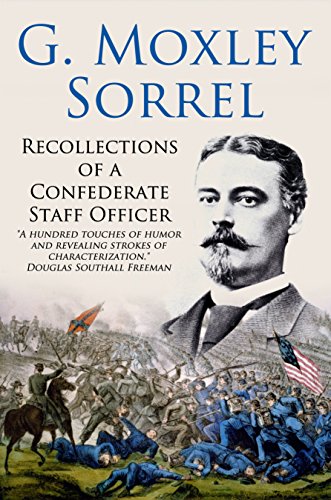
This memoir of the Civil War, Recollections of a Confederate Staff Officer by G. Moxley Sorrell (1838-1901), was a genuine pleasure to read. Published some 35 years after the war ended, it is not a typical military memoir. Sorrel himself says as much at the beginning; he leaves the discussion of most military strategy and tactics to others. But he occupied a significant position. For much of the war, he was the chief of staff for Brigadier General James Longstreet.

G. Mosley Sorrell

He was part of numerous battles in the eastern theater of the war: both battles of Bull Run (Manassas), Seven Pines, Sharpsburg (Antietam), Fredericksburg, Gettysburg, Chickamauga, the eastern Tennessee campaign, the Wilderness, Spotsylvania, and Petersburg. A considerable amount of his work was administrative and operational, but he did have horses shot from underneath him and was wounded himself. 

It’s Sorrell’s style of writing that’s so engaging. He’s almost courtly. He’s always gracious, even when he’s critical (he didn’t think much of Union General George McClellan). It’s a personal style associated with the manners of the Old South; I can recall relatives from my own and my wife’s family who manifested a similar demeanor. Sorrell fully manifests it.

Recollections of a Confederate Staff Officer may be short on the Civil War’s strategy and tactics, but Sorrell had a perceptive eye toward the personalities of the conflict and what played an increasingly important role – the shortage of soldiers for the Confederate army. 

Some Related Readings

Commanding the Regiment: William Sperry’s Creative Cannoneering – Edward Alexander at Emerging Civil War.

Righting the Longstreet Record at Gettysburg: Six Matters of Controversy and Confusion by Cory Pfarr – Booknotes at Civil War Books and Authors.

From Manassas to Appomattox: Memoirs of the Civil War in America by James Longstreet.

“My Dearest Julia” by Ulysses S. Grant

June 7, 2023 By Glynn Young Leave a Comment

A favorite place to visit in St. Louis is Whitehaven, the home of Ulysses S. Grant (1822-1885) and his wife Julia Dent Grant (1826-1902). It’s operated by the National Park Service in near southwest St. Louis County. It sits across a road from Grant’s Farm, for decades the country estate of the Augustus Busch family (they of Anheuser-Busch fame). Today, Grant’s Farm is a popular attraction for families, with a petting zoo, views of the Clydesdale horses (in stables and adjacent pastures), and even a train that travels around the property. My regular biking trail, named Grant’s Trail, runs right alongside the pastures, the farm parking lot, and Whitehaven. 

Hardscrabble Farm, which Grant operated as a farmer for a short period, is on the Grant’s Farm property, including the log cabin farmhouse. The Dent family had owned about 800 acres in the area and farmed it with the help of slaves. Grant’s Ohio family was not happy at all with their son marrying into a slave owning family in a slave state.

Grant had met Julia Dent while stationed at Jefferson Barracks, in St. Louis County on the Mississippi River and due south of the city of St. Louis. He’d met her through her brother, and he was apparently smitten early on. Because of the many changes in his military assignments (Louisiana, Texas, Mexico, Michigan, the Pacific Northwest, and California), they were often separated, both before and after their marriage in 1848. And then came the Civil War years.

They did what most people did in similar circumstances; they wrote letters. Julia’s letters have not survived, but a considerable number of Grant’s have. Some 85 of them have been assembled into My Dearest Julia: The Wartime Letters of Ulysses S. Grant to His Wife. This edition includes an informative introduction by Grant biographer Ron Chernow. 

When we read a biography or a history, we usually don’t get the fully emotional side of the story. You usually have a better opportunity with letters. This is the case with My Dearest Julia. The cigar-smoking, often-ruthless general was deeply in love with his wife. The letters make clear his deep regard, as well as his sense of partnership with her in the marriage. He knew she was a capable woman, and he often entrusted her with legal proceedings and other duties, knowing she would carry them out fully, faithfully, and competently. 

Not surprisingly, the letters get shorter during the Civil War. The demands on his time and attention would have been enormous, but he always found the time to send sometimes brief and occasionally longer letters. 

The volume includes one non-military letter – the last one he wrote in 1885. Dying from throat cancer, he was finishing his memoirs for publication of Mark Twain. He was determined that Julia would be provided for; their fortune had been wiped out in bad investments. Finish them he did, and he died a few days later: 

“With these few inunctions, and the Knowledge I have of your love and affections, and of the dutiful affection of all our children, I bid you a final farewell until we meet in another, and I trust better, world.” Signed U.S. Grant.

Related:

The Missouri Civil War Museum. 

  • « Go to Previous Page
  • Page 1
  • Interim pages omitted …
  • Page 8
  • Page 9
  • Page 10
  • Page 11
  • Page 12
  • Interim pages omitted …
  • Page 14
  • Go to Next Page »

Footer

GY


Meet the Man

An award-winning speechwriter and communications professional, Glynn Young is the author of three novels and the non-fiction book Poetry at Work.


 01_facebook 02_twitter 26_googleplus 07_GG Talk

Copyright © 2026 Glynn Young · Site by The Willingham Enterprise · Log in | Managed by Fistbump Media LLC