• Skip to primary navigation
  • Skip to main content
  • Skip to footer

Dancing Priest

Author and Novelist Glynn Young

  • HOME
  • BLOG
  • BOOKS
    • Brookhaven
    • Dancing Prince
    • Dancing Prophet
    • Dancing Priest
    • A Light Shining
    • Dancing King
    • Poetry at Work
  • ABOUT
  • CONTACT

Blog

Dancing King Stories: The Tower of London

April 30, 2018 By Glynn Young 1 Comment

Tower of London

For almost a millennium, the Tower of London has stood watch over the city, a symbol of William the Conqueror who built it. Few buildings evoke such a mixture of emotions, The Tower has served as royal residence, prison, armory, mint, torture chamber, and even a menagerie of exotic animals presented to British monarchs.

In 2014, to mark the 100thanniversary of the start of World War I, the Tower was host to one of the most remarkable art installations ever – the planting of ceramic poppies in the moat, one for each casualty of the warm until almost 900,000 had been placed by that November.

Tower of London poppies
The ceramic poppies int he Tower of London moat in 2014.

From the time of William I to Charles II in 1660, the Tower served another purpose – the start of the coronation procession for each British monarch. Charles II was the last; his brother James II, something of a closet Catholic, was supposedly crowned privately in a Catholic ceremony and then proceeded from Whitehall Palace to Westminster Abbey for the “protestant coronation.” No monarch after that did the Tower to Westminster procession.

In my novel Dancing King, Michael and Sarah Kent-Hughes return to the earlier tradition, with a procession starting from the Tower and ending at Westminster Abbey. It’s a considerably longer route than what the real British monarchs do today, riding from Buckingham Palace to the Abbey.

Right as the procession begins, Sarah asks about how the street names will change. And they do – Tower Hill, Great Tower Street, Eastcheap, Cannon Street, St. Paul’s Churchyard, Ludgate Hill, Fleet Street, and the Strand are essentially the same thoroughfare. The change in names is a kind of record of a lot of London history.

Michael reminds Sarah of what they’re returning to the earlier tradition of leaving from the Tower, and he cites two reasons.

First, the longer route affords many more people to see the king and queen in the procession. The route stretches from the Tower, through the City of London (the business district), past St. Paul’s Cathedral and then Fleet Street, past the Royal Courts of Justice, then the Strand, just skirting London’s theatre district. It continues on the Strand past Charing Cross Station to Trafalgar Square, down Whitehall to the Parliament building, and then a short turn to Westminster Abbey.

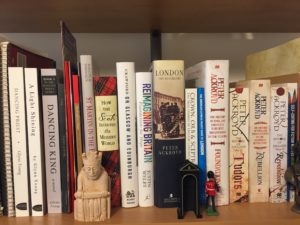
Dancing KingMany a time have my wife and I ridden the iconic double-decker bus along that route.

Second, Michael explains that proceeding through the business district, the theatre district, and the center of legal practice shows that the Crown recognizes the importance of these industries and professions – business, banking, law, and the theatre – to British national life. The coronation of a new king isn’t only about a new monarch; it’s a celebration of what matters and what’s important to the British nation. It’s about history and tradition, yes, but it’s also about the future.

It’s never explicitly stated, but Michael Kent-Hughes is beginning the process of becoming the “People’s King.”

Top photograph: The Tower of London as seen from the Thames River, with the White Tower in the center. Photo courtesy of Wikimedia.

I Know My Platform Holds at Least 2 or 3 People

April 27, 2018 By Glynn Young 2 Comments

Platform

The year 2013 was not the easiest for me or my family.

My mother had to be moved from her home of 58 years to a retirement home, which meant the “breaking up” of her house and the breaking up of where her three sons had spent most of their formative years.

Work, normally a state a barely controlled chaos, dropped the “barely controlled” and went through severe regime change and was rather suddenly “under new management.” Work demands on my time escalated, and sharply.

Poetry at WorkI was trying to get a book manuscript completed (what was eventually published as Poetry at Work) and I know I was driving the editor frantic (on a good day) and off the cliff (on a bad day) as we struggled, or I struggled, to get it done. I was also trying to promote my second novel, A Light Shining, published right at the end of 2012. That was three books published in two years.

I wasn’t thinking a lot about marketing and promotion.

I don’t have a household name. I don’t have three million people following me on Twitter, or hundreds of thousands of likes on Facebook or Google+. I’m not on the public speaking circuit.

To use the word that is the Holy Grail of agents and publishers everywhere, I don’t have a platform. Or if I do, my platform is barely big enough to hold me and two or three friends.

Publishers like authors with a pre-existing platform – it helps guarantee sales, and publishers like to make money. That’s how they stay in business. It makes perfectly good business sense for a publisher to contract with, say, Justin Bieber, rather than a more literary author. (It also provides an interesting commentary on the state of American culture, but that’s another story.)

For an author, it’s only marginally easier if you write non-fiction rather than fiction. Self-help has been a major publishing category for much of the last 100 years. If you have a method or a formula that will seemingly help lots of people do something they want to do – get hired, lose weight, deal with difficult relatives, conquer depression – then you have a pre-existing platform and audience. And the publisher may help you find it.

A Light ShiningBut you, the author, have to work at it. I know the writer’s mantra – “I’m a writer not a marketer” and “I’m an introvert not a gifted public speaker” (been there, done that) – but the fact is that self-promotion of what you write isn’t a luxury. Even the best and biggest publishers won’t do that for you, unless your name is Jan Karon, Max Lucado or Karen Kingsbury in Christian publishing or Stephen King and James Patterson in general publishing.

So, what about the rest of us?

In On Being a Writer: 12 Simple Habits for a Writing Life That Lasts, Ann Kroeker (co-author with Charity Craig) has something simple yet profound to say about this, and based on her own experience: “Promotion and marketing – whether speaking, radio interviews, social media interaction – are best positioned as an extension of the original book (or story or poem) a writer felt compelled to write down and submit for broader distribution.”

In other words, the promotion and marketing you do for your writing is simply an extension of the story you’ve already written.

I stumbled partially (and rather marginally) into this with A Light Shining. To help promote the book, I interviewed the two lead characters as if they were real people (and for me, they had indeed become real people). While this didn’t result in a massive increase in sales (in fact, I’m not sure if it increased sales at all), it’s this kind of approach – understanding that your story doesn’t stop at the end of the book – that will lead you in the direction of creating and building a “platform.”

And this, too: your reading audience isn’t going to magically find you. You have to find the audience.

Unfortunately, that takes work, work that isn’t strictly writing. Seeing is as an extension of your writing, part of the same creative process, will help.

Photograph by Paola Chaaya via Unsplash. Used with permission.

Dancing King Stories: The Victoria Memorial

April 23, 2018 By Glynn Young 1 Comment

Victoria Memorial

Queen Victoria died in 1901, after the longest reign by any British monarch (a record broken only by Queen Elizabeth II). To honor her memory, a memorial was designed that same year. The central monument – what most tourists think of as the Victoria Memorial– was constructed between 1906 and 1911. The memorial was not completed until 1924.

The entire semi-circular design as constructed in front of Buckingham Palace includes the Dominion Gates (the Canada Gate, the Australia Gate, and the South and West Africa Gates); the Memorial Gardens; and the central monument, built of 2,300 tons of Carrara marble and comprised of the monument atop a staired terrace.

Victoria Memorial unveiling
The unveiling ceremony in 1911.

Many a time have I walked around those gardens and not realized they’re part of the overall Victoria Memorial. They’re planted on a seasonal basis, with summer plantings including scarlet geraniums (to match the color of the uniforms of the Queen’s Guard), spider plants, salvias, and weeping figs. Winter plantings (for spring flowering) include yellow wallflowers and red tulips – some 50,000 of them.

The memorial plan required some rerouting of the streets in front of the palace and the shortening of The Mall. Thomas Brockwas chosen to be the designer. Funding was appropriated by Parliament and Dominion nations like Canada, Australia, New Zealand, and others contributed. In 1911, Mr. Brock was knighted for his service on the memorial.

Victoria Memorial London
The author standing by the monument.

During the unveiling ceremony that year, the two senior grandsons and their families attended – King George V of Britain and Kaiser Wilhelm II of Germany. Winston Churchill was Home Secretary at the time and had the duty of carrying the speeches to be given (as opposed to giving one himself).

This is the area where crowds gather for significant events in the life of Britain – the ending of World War II in Europe, coronations, royal weddings, and the Golden and Diamond Jubilees of Queen Elizabeth. This was also the area where the 2012 parade of the British Olympic and Paralympic teams ended, following a route through the City of London, the Strand and Trafalgar Square, and The Mall. (My wife and I watched the parade on the Strand across the street from Charing Cross Station.)

The memorial area has also seen its fair share of protests, including the Million Mask March in November 2013 when the Memorial area was damaged.

View of the palace
Looking from the Victoria Monument to Buckingham Palace.

In Dancing King, the Victoria Memorial area is the setting for a critical scene, perhaps thepivotal scene of the novel. The memorial was chosen for the scene because of all the royal connections. Michael Kent-Hughes meets with protesters inside the palace, while crowds gather in front and watch the televised meeting on mobile phones and tablets. Michael doesn’t bend an inch in regard to the protesters’ demands, and his polite but firm statements are met with cheers and roars from the crowd in front.

When the meeting ends, Michael tells his security people that, while he knows the risks, he’s going outside the palace to “meet with my people.” From that point on, the story – Michael’s story and Britain’s story – changes.

Just how much it changes will be seen in book four (in process) and book five (planned).

Top photograph: a panoramic view of the gardens, monument, and Buckingham Palace.

On the Power of Noticing

April 20, 2018 By Glynn Young 2 Comments

On the power of noticing

One very vivid memory I have from when I was five years old is from kindergarten. During recess in the front yard of the church which sponsored our kindergarten, a little girl and I ran around in our sock feet. We had taken off our shoes for some reason. When it was time to go in, she slipped her shoes on and ran inside. And I stared at my shoes. The laces were untied, and I didn’t know how to retie them.

Her name was Joy. My name felt more like terrified. We weren’t supposed to remove our shoes, even in the classroom.

How do I remember this? I don’t know, but I know it’s important for writing.

In On Being a Writer: 12 Simple Habits for a Writing Life That Lasts, Ann Kroeker (co-author with Charity Craig) gives some advice courtesy of another writer, Dorothea Braude, in how to engage memory: “Set aside a short period each day: when you will, by taking thought, recapture a childlike ‘innocence of eye,’ the state of wide-eyed interest you have when you were five years old.”

Ann, like the rest of us on the planet, has to do more than simply sitting and thinking to recapture that “innocence of eye.” She has to write her thoughts and observations down, using whatever is closest at hand – a journal, a Word document, phone or tablet apps, or whatever else is handy (I’ve been known to write thoughts on grocery lists).

I carry a journal with me just about everywhere I go, including business meetings, church worship services, and sometimes even the gym. In the one I’m carrying now (its predecessors safely stored on a bookshelf above my computer), you might find rough drafts of poems, quotes (like the one by Dorothea Braude cited above), my notes from a poetry reading with Billy Collins, sermon notes, and odd facts like “During August 1914, the Times of London received more than 100 poetry submissions about the war every day.”

When my wife and I went to Amsterdam and Paris for a belated 25th wedding anniversary trip, I carried a travel journal with me, dutifully recording each day where we went, what we saw, where we ate, and what we bought. It was not only helpful for correcting faulty memories later, it was also useful for helping to keep track of expenses and anything that might have to be declared for Customs.

I did the same thing these past six years for our trips to England. Except these travel journals are slightly different. In addition to places visited and places we ate, they also include drafts of poems written while on a train to Oxford, notations from ads on the tube in London, a few comments about Salisbury Cathedral, observations from a walk in St. James Park, street names and directions for my Dancing Priestnovels, and any number of things I noticed and didn’t want to forget.

Traveling is helpful for writing because you’re seeing the unfamiliar and the new. You’re looking at something with new eyes – those “eyes of innocence.” I’ve actually written the first draft of a novel because I looked at something familiar – an old apartment complex – with a completely new eye.

Like I said, I don’t know how this works, but for writers, it’s critical.

Photograph by Peter Hershey via Unsplash. Used with permission.

Dancing King Stories: Christmas in Edinburgh

April 16, 2018 By Glynn Young Leave a Comment

An Cala

In my novel Dancing King, Michael and Sarah Kent-Hughes have something of a break from London, when they go to Scotland for Christmas (with a slight interruption with Michael’s sermon at Southwark Cathedralin London). It’s a relatively short part in the narrative, but two important things happen.

University of Edinburgh
The University of Edinburgh

First, Michael has a conversation in the stable with his guardian father, Ian McLaren. Ian and his wife Iris were surprised – shocked is a better word – to discover they become the guardians of a six-year-old boy. Childless themselves, they raised him as their own child, and he still calls them “Ma and Da.” And Michael gets his degree from the University of Edinburgh, which is where he meets American exchange students and twins David and Sarah Hughes in the first novel in the series, Dancing Priest.

McLarens barn
This is a converted barn (now a vacation home) but is the idea for the McLaren stable

Their home, known to the family simply as McLarens, is some 40 miles from the center of Edinburgh, positioned in a somewhat rural area that’s hilly (as a boy and teenager, Michael does considerable mountain biking on the property). Although born in southern England, Michael considers Scotland and Edinburgh as “home.”

Edinburgh is on the eastern side of Scotland. The inspiration for McLarens is actually on the western side. The address for the home and rather famous gardens of An Calais the “Isle of Seil, Argyll, and Bute,” near the village of Ellenabeich. The gardens were first established in 1930, and it took considerable renovation and blasting of the terrain to plant them. Then, as now, the gardens feature azaleas, rhododendrons, and roses.

Jenners
Jenners Department Store in Edinburgh

For the Dancing Priest novels, I “borrowed” the house and gardens, moved them to east side of Scotland near Edinburgh, and expanded the size of the property. I created a barn / stable for equine veterinarian Ian, and it’s there in Dancing Kingthat he and Michael have a long talk on the morning of Christmas Eve. The scene is meant to show the closeness and tenderness in their relationship and even add a bit of humor. It was not in the first draft of the manuscript but came during the editing process; it was one of those ideas that suddenly began to spill from my head on to the page in front of me. And it turned into one of my favorite scenes in the book.

Jenners Grand Hall
Jenners Grand Hall

That afternoon, Ian leads Michael, his adopted sons Jason and Jim, the baby Hank, Sarah’s brother David and his son Gavin, and Michael’s best friend Tommy MacFarland on the annual McLaren Men Last-Minute Christmas Eve Shopping Expedition to downtown Edinburgh. Their first stop is Jenners Department Store.

Jenners, often called the “Harrod’s of the North,” was the largest independent department store in the U.K. until 2005, when it was bought by House of Fraser. It’s a beautiful, and old, store, with that classic Victorian architecture and a spectacular grand hall. And it’s there that Michael’s friends and family learn firsthand how life has changed for Michael and his boys. They’re recognized as soon as they step through the doors, and Michael feels the obligation to speak to the growing crowd.

What the Scotland scenes show is that Michael Kent-Hughes has the continuity of a loving family and the press of new and demanding obligations.

Top photograph: the home at An Cala Gardens. Photograph of the exterior of Jenners is by Stuart Caieand the interior by Christian Bickel, both via Wikimedia.

Writing: The Right Reason

April 13, 2018 By Glynn Young Leave a Comment

Writing The Right Reason

I was at a writer’s conference, carrying with me my selection of a work in progress like hundreds of others, scheduled for a meeting with both an editor and an agent. Like most of the people there, when not in a general session or a seminar, I spent a lot of time milling about, looking at the writers’ books for sale, talking to a few people, trying to understand what I was even doing there.

At one of the luncheons, a woman sat next to me, her arms full of books, papers, notebooks, purse, briefcase, and water bottle. She smiled expansively at the rest of us at the table and announced, “I am a writer.” Loudly. Loud enough so that the people at the next table turned their heads.

She went on to tell us, knowing we were all phenomenally interested, that she was in her positive affirmation mode. Declaring herself to be a writer meant, as night followed day, that she was one. And she went on to explain what that meant.

“One day,” she said, “I will be on that dais, getting ready to make the luncheon address. I will be signing books during the meet-the-authors sessions. My books will be on the best-seller lists. I will be mobbed by people asking for advice and the name of my agent, and manuscripts thrust in my face to read.” She smiled. “I will not just be a writer; I will be an author” (emphasis in the original). She looked around, a smug smile on her face. “And each of you knows that’s what you want, too.”

The rest of us at the table suddenly discovered reasons why we had to be somewhere else. And if we had to choose between two good seminars scheduled at the same time, the decision would be easy once we saw which one she had chosen.

What struck me about her words wasn’t her brazenness. It was that she didn’t want to become a writer, not really. What she instead wanted was the experience of becoming a writer. The difference was, and is, huge. One implies work; the other implies adulation. One implies a love for others; the other implies a love for self.

In  Forgotten God: The Tragic Neglect of the Holy Spirit, Francis Chan asks a rather pointed question about Christians’ desire to be “filled with the Spirit.” And that question is, “Do I want to lead or be led by the Spirit?”

It’s not unlike “do I want to write or have the experience of being a writer?”

Chan asks the question rather bluntly because there’s no dancing around it; this isn’t the time to be polite. Your faith is either all about you, or it’s not. How you live your faith is either all about you, or it’s not. How you pray is either all about you, or it’s not.

Do I want to lead or be led by the Spirit?

That question requires a deep pondering, a prayerful searching of the soul. The answer isn’t as automatic as we like to think it is, or hope it is.

Because if there’s one thing that’s true about the Christian faith, it’s that it’s not about the person holding that faith. It never was and it never will be. To be a Christian is to be other-directed, in the same way Jesus was other-directed. For him, and for many of us over the centuries, it meant being other-directed to the death.

Jesus didn’t die to save himself.

That’s why Francis Chan asks that question about the Spirit.

Do I want to lead or be led by the Spirit?

Photograph by Aaron Burden via Unsplash. Used with permission.

  • « Go to Previous Page
  • Page 1
  • Interim pages omitted …
  • Page 58
  • Page 59
  • Page 60
  • Page 61
  • Page 62
  • Interim pages omitted …
  • Page 66
  • Go to Next Page »

Footer

GY


Meet the Man

An award-winning speechwriter and communications professional, Glynn Young is the author of six novels and the non-fiction book Poetry at Work.


 01_facebook 02_twitter 26_googleplus 07_GG Talk

Copyright © 2026 Glynn Young · Site by The Willingham Enterprise · Log in | Managed by Fistbump Media LLC