• Skip to primary navigation
  • Skip to main content
  • Skip to footer

Dancing Priest

Author and Novelist Glynn Young

  • HOME
  • BLOG
  • BOOKS
    • Brookhaven
    • Dancing Prince
    • Dancing Prophet
    • Dancing Priest
    • A Light Shining
    • Dancing King
    • Poetry at Work
  • ABOUT
  • CONTACT

Poetry at Work

Poetry at Work, Chapter 10: The Poetry of Beauty on the Workplace

March 18, 2019 By Glynn Young Leave a Comment

The worst view I ever had from my assigned office at work was of the building’s designated smoking area. I had the most coveted type of office – a closed-door office, with a window. Except the window faced the smoking area outside the building, with its awning-like protection and clouds of smoke.

The best view I ever had from my assigned office at work was that same office – after smoking was banned entirely from the campus. No more plastic awning. No more clouds of smoke. Just an uninterrupted view of nearby woods.

If someone asked you to describe beauty at your workplace, you would likely think of architectural structures, window views, fountains, waterways, or woods. You might think of people, but today’s cultural and work environments require that great care be taken when talking about people. 

To continue reading, please see my post today at Literary Life.

Poetry at Work, Chapter 9: The Poet in the Culture of Control

March 12, 2019 By Glynn Young Leave a Comment

Poetry at Work Poetry of the Workspace

For most of the 20thcentury, the structure of corporations was based on the technology of mass production. It was a command-and-control model, with managers directing workers, who had a very specific task to accomplish. It was not unlike the military.

In the 1970s, that structure began to break down. It was almost odd – an organizational model that had survived two world wars and the Great Depression was breaking down for what appeared to be smaller factors. Inflation raged almost out control (I remember a prime lending rate of 21 percent); oil embargoes were turning major industries like petroleum refining, chemical manufacturing, and automobiles on their heads. National psychological blows happened as well, contributing to the disruptive environment – the Watergate crisis, the end of the Vietnam War, and the Iranian revolution that led to Americans being held hostage for more than a year. The reckoning started in the 1980s, as company after company reorganized (over and over again), laid people off (over and over again), and often went out of business altogether. At the end of the 1980s, Tim Berners-Lee invented what would become the worldwide web.

It was an unsettled time to work for a large company.

To continue reading, please see my post at Literary Life.

Poetry at Work, Chapter 8: The Poetry of the Organization Chart

March 4, 2019 By Glynn Young Leave a Comment

Poetry at Work Poetry of the Workspace

I was sitting with a woman in the Human Resources Department. There had been a reorganization of our department, part of a general reshuffling across the company, and I’d been assigned to sit with her to work out the new organization chart. 

You would think this was something of a useless exercise. Shouldn’t it be a simple matter of “here’s the boss, here are his or her direct reports, and here’s who reports to them.” But it was anything but simple, and I was to get a lesson in the Byzantine art form of corporate organization charts.

First, she pointed out, not all of the boss direct reports had the same title. Some were directors; some were managers. Next, there were directors and there were directors – a title wasn’t necessarily indicative of grade level, and grade level was everything. The chart had to indicate that by a subtle positioning of the boxes, with some slightly more elevated than the others. The same thing applied to the managers. Then there was the problem of some managers have more people reporting to them than directors did. 

To continue reading, please see my post today at Literary Life.
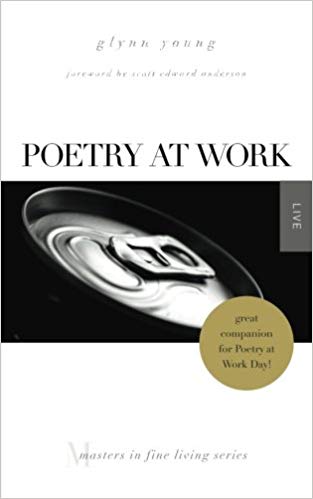
Poetry at Work, Chapter 6: The Poetry of the Organization Chart

February 18, 2019 By Glynn Young Leave a Comment

Poetry at Work

I was sitting with a woman in the Human Resources Department. There had been a reorganization of our department, part of a general reshuffling across the company, and I’d been assigned to sit with her to work out the new organization chart. 

You would think this was something of a useless exercise. Shouldn’t it be a simple matter of “here’s the boss, here are his or her direct reports, and here’s who reports to them.” But it was anything but simple, and I was to get a lesson in the Byzantine art form of corporate organization charts.

To continue reading, please see my post today at Literary Life.

Poetry at Work, Chapter 5: Poetry of the Boss

February 11, 2019 By Glynn Young Leave a Comment

Poetry at Work

More than 40 years, I was handed my college diploma and, two days later, showed up for work at my first official job. I didn’t realize it until much later, but I walked into the doors of my employer that day carrying an assumption. I believed that people in positions of authority – bosses – always knew what they were doing. Why else would they be bosses?

Slightly more than a decade later, my assumption continuing to take body blow after body blow, I was presented incontrovertible evidence that my assumption had been flat-out wrong.

A group of us were sitting in a conference room, waiting for the news to go public that one of the company’s top products had a problem. The first indication would be the stock market. We all knew the news was imminent, and we had prepared for it as if a tsunami was about to strike, which, metaphorically, turned out to be true. The call came, confirming that the news was public, and for a very brief moment we experienced a silence.

To continue reading, please see my post today at Literary Life.

Poetry at Work, Chapter 3: The Poetry of the Workspace

January 28, 2019 By Glynn Young Leave a Comment

Poetry at Work Poetry of the Workspace

My first workspace after college graduation was a newspaper copydesk.

I’d been hired as a copy editor at the Beaumont, Texas, Enterprise. The title was grander than the reality of the entry-level job; I was one of four copy editors, and my workspace was a desk pushed against seven other desks to form a squat “H.” We were collaborative and team-based about three decades before it became corporate cool. 

It was a perfectly comfortable space for me. My last semester before graduation, I had worked in exactly the same kind of space for the college newspaper. The space in college and the space at Enterpriserequired learned deafness; you learned to blot out a lot of sounds – reporters talking with editors; wire service machines; the whirr of pre-fax telephone transmissions; people from page paste-up coming to an editor to trim a story; the sports department on the other side of a wall that was not floor-to-ceiling; and the nearby receptionist who enthusiastically (loudly) greeted visitors, told jokes, and handled incoming telephone calls.

To continue reading, please see my post today at Literary Life.

  • « Go to Previous Page
  • Page 1
  • Page 2
  • Page 3
  • Page 4
  • Page 5
  • Go to Next Page »

Footer

GY


Meet the Man

An award-winning speechwriter and communications professional, Glynn Young is the author of three novels and the non-fiction book Poetry at Work.


 01_facebook 02_twitter 26_googleplus 07_GG Talk

Copyright © 2026 Glynn Young · Site by The Willingham Enterprise · Log in | Managed by Fistbump Media LLC