• Skip to primary navigation
  • Skip to main content
  • Skip to footer

Dancing Priest

Author and Novelist Glynn Young

  • HOME
  • BLOG
  • BOOKS
    • Brookhaven
    • Dancing Prince
    • Dancing Prophet
    • Dancing Priest
    • A Light Shining
    • Dancing King
    • Poetry at Work
  • ABOUT
  • CONTACT

literary criticism

A Reflection on “Winesburg, Ohio”

April 26, 2023 By Glynn Young Leave a Comment

I’ve always been attracted to the works of the American Realist and Modernism periods. In fiction, that meant Willa Cather, Edith Wharton, Jack London, and Theodore Dreiser, and moving into Ernest Hemingway, F. Scott Fitzgerald, and William Faulkner, among others. In poetry, that meant Edgar Lee Masters, Sara Teadsale, Vachel Lindsay, and T.S. Eliot, among quite a few others.

This attraction likely relates to my middle school and high school English teachers, almost all of whom graduated from college in the 1940s and 1950s. They would have defined the Realist and early Modernism writers as the ones they were most influenced by, and they tended to wax eloquent on these particular writers and poets in particular. As a high school junior, taking American literature, I read Wharton’s Ethan Frome, Cather’s My Antonia, T.S. Eliot’s Four Quartets and The Waste Land, and Masters’ Spoon River Anthology. It was a challenging year for all my subjects, but what I read in English was wonderful.

Main Street, Clyde, Ohio, about 1900

What I don’t recall reading at all was anything by Sherwood Anderson (1876-1941), not even a short story. And yet Anderson, during the period itself, was considered a major figure in literature. He had a significant influence on both Hemingway and Faulkner, and especially Hemingway, who would eventually write an “anti-Anderson” novel to prove he had broken free and become his own writer.

I recently read Winesburg, Ohio and reviewed it over at Faith, Fiction, Friends. I knew little about it, other than it was a collection of connected short stories that had established Anderson as a significant writer. This edition has an introduction by the writer and literary critic Irving Howe, and it was Howe who helped me understand what had happened to Anderson and even perhaps why he was little mentioned by my English teachers.

What happened was that, in 1941, the year Anderson died, critic Lionel Trilling (1905-1975) wrote an essay that became hugely influential. It was an essay about Anderson and Winesburg, Ohio, and it dismissed the work as something less than great. Howe wrote that the Trilling essay relegated Anderson to something less than the first rank of American writers. It’s not a surprise that my teachers, in college during the period when Trilling’s essay was making its waves, might possibly have discounted Anderson in general and Winesburg, Ohio in particular and instead focused on more lauded writers.

Cabbage delivery, Clyde, Ohio

The collection was published in 1919. As I read it, I was surprised by how contemporary it sounded. It’s a clean, simple prose, very straightforward and matter of fact. It’s also almost entirely devoid of dialogue. Its ease of reading is deceptive; you have to read carefully and closely to understand all of what’s going on in the stories.

The characters are all what Anderson called “grotesques,” what Flannery O’Connor in a later generation might have labeled “misfits.” In fact, I wondered if O’Connor must have read Winesburg, Ohio, just like Anderson himself must have read Spoon River Anthology, published four years earlier than Anderson’s collection. I could see how Anderson had influenced Faulkner, and how Hemingway adopted and adapted at least some of Anderson’s bare bones writing style.

Clyde Cutlery Co., about 1897

The fictional Winesburg is loosely based on the small town of Clyde, Ohio, southeast of Toledo. The stories are all set in the late 1890s, or around the turn of the century, about the time Anderson enlisted in the army and fought in the Spanish-American War. It’s a town still experiencing the lingering effects of the American Civil War and the burgeoning influence of the Industrial Revolution. Many of the stories are about farmers and their family members, storekeepers, bankers, the newspaper reporter, and other community pillars. While the characters are generally drawn in an unflattering portrait, you do come to known them and even like them, flaws and all.

To this day, Clyde proudly proclaims itself as the Winesburg of Anderson’s stories. The author put the small town on the literary map, and the town never forgot it. I suspect the town also didn’t think much of Trilling’s assessment of its most famous son.

Top photograph: Sherwood Anderson in 1898, about the time in which Winesburg, Ohio, is set.
William’s Faulkner’s Civil War

January 11, 2023 By Glynn Young 2 Comments

If there is one writer who cast the largest shadow upon southern U.S. literature in the 20th century, it’s William Faulkner. He also cast one of the largest shadows over all American literature in the 20th century. At my university, few escaped the required courses in American literature without reading the short stories “Barn Burning” and/or “The Bear.” I’d read “Barn Burning in high school, but, taking English rather than American literature in college, I didn’t read Faulkner until years later. It was Flannery O’Connor who led me to Faulkner, and then I read nearly everything he wrote.

Michael Gorra has studied and taught Faulkner, Faulkner’s works, and literature for more than 40 years. The Mary Augusta Jordan Professor of English Language and Literature at Smith College, he’s also served as editor of the Norton Critical Editions of Faulkner’s As I Lay Dying and The Sound and the Fury. The man knows his Faulkner.

William Faulkner as a young man

And to know Faulkner, you have to know the Civil War. The war, its aftermath, the “Lost Cause,” and the memory of the war – even by those who didn’t experience it – is a major theme, perhaps the major theme, in the history and literature of the South. Gorra knows his Civil War, too, and he’s a Connecticut-born Yankee who teaches at a Yankee university in Massachusetts.

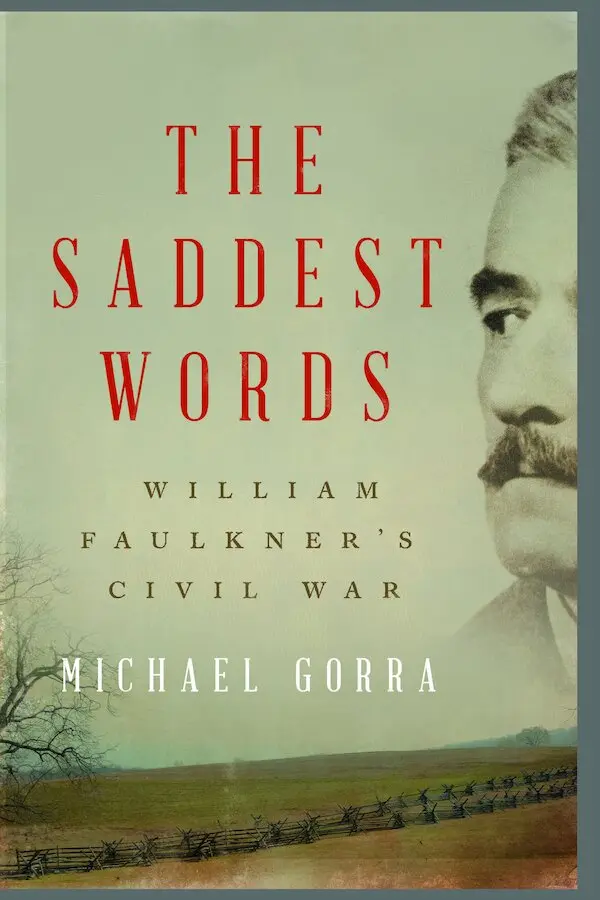
Gorra’s The Saddest Words: William Faulkner’s Civil War is a remarkable work of literary criticism. It’s about the themes of the war in Faulkner’s writings, but to understand those themes, you have to grasp the story of the war and its significant details. Gorra does that, but he does more. He’s read the letters and memoirs of people who fought and lived the war. He’s studied the major battles, especially the ones that play even a small role in Faulkner’s novels and stories. He’s walked the terrain of the war, and he’s studied how the war was fought in Faulkner’s home state of Mississippi. 

All of this permeates Faulkner’s novels and short stories. Sometimes it’s an overt influence; sometimes, it’s very subtle. Reading Faulkner years after university might have been the best thing that happened to me in understanding his works, because I recognized how much he was talking about had permeated my own family.

Michael Gorra

Literary criticism is often tedious and difficult. Gorra’s work on Faulkner here is anything but that. His writing is accessible, and he tells Civil War stories that amplify and expand upon what Faulkner did. He makes the writer understandable in a way few critics can. And he doesn’t shy away from the controversial aspects of Faulkner’s works, and there are plenty of controversial aspects.

Gorra’s published works include Portrait of a Novel: Henry James and the Making of An American Masterpiece (2012), a finalist for the Pulitzer Prize in Biography; The Bells in Their Silence: Travels through Germany (2004); After Empire: Scott, Naipaul, Rushdie (1997); and The English Novel at Mid-Century (1990). He’s also served as editor for volumes of stories by Joseph Conrad and Henry James for Penguin.  His awards and recognitions include a Guggenheim fellowship, two fellowships from the National Endowment for the Humanities, including a Public Scholar Award, and a National Book Critics Circle award for his work as a reviewer.

The Saddest Words tells a wonderful story of how one of the most important American writers used family history, family stories, and historical events to create what became some of the most significant literary works of the 20thcentury. The Civil War sits at the center of it all, much like it continues to sit at the center of American life.

Footer

GY


Meet the Man

An award-winning speechwriter and communications professional, Glynn Young is the author of six novels and the non-fiction book Poetry at Work.


 01_facebook 02_twitter 26_googleplus 07_GG Talk

Copyright © 2026 Glynn Young · Site by The Willingham Enterprise · Log in | Managed by Fistbump Media LLC