• Skip to primary navigation
  • Skip to main content
  • Skip to footer

Dancing Priest

Author and Novelist Glynn Young

  • HOME
  • BLOG
  • BOOKS
    • Brookhaven
    • Dancing Prince
    • Dancing Prophet
    • Dancing Priest
    • A Light Shining
    • Dancing King
    • Poetry at Work
  • ABOUT
  • CONTACT

childhood

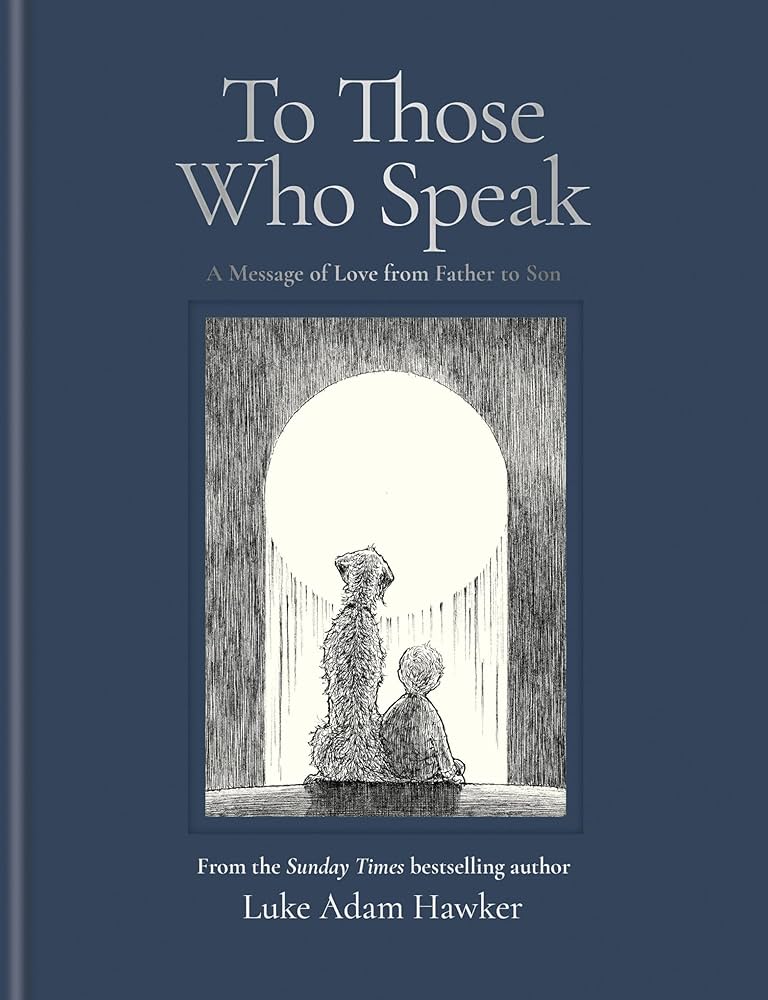
“To Those Who Speak” by Adam Luke Hawker

May 20, 2026 By Glynn Young Leave a Comment

Luke Adam Hawker is a designer who made the leap to full-time art in 2015. His background is architecture and design, and in his art, he works to connect places and people. His limited-edition prints can be found at several locations in London, including the Royal Opera House, St. Paul’s Cathedral, the Old Royal Naval College, and Battersea Power Station.

Hawker has also published three books. Together (2021) is a graphic novel that turned into a surprise bestseller. The Last Tree: A Seed of Hope (2023) is a fable about a world without trees. This year, he published To Those Who Speak, a much more personal story that’s less a story and more of a non-fictional account with quiet, profound illustrations. 

Luke Adam Hawker

The story is this, simply: Hawker and his wife had a son born with an extra X chromosome. The boy is also non-verbal. Hawker did what most parents would do – researched, read, and try to understand how he could teach his son to understand and communicate. The family had or bought a dog, and the dog attached itself to the boy. The dog and the boy seemed to understand each other without a word being exchanged. 

At some point, Hawker understood. Perhaps it wasn’t that the non-verbal boy could learn to understand words. Instead, perhaps the verbal parent could learn how to communicate to the non-verbal boy. And that’s what happened. One thing that resulted was this book, To Those Who Speak.

As Hawker says in his introduction, it is not a children’s book, but it is also not not a children’s book. Using black-and-white drawings and minimal words, the book is “an expression of gratitude” to his son for what Hawker calls an Invaluable education.

Emotion wells as you read and absorb the drawings. The boy meets the dog. They become each other’s world. The boy begins to hum. He and the dog discover the peace of wandering among trees. Hawker begins to see how much his son can say without uttering a word. The boy’s development is measured by steps, not milestones. The first unspoken but hand-shaped word. A respiratory illness (not uncommon among children with the extra X chromosome), an illness that was nearly fatal.

You don’t need many words to describe this beautiful book. You just nod and sit with it.

Sometimes Fiction Imitates Life

July 24, 2024 By Glynn Young 2 Comments

You read a book like A Place on Earth by Wendell Berry, and you’re reminded of your own family and where you came from. Characters like Burley Coulter and Uncle Jack seem to be almost lifted wholesale from what I remember of many of the “characters” I knew as a child.

My father’s family lived mostly in the Shreveport, Louisiana, area, with a much larger group in Brookhaven, Mississippi (it was my grandfather who would wander away from Brookhaven and settle first in central Louisiana, in a town called Jena. He was working as a surveyor for a railroad company, and he lived in a boarding house operated by my great-grandmother and his eventual mother-in-law. 

My father and his three sisters were all born in Jena but had moved to Shreveport by the late 1920s. Rubye was the oldest, followed by my Aunt Myrtle, my father, and my Aunt Ruth. There would have been an Aunt Elouise, born two years before my father, but she died the same year my father as born.

Each summer, from the time I was 8 to about 13, I would fly to Shreveport to spend a week with my grandmother. My grandfather had died when I was nine months old, so I never knew him. My grandmother lived across the street from my father’s oldest sister (and the family’s firstborn) and her husband. Aunt Rubye and Uncle Revis were responsible for some of my most vivid memories of Shreveport.

Both were “characters,” Aunt Rubye only slightly more staid than Uncle Revis. She was famous for her looks of disapproval and her biscuits. He wore a cowboy hat and drove a gigantic Dodge that was a faded pink and only slightly smaller than an ocean liner. My grandmother usually ate her lunch and dinner with them, which meant I did, too, when I visited. My visits usually coincided with harvesting the acre of vegetable gardens they had behind their small frame house. I learned to dig up potatoes, pick corn (and when to know it was ready), pick green peans (and help shell them; no body ate for free). 

The Lennon Sisters

Saturday evenings were devoted to watching the Lawrence Welk Show on television. I wasn’t a particular fan, but the best part was the running commentary on the individual acts from Uncle Revis. My favorite part was when the Lennon Sisters performed. You would hear my uncle begin to mutter until he couldn’t stand it any longer. He’s shout “Ignorant!” at the television set. “They’re ignorant1” My grandmother would smile, my Aunt Rubye would roll her eyes, and I’d go off into gales of laughter. I suspect that his commentary was for my benefit and amusement.

He’d let me tag along with him when he ran errands. He always seemed to have a pipe in his mouth, even when he wasn’t smoking it. We’d go tooling all over Shreveport in that big Dodge. I’d go with my grandmother when she had errands to run as well. She drove a black 1940 Ford that always, always was breaking down, usually in a part of town you didn’t want to break down in. I met the most interesting people because of that car’s problems.

Uncle Revis hated one thing even more than the Lennon Sisters. 

Cats. 

When I was about 10, I was sitting with him on the back steps after dinner. For whatever reason, we had no garden duties that might. It was one of those beautiful Southern summer evenings, still light. He was smoking his pipe, and he was talking about his favorite writers, of which James Michener was No. 1 on the list. Suddenly, he grabbed a rifle from behind us (which I didn’t know he had at hand) and fired off a shot at the fence between his yard and the neighbor’s house next door. A cat went flying in the air. 

The next-door neighbor loved cats, with at least a dozen and often more roaming around. If they stayed at the neighbor’s house, Uncle Revis would have been fine. But, as all of them were outdoor cats, they roamed the outdoors. And they seemed to know that Uncle Revis didn’t like them. All the more reason to visit.

Aunt Rubye came flying on to the back porch, shouting at my uncle. This might have been Shreveport in the 1960s, but firing a firearm inside the city limits was something only the police could do. But that wasn’t Aunt Rubye’s issue. 

What she was upset about was the reaction from the neighbors. As it turned out, they were their son’s in-laws. And they might, she said, breathing fire, think it was an insult aimed at them.

“Well,” Uncle Revis said, “they’d have to be pretty smart to figure that out. That won’t be a problem.”

Uncle Jack and Burley Coulter up in Port William, Kentucky would be proud. Yes, sometimes fiction does indeed imitate life.

Top photograph: My father and my Aunt Ruth in Jena, Louisiana, about 1923.

Footer

GY


Meet the Man

An award-winning speechwriter and communications professional, Glynn Young is the author of six novels and the non-fiction book Poetry at Work.


 01_facebook 02_twitter 26_googleplus 07_GG Talk

Copyright © 2026 Glynn Young · Site by The Willingham Enterprise · Log in | Managed by Fistbump Media LLC