• Skip to primary navigation
  • Skip to main content
  • Skip to footer

Dancing Priest

Author and Novelist Glynn Young

  • HOME
  • BLOG
  • BOOKS
    • Brookhaven
    • Dancing Prince
    • Dancing Prophet
    • Dancing Priest
    • A Light Shining
    • Dancing King
    • Poetry at Work
  • ABOUT
  • CONTACT

art

“The Prodigal of Leningrad” by Daniel Taylor

January 28, 2026 By Glynn Young Leave a Comment

I’m trying to remember when I first became interested in Russian history. Most likely, when I was 10, and one of my Christmas presents (my mother knew me) was a Horizon Caravel book entitled Russia Under the Czars. I must have read it a dozen times. And I still have it.

My senior year in high school, I discovered Aleksandr Solzhenitsyn and his One Day in the Life of Ivan Denisovich, Cancer Ward, and The First Circle. In college, I took two semesters of Russian history, and I was glad I knew more about Russia’s past than most people. The professor was a great lecturer; he was also an unapologetic defender of the Soviet regime.

In my first job as a newspaper copy, I still remember editing the front page to include the announcement about the publication of Solzhenitsyn’s The Gulag Archipelago, Part 1. It was first published in French in Paris, and that publication led to the Soviet Union expelling Solzhenitsyn from the country. As soon as the English version was announced, I placed my pre-order at the Cokesbury Bookstore in downtown Houston, Texas. I read it almost immediately, and the next two volumes that followed.

Fast forward 40 years. I had read two novels by Daniel Taylor, Death Comes for the Deconstructionist and Do We Not Bleed?. I liked them both. I was surprised when I saw the title of his upcoming new novel, The Prodigal of Leningrad. It was a decided shift from his previous works to a story about a docent at The Hermitage museum in Leningrad during the German siege of World War II. 

I knew the basic historical facts – how German and Finnish troops essentially encircled the city for nearly 900 days, with German planes bombing at will and all supplies cut off. Some 650,000 Leningraders died, many from starvation. The siege began in 1941 and lasted until 1943.

I wondered what would Daniel Taylor do with that setting. Far more than I expected, as it turns out. It may be one of the most Russian novels written by a non-Russian that I’ve read. It is a story of war and deprivation. But it is also a story about the Soviet Gulag, art, fith, and one of the most extraordinary paintings in the Hermitage – “The Return of the Prodigal” by Rembrandt.

Leningrader Daniil Aslanov works as a docent at The Hermitage. He’s an outstanding tour guide, and his favorite painting is “The Return of the Prodigal.” But all of the valuable art orks, including his beloved Rembrandt, have been removed and stored in safety, in case the Germans break through. What is left are empty frames, but Daniil can still talk about the missing paintings. He talks with his friends as well, which can be a dangerous thing in Stalin’s Russia. For at least two of them, he is in danger simply for not reporting what they talk about – criticism of the beloved ruler, the Soviet system, and anything that might be considered disloyal. Which would be anything at all.

Daniil’s story is paralleled by the story of his grandfather, whom Daniil believes is dead but is still very much alive in the Gulag. The grandfather was an Orthodox priest, and that was his crime; the Soviet regime has murdered thousands of them. But in the camps, even atheists come to appreciate this aging man who doesn’t judge, who sits with the dying, and who gives final blessings to the dwindling few who still believe. 

The siege, the mass starvation, the bombing, and the corruption of the Soviet system will lead Daniil to a particular end. Like depicted in the Rembrandt painting, the prodigal will return.

Daniel Taylor

Taylor is the author of The Skeptical Believer, Tell Me a Story, Creating a Spiritual Legacy, The Myth of Certainty and several other books. He’s contributed to Bible translations and is co-founder of The Legacy Center, created to help families and individuals find their stories, values and meaning. He’s also a contributing editor for Christianity Today’s Books and Culture Magazine. Taylor blogs at Neither/Nor: Ruminations of a Spiritual Traveler. Death Comes for the Deconstructionist won Christianity Today’s best novel award in its annual book awards and the Illumination Award for best fiction by an independent publisher.

The Prodigal of Leningrad connects art, faith, and a terrible time in Russian and human history to tell a story of how one man finds his soul. It’s a remarkable story.

Related:

My review of Death Comes for the Deconstructionist.

Do We Not Bleed? by Daniel Taylor.

Painting: The Return of the Prodigal Son by Rembrandt van Rijn, The Hermitage, St. Petersburg, Russia.

“A Month in Siena” by Hisham Matar

December 10, 2025 By Glynn Young Leave a Comment

Hisham Matar won the Pulitzer Prize for biography for The Return, the story of his search for his father, who’d been kidnapped and presumably killed by the Libyan government. His first novel, In the Country of Men, won several recognitions and awards. Virtually every book he writes wins awards, including the National Book Critics Circle Award for his novel, My Friends, in 2025.

There’s one exception, and it’s a gem of a story. 

In 2014 or 2015, Matar traveled to Siena, Italy, as something of a retreat or rest. He was still recovering from the intensity of writing The Return, not to mention the number of widespread accolades it received. Siena was meant to be a respite, and it was. He describes that respite in A Month in Siena, a non-fiction work about his own life, the churches in the town, and the artwork contained in those churches and the local museum. 

“I found something in Siena for which I am yet to have a description,” he writes, but for which I have been searching, and it came at a resonant juncture: the time between having completed a book and seeing it made public; but also at that strange meeting point of two contradictory events—the bright achievement of having finished a book and the dark maturation of the likelihood, inescapable now, that I will have to spend the rest of my days without even knowing what happened to my father, how or when he died or where his remains might be.”

His father had been a Libyan diplomat who became a dissident. The family was living in exile in Cairo when agents of the Qaffadi regime in Libya kidnapped his father, who disappeared inside Libya. 

Matar finds solace in art, and specifically, the art of the Sienese School, which flourished largely in the 13th and 14thcenturies. (The National Gallery in London hosted an exhibition this year on “Siena: The Rise of Painting.”) The writer visits churches for specific paintings and spends so much time at Siena’s art museums that museum guards come to see him as something of a fixture. He could sit for an hour or more, and it was often more, simply absorbing a particular painting. Some of the artists may be familiar, like Caravaggio; others are well known in the art world but perhaps less by the general public, like Ambrogio Lorenzetti and Michelangelo Pistoletto.

Hisham Matar

It’s a small book, about 130 pages, and it includes reproductions of the paintings Matar studied. It’s also a quiet book; Matar conveys the sense of retreat and rest he was seeking through his style, the words he uses, and the stories he tells.

In addition to his numerous literary recognitions, Matar divides his time between New York and London. He teaches literature at Barnard College, Columbia University.

A Month in Siena will likely instill a similar desire that Matar had – to walk the streets of this ancient walled city, meet its people, eat its food, and explore its churches and museums. But you especially want to sit and study its art. 

Top photograph: An aerial view of Siena by Patrick Schneider via Unsplash. Used with permission.

A Tale of Two Paintings

October 6, 2020 By Glynn Young Leave a Comment

I’ve talked about how an exhibition at the Tate Modern plays a critical role in Dancing Prince. In turn, two paintings in the exhibition play a critical role in the narrative of the novel. 

Jason Kent-Hughes, the adopted son of Michael and Sarah, is working as an assistant curator at the Tate Modern. Sarah describes him as their “San Francisco street child with a gift for painting and art administration.” After graduating from school in London, he did a year of military and then enrolled at the Slade School of Fine Art, part of University College London. After receiving his degree, he joined the Tate Modern.

As he explains to Michael, he gave a talk at the museum about the paintings done by Sarah that are in the Tate’s collection. It’s part of a regular weekly feature, he says, in which a staff member speaks about their choice of topic – something they’re working on, something in the collection, an upcoming exhibition, a research project, and so on. 

The lectures are open to the public and generally draw anywhere from 30 to 300 people, apart from the staff attending. Jason’s talk on Sarah’s paintings brings 2,000, forcing the museum to move the event to Power Hall (the Tate Modern’s huge interior space). It’s also videotaped and posted for sale on the museum’s web site, resulting in 30,000 orders during the first day. The museum suspects there’s a huge financial and artistic potential here, and it asks Jason to curate a major exhibition of Sarah’s work. Assembling the exhibition becomes his full-time job for the next 18 months.

Jason uses a journal of works kept by Sarah, starting with the paintings she did for her senior university project (described in Dancing Priest). Through some fairly intense work, he’s able to track 99 of her 101 listed paintings. The two that he can’t locate are the last ones, and they’re described in the journal with rather puzzling letters. What he knows is that these two paintings are likely important, because Sarah had been evolving her style and clearly reaching for something more.

Jim Kent-Hughes, the other adopted son of Michael and Sarah, accidentally comes across painting #100. It is their youngest child, Tommy, who holds the key to painting #101. All of Sarah’s paintings, and even her studio, become flashpoints in the relationship between Michael and Tommy. But those two paintings will be the most serious tension points. 

I’d like to say I understood exactly what I was doing when I developed the story of the two paintings. Perhaps I did, subconsciously. But it was only after the book was published, and I had reread it (twice), that I realized the story of the two paintings are the bookends for the entire series of five novels. Sarah’s paintings and art play an important role in the first book, Dancing Priest. And they play a critical role in the final book, Dancing Prince.

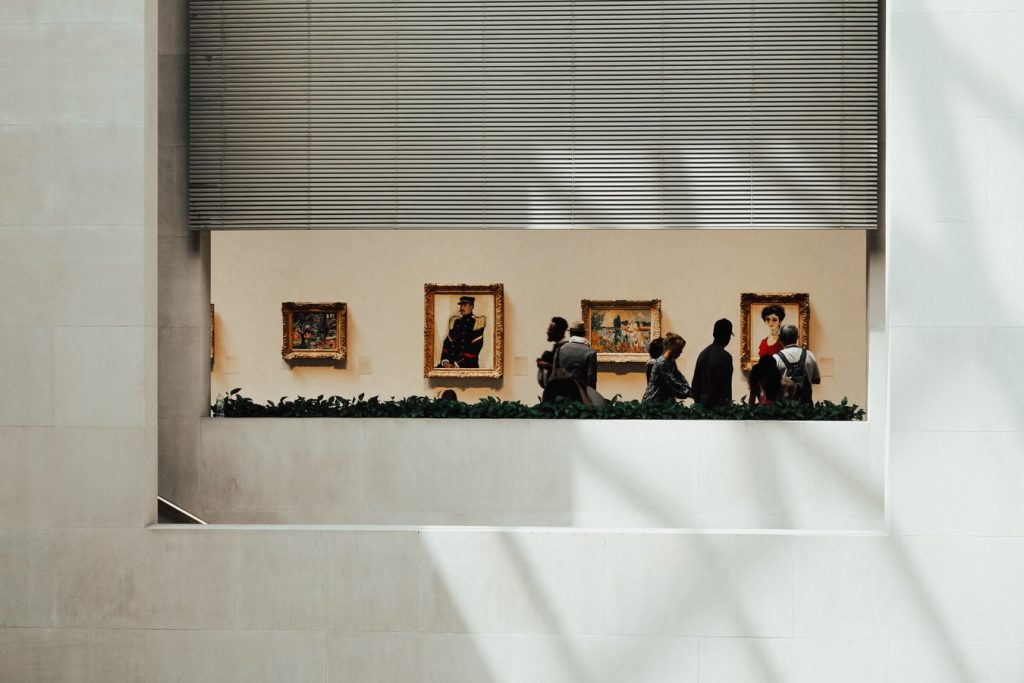
The story of the two paintings also speaks to something else – the meaning of art in our lives. We can look at a painting say “I like it” or “I don’t like it” or “They call that art? I could have painted that.” Or we can be so struck by a painting that words fail us. The first time that happened to me was in London, and (surprise) it was at the Tate Modern. It was a portrait of Marguerite Kelsey by Meredith Frampton. That one painting brought me back three times to the museum during a 2012 visit, and I still don’t know if I can adequately describe the impression it made on me. Another annual exhibition in London that we’ve seen all five times we’ve visited is the BP Portrait Awards, which has a similar effect on me. 

In Dancing Prince, those last two paintings will affect virtually every character who sees them in a very similar way that those paintings in London affected me. For Michael and Tommy, the impact will be far greater. 

Top photograph by Abbie Bernet, and middle photograph by Zalfa Imani, via Unsplash. Used with permission. 

Footer

GY


Meet the Man

An award-winning speechwriter and communications professional, Glynn Young is the author of six novels and the non-fiction book Poetry at Work.


 01_facebook 02_twitter 26_googleplus 07_GG Talk

Copyright © 2026 Glynn Young · Site by The Willingham Enterprise · Log in | Managed by Fistbump Media LLC