
• Skip to primary navigation
  • Skip to main content
  • Skip to footer

Dancing Priest

Author and Novelist Glynn Young

  • HOME
  • BLOG
  • BOOKS
    • Brookhaven
    • Dancing Prince
    • Dancing Prophet
    • Dancing Priest
    • A Light Shining
    • Dancing King
    • Poetry at Work
  • ABOUT
  • CONTACT

A Light Shining

Dancing King Stories: Researching a Novel

July 16, 2018 By Glynn Young 2 Comments

I’m looking at a web site called English Historical Fiction Authors. Its audience is authors who write period historical novels. The various posts are written by the authors themselves. So, you can learn about how ice cream was made in the 18thcentury, what pieces of furniture would have been found in an upper-class hoe in the 16thcentury, who the Lord Proprietors of Carolina were in the 17thcentury, the friendship between the British Saxon Osulf and one of Charlemagne’s sons; and similar kinds of really detailed information. If you want your period novel to show authenticity, you need authentic historical details.

I don’t write historical novels. Mine fall into the more contemporary genre; actually, they’re set a few years ahead of our own times. So, I don’t have to be concerned with a lot of historical detail, like what Osulf really thought of his friend Charles a thousand years ago.

But it doesn’t mean I’ve escaped the research yoke. Far from it.

I do two kinds of research for my novels. The first is the reading kind – books, articles, web sites, blogs, even social media. The second is the foot-power kind – research by walking around.

A section of A Light Shining is set in Tuscany and Umbria; I’ve never been but I almost went in 2007, and had read so much and studied so much that I had the map of Florence memorized. For Dancing Priest, I had so many books and travel guides on Edinburgh and the University of Edinburgh that I could have opened a travel library. That’s the reading and study kind of research.
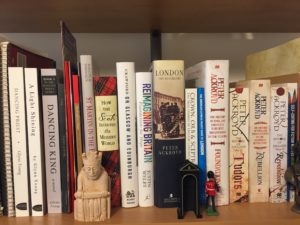
bookshelf Dancing King
The bookshelf above my computer

And then a crucial scene in Dancing King happens in Southwark Cathedral; I’ve been there three times, walked around, bought and read the guidebook, took pictures, and talked with the nice lady in the gift shop. I stood in the pulpit and looked at where people would be sitting in the nave. And that hill in downtown San Francisco where Michael Kent rides his bike in Dancing Priest? I’ve walked up that hill.

Walking-around research is extremely valuable. You see and feel what the streets look like, you peer into windows, you see a barrister’s gown and wig on sale for 550 pounds, you notice how Essex Street slopes toward the Thames River. A pub in London may superficially resemble a pub in St. Louis, but if you sit long enough, you begin to notice the differences.

Both kinds of research are critical, even for a contemporary novel.

On the bookshelf above my computer sit the guidebook to Buckingham Palace; four volumes of Peter Ackroyd’s history of England (the fifth is to be published later this year), a guidebook to London, a book entitled Crown, Orb & Sceptre which will tell you everything you want to know about every coronation in English history, a history of St. Martin-in-the-Fields Church, a booklet on the royal line of succession, a guide to Southwark Cathedral, a brochure about the guards associated with Buckingham Palace, and related books. I turn to them often.

I been to England five times in the last six years, and every trip has been both vacation and research. Whatever place we visit – the British Museum, Canterbury Cathedral, the Museum of London, All Hallow’s by the Tower Church, the Imperial War Museum – I buy the official guidebook, which is always packed with information. I see art exhibitions to enjoy the exhibitions and to imagine what they would be like in a novel. I take photos of favorite paintings.

And I take walks. I’ve walked London’s South Bank countless times, along with Piccadilly, the City, Westminster, Hampstead, Pimlico, Belgravia, Mayfair, the Temple, Lambeth, Covent Garden, Charing Cross Road, the West End, and Spitalfields. I’ve walked Oxford, Cambridge, Salisbury, and Windsor. Every walk is research.

I pay attention to contemporary British artists and writers. I read novelists like Paul Kingsnorth (Beast) and Mark Haddon (The Curious Incident of the Dog in the Night-Time). I read contemporary British plays. Contemporary literary culture provides a take on the pulse of the country and insights you can’t get from non-fiction.

It’s not just the historical or period novels that demand research. Contemporary ones do, too. And I think I’d rather eat ice cream in 21stcentury England than what the Georgians considered ice cream in the 18thcentury.

Top photograph by Gaelle Marcel viaUnsplash. Used with permission.

Dancing King Stories: Unexpectedly Writing a Series

July 9, 2018 By Glynn Young 1 Comment

DK Stories writing a series

I never intended to write a series of novels. In fact, I never really thought about publishing what I was doing, first in my head and later on paper. Dancing Priest existed only in my head for almost five years. It began with an image and gradually progressed to a story.

You can tell a story in your mind much faster than you can write it down.

But I did eventually push it on to a computer screen, all 250,000 words of it. It was too big for a novel, too unwieldy, shooting off in too many directions. Metaphorically speaking, I took an ax to the manuscript at about the 110,000-word mark. And then I spent the next two years culling those 110,000 words down to about 90,000. I rewrote the story at least once. And that was what was eventually published as Dancing Priest.

Dancing PriestThe manuscript carcass – what was left over – had piled up. The publisher suggested a sequel. Out came the metaphorical ax again and chopped off about 65,000 words. Because of changes in Dancing Priest during the rewriting and editing process, those 65,000 words had to be reworked even more than the first manuscript. The story grew.

The editor suggested an additional villain And he was right. He didn’t suggest what kind of villain, only that one was needed. I created an assassin. Thinking I would come back and give him a name. After trying out various possibilities, I saw something else. Leaving him nameless actually heightened the tension of the story, and my nameless assassin carried that tension right to the end of the story. And the story was published as A Light Shining.

A Light ShiningAnd there I stopped. My day job became crazy. I actually published a non-fiction book (Poetry at Work) the year after A Light Shining. At first it seemed easy. It was much shorter than the novels, but on top of the day job and my mother’s growing infirmities, it became increasingly difficult. And I was writing to a deadline. I made it, but I nearly collapsed from the effort.

Four years passed. And then at a lunch with the publisher of my novels, I mentioned I was trying to sort through a possible third novel. The manuscript was something of a jumbled 50,000 words, the last part of that original 250,000 words that came pouring out of my in the fall and winter of 2005. I had to reread Dancing Priest and A Light Shining – twice – to see how to shape and reshape, write and rewrite those 50,000 words. And this wasn’t the book I wanted to be working; the one I wanted to be writing would fall fourth in the series. But I couldn’t get to the fourth because too much would be missing after A Light Shining.

Dancing KingSo Dancing King eventually saw the light of day. It started off as a kind of orphan; it ended up being my favorite of the three.

Now I’m deep into the fourth in the series. I have a working title in my head but I don’t know if it will stick or not. The manuscript is somewhere in the vicinity of 70,000 words at the moment, heading toward 90,000. It’s in two pieces – the new, rewritten and revised version, and the old manuscript (or what’s left of it). I’m reading and revising, reading and discarding, reading and adding something new.

I didn’t intend to develop a series of related novels, but there was simply too much story that I needed to tell. And so, there it is. A story about a priest dancing on a beach because a story about priest who was also a cyclist with a jumbled family and who eventually became a king.

And now he’s on his way to become a reformer, but not in the way he expected. And not in the way I expected.

Top photograph by Patrick Tomasso via Unsplash. Used with permission.

Dancing King Stories: Sarah Kent-Hughes

July 2, 2018 By Glynn Young 2 Comments

Sarah Kent Hughes Dancing King

The story of Michael Kent and Sarah Hughes begins in Dancing Priest, the first novel in the Dancing Priest series. And while other narratives will stream through the series, the love story of Michael and Sarah remains the core.

They meet at the University of Edinburgh. She’s an art student at the University of Southern California, studying a year abroad with her brother David Hughes. She and Michael share a class in medieval church history; he sees her sitting a few rows away and is instantly smitten. He introduces himself after the class, she thinks she’s been hit on for the fourth time that day; and she dismisses him with an Anglo-Saxon profanity, believing his statement about studying for the priesthood to be a come-on line.

But they both get passed that, and at a school festival, dance what comes to be known as the “last tango in Edinburgh.” And it’s during that dance that the dancing priest of the title is born.

Dancing Priest is the story of how Michael and Sarah find each other, lose each other, and then find each other again. In the process, they are both growing and maturing, Sarah moving steadily toward the faith that divided her from Michael and Michael learning that the priesthood of study and preparation may not be the same as the priesthood meeting life on the streets.

In A Light Shining, the second novel in the series, Sarah almost becomes the main character. She and Michael are married, living in San Francisco, and soon expecting their first child. And then comes The Violence, a planned and coordinated terrorist attack on Britain’s royal family, Michael’s brother Henry, and Michael and Sarah. The attack on a very pregnant Sarah is thwarted by their two adopted son, Jason and Jim, but Michael almost dies. Sarah goes through childbirth while Michael is in surgery. And while he’s recovering and still unconscious, she assumes responsibilities far beyond the typical new young mother.

Dancing KingIn Dancing King, the third in the Dancing Priest series, Sarah becomes one of the narrators of the story – the arrival in London, the upheavals with palace staff, the creation of a new staff, and the growing attacks by people determined to drive Michael and Sarah from the throne.

Sarah is self-confident and assured, but she is also shy. She’s also slightly terrified at dealing with all of her new responsibilities. Physically, she’s about 5 feet 7, golden-brown hair, brown eyes, with high cheekbones. Michael thinks she’s absolutely dazzling. Her favorites clothes to wear are jeans and a man’s dress shirt (which is what she was wearing when she and Michael first met).

She also is an artist, with an artist’s soul and temperament. Sarah had been on her way to establishing a successful career in painting when she met Michael again and married him. She will continue to paint, in addition to all of her new responsibilities. Her painting style is Realism; people often think her paintings are photographs.

At the very beginning of Dancing King, as the family is leaving their life in San Francisco and flying to London, the man who will become Michael’s chief of staff is sitting on a jump seat across from Michael and Sarah in the car to the airport. Reflecting on the events detailed in A Light Shining, what he says about Sarah and her husband is the key theme of the book:

“This young woman, this young queen with a new baby sitting across from me in the SUV, had been the pivotal player. The PM knew that. I knew that. And I had had to insert myself into her fear, confusion, and shock. I didn’t expect to be inserted into the middle of her faith. And her husband’s faith.”

Photograph by Andrei Lazarev via Unsplash. Used with permission.

Dancing King Stories: Josh Gittings, Chief of Staff

June 4, 2018 By Glynn Young 4 Comments

Josh Gittings Dancing King

In my second novel A Light Shining, Josh Gittings is a special assistant to Prime Minister Peter Bolting. And in his case, “special” means “political.” Gittings does what Bolting needs him to do, and much of that is ruthless. Gittings has been involved in Labour Party politics and working for Bolting since he graduated from college 20 years before.

He’s a character who understands what his value is, what his role is, and what’s expected of him. He knows he’s often called “Rasputin,” and he’s self-aware enough to understand that it’s a justified nickname. He watches everything. He pays attention to small details. He can deal with political friends and enemies alike, and he sees little difference between them, because who’s your political friend today will be your political enemy tomorrow.

Josh Gittings is a man of the political 21stcentury.

A Light ShiningWhen the royal family is assassinated in Britain and Michael Kent-Hughes is shot in San Francisco, Gittings, 41, is dispatched by the prime minister to California to be his man on the ground. He’s there to do the PM’s bidding. If Michael survives the shooting and surgery, Gittings is there to assist and guide. If Michael dies, Gittings is there to help Sarah Kent-Hughes and her newborn son. He’s there to make sure the world knows that the PM is with the new royal family.

It’s a cold, calculating, and rather bloodless job. And Gittings is perfectly suited for it. And it all goes according to Gittings’ playbook, until he meets and begins to work with Sarah, as Michael remains unconscious after surgery. Within two days of meeting her, he’s beginning to question what he considers the fundamentals of his career and of his life. When she speaks at her press conference, calling passionately for an end to The Violence in Britain, he finds himself in tears.

The third novel in the series, Dancing King, opens with Gittings leaving San Francisco with Britain’s new royal family. It is seven weeks after Michael’s discharge from the hospital; Gittings has spent those seven weeks working with Michael and Sarah, helping them in innumerable ways. And in the process, he has discovered that being with them has begun to change his own life profoundly. As he tells them later in the book, “I began to learn what’s really important in life.”

For those seven weeks, Gittings lives in Michael’s old apartment at St. Anselm’s Church, across the plaza from Michael and Sarah’s loft. He has ample opportunities to talk with Father John Stevens, the church’s head pastor and Michael’s boss. Father John plays a critical role as well, mostly in telling Gittings stories about the church and stories about Michael.

Dancing KingDuring the trans-Atlantic telephone conversations, Josh’s live-in girlfriend, Zena Chatwick, can hear the change that’s happening in Gittings simply by listening to his voice. When he arrives with Michael and Sarah in London, he tells Zena he’s moving out of their flat in Chelsea. And he asks her to marry him, “to make an honest man of myself.” He helps Michael interview and staff various palace positions, eventually submitting his own application for chief of staff. That such a ruthless character as Gittings becomes one of Michael’s closest confidantes raises questions in the minds of many. Michael doesn’t care; he knows how his new friend has changed.

The character of Josh Gittings is fictional, but there are elements of two people who contributed to his creation. One was an individual much like Gittings – political, ruthless, prepared to do whatever was required to achieve the desired ends. The other is rather more famous – Charles Colson, President Richard Nixon’s “hatchet man.” Colson was one of the most ruthless of political operatives, until the Nixonian world collapsed, he went to prison, and people reached out to him in love and faith. Colson became a profoundly changed man.

And that’s what happens to Josh Gittings in A Light Shining and Dancing King.

Photograph by George Hodan via Public Domain Pictures. Used with permission.

Dancing King Stories: The Green Drawing Room

March 12, 2018 By Glynn Young 4 Comments

Green Room to Throne Room Dancing King

Before there was a Buckingham Palace, there was a Buckingham House, built by the Duke of Buckingham in the early 18th century. George III bought it in 1761 as a residence for his wife, Queen Charlotte, and it became known as the Queen’s House. The royal family spent considerable and increasing time there, and it came to be known as the family’s London residence. The Green Drawing Room, known by that name today (or simply the “Green Room”), was originally the Duchess of Buckingham’s saloon, and was the largest room on the first floor (what Americans call the second floor) of the house.

Over the centuries, the room has been remade a number of times. For Queen Charlotte, large wall drawings were brought from Hampton Court Palace and the ceiling was painted. Later, the drawings were replaced, and the ceiling plastered. Doorways have been added and chimney mantles replaced. In the 1830s, green silk was used to decorate the walls.

Green Drawing Room Dancing King
The Green Drawing Room in Buckingham Palace.

When he was completely redesigning Buckingham House to turn it into the royal palace, John Nash kept the house structure and then added two wings. Eventually, a fourth wing was added, making the familiar “square around the central courtyard” design that’s known today.

The last time the Green Drawing was redecorated was 1949. It is one of the official state rooms that’s included on the public tour of the palace. Its walls are decorated with green and gold silk wallpaper (replaced every 30 years) and highlighted by white and gold plasterwork. The doorway at one end leads directly to the Throne Room; the Green Drawing Room, in fact, serves as an anteroom for the Throne Room.

In Dancing King, Michael Kent-Hughes agrees to meet with protestors, and the place selected for the meeting is the Green Drawing Room. To reach the room, the four representing the protestors would enter the building on the lower level, walk up the palace stairs, and then arrive at the Green Room. A table and chairs have been placed in the room for the meeting. Michael is waiting and introduces himself as he shakes their hands.

Once all are seated, what the protestors would have seen would be Michael with the doors open to the Throne Room behind him – a reminder of his position. He meets them as petitioners, and he firmly rejects their demands. One demand he finds particularly problematic and objectionable – and that is that he change the coronation oath to style himself “defender of the faiths.”

Palace Floor Plan Dancing King
The Green Drawing Room is marked by the letter G and the Throne Room by the letter F.

I had an original source for that demand – Charles, the Prince of Wales and heir to the British throne. Almost 20 years ago, Charles made a public comment about seeing himself as a “defender of the faiths,” to acknowledge all of the religions in Britain. The comment caused something of an uproar, and we can only imagine what the Queen herself, a devout Christian, thought (and said, privately). He’s tempered that sentiment somewhat in the intervening years, and now leans toward “defender of faith” or the traditional “defender of the faith.”

Dancing KingMichael explains to the protestors what acceding to this demand would mean – that they would be acknowledging him as the head of all religions in Britain, including Islam, and their clergy would serve at his pleasure. They’re horrified – that isn’t what they thought their demand was about.

This scene, like the one that immediately follows outside the palace, begins a theme that actually surprised me when I realized what was happening. Both scenes were written toward the end of the manuscript process and were not part of the older manuscripts written more than a decade ago.

The theme is the limits of constitutional and representative government, and what happens when that kind of government begins to falter. That theme was never part of the “original intent” of these stories, but the seeds of it can be found in A Light Shining and the sprouts in Dancing King.

Top photograph: Looking through the Green Drawing Room to the Throne Room.

.

Talking with Megan Willome about “Dancing King”

March 2, 2018 By Glynn Young Leave a Comment

Buckingham Palace Dancing King

Writer Megan Willome and I had a long conversation about Dancing King, writing, fiction, characters, the use of emotion, crowd scenes, and even bicycles in London. She had read all three books in the Dancing Priest series.

“The stories haunt you, and not in a scary way. They serve as almost an alternate history: What if the Athens Olympics unfolded like that? What if England had a king on the throne instead of a queen? Like any good alternate history, it has enough true details to make it seem real. So real that I find myself thinking The Violence from book 2, A Light Shining, was as real as The Troubles.”

You can read her discussion and our conversation at Megan’s blog.

  • « Go to Previous Page
  • Page 1
  • Page 2
  • Page 3
  • Page 4
  • Go to Next Page »

Footer

GY


Meet the Man

An award-winning speechwriter and communications professional, Glynn Young is the author of three novels and the non-fiction book Poetry at Work.


 01_facebook 02_twitter 26_googleplus 07_GG Talk

Copyright © 2026 Glynn Young · Site by The Willingham Enterprise · Log in | Managed by Fistbump Media LLC