• Skip to primary navigation
  • Skip to main content
  • Skip to footer

Dancing Priest

Author and Novelist Glynn Young

  • HOME
  • BLOG
  • BOOKS
    • Brookhaven
    • Dancing Prince
    • Dancing Prophet
    • Dancing Priest
    • A Light Shining
    • Dancing King
    • Poetry at Work
  • ABOUT
  • CONTACT

Uncategorized

Poetry at Work, Chapter 16: The Poetry of Unemployment

April 29, 2019 By Glynn Young Leave a Comment

Poetry at Work

It happens to most of us, at one time or another in our careers. You’re called into the boss’s office and discover there’s an HR person waiting as well. Yep, you’re being laid off.

Sometimes you’re expecting it; sometimes you’re not. In my case, I knew it was coming. A work colleague had found out and couldn’t keep it to herself. She tried to look appropriately sad and concerned, but it didn’t work. She was actually rather gleeful (yes, there was a history here). I looked at her and said, “You won’t understand this, but a considerable amount of good will come out of this for me.” Her almost angry response: “You’re just in denial.” 

Perhaps I was. I felt my ears grow warm, a sure indication that I fully understood what was happening. And I really upset the process when I walked from her office to my boss’s office and told him I knew I was shortly to be laid off. He blew up – because it upset the usual process for these “elimination” programs. 

To continue reading, please see my post today at Literary Life.

Poetry at Work, Chapter 12: The Poetry of Transparency

April 1, 2019 By Glynn Young Leave a Comment

Poetry at Work Poetry of the Workspace

It was the days before PowerPoint. Holding our overhead transparencies, three of us sat waiting to be called into the management meeting. We were three public relations people, three poets, working for a chemical company. And it was our job to explain to the people running the company why we had to tell people how much pollution the company was responsible for, and, more to the point, what we thought the company should do about it.

If you know anything about working for corporations, you know that this would not be a moment to inspire self-confidence. In fact, we expected to be shredded.

A new federal law had been implemented. Companies large and small had to publish, annually, how much toxic emissions were emitted each year from operations. Our chemical company would be reporting big numbers. So would automobile and tire manufacturers, and steel makers. So would newspapers (toxic emissions are associated with printing presses). All manufacturers were affected, but especially chemical companies.

To continue reading, please see my post today at Literary Life.

In Praise of Reading Poetry

February 26, 2019 By Glynn Young Leave a Comment

Like most of us, I read poetry – a lot of poetry – in high school and college English classes primarily because it was assigned. I was much more interested in fiction (Dickens!) and noir mysteries (Dashiell Hammett!) than I was in Tennyson, Wordsworth, Coleridge, and the Elizabethans. 

My attitude changed with T.S. Eliot and “The Love Song of J. Alfred Prufrock.” It was first published in 1915, and Poetry Magazine published it only as a favor to Ezra Pound. The editors were so uncomfortable with it that they placed it at the back of the issue. But it was our first great modernist poem, and it changed poetry forever. A high school senior, I read that poem, and I was mesmerized. I went to the local bookstore and bought a small paperback edition of Four Quartets (I still have it; it’s now more than 50 years old).

To continue reading, please see my post today at the American Christian Fiction Writers blog.

Photograph by Thought Catalog via Unsplash. Used with permission.

Poetry at Work, Chapter 7: The Poetry of PowerPoint

February 25, 2019 By Glynn Young Leave a Comment

Poetry at Work Poetry of the Workspace

I’ve been blogging for almost 10 years. Mostly, I blog about books and poetry. Occasionally I talk about art and work. For years, the blog post that held the record for the most number of visits was work-related: I Hate PowerPoint. That is, until another post overtook and surpassed it: A Sign of the Apocalypse (at the Office), which was also about PowerPoint. 

It turned out that I wasn’t alone in my dislike of PowerPoint. 

Actually, the problem wasn’t (and isn’t) PowerPoint. It’s how speakers and presenters misuse PowerPoint. “We treat it like the canvas for Homer’s Iliad,” I wrote in Poetry at Work, “when we should instead treat it like the backdrop for a haiku.”

To continue reading, please see my post today at Literary Life.
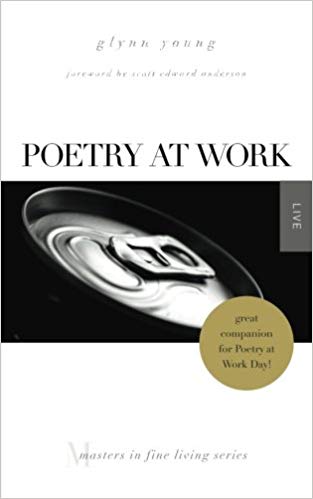
Poetry at Work, Chapter 6: The Poetry of the Organization Chart

February 18, 2019 By Glynn Young Leave a Comment

Poetry at Work

I was sitting with a woman in the Human Resources Department. There had been a reorganization of our department, part of a general reshuffling across the company, and I’d been assigned to sit with her to work out the new organization chart. 

You would think this was something of a useless exercise. Shouldn’t it be a simple matter of “here’s the boss, here are his or her direct reports, and here’s who reports to them.” But it was anything but simple, and I was to get a lesson in the Byzantine art form of corporate organization charts.

To continue reading, please see my post today at Literary Life.

“A Light Shining:” Tears and the Heroic

December 4, 2017 By Glynn Young Leave a Comment

San Francisco Hospital A Light Shining

Not long after A Light Shining was published, a colleague at work knocked on my door and asked if I had a minute. He sat down, and told me he had downloaded A Light Shining for his Kindle. And he had read it.

“I stayed awake until 4 a.m. to finish it,” he said. “I couldn’t put it down. I’m here to make a plea for a third novel in the series.”

I laughed. “We have to see what happens with the second one first.”

He smiled. “When I reached the part with Sarah’s speech, I lost it. I’m sitting there blubbering, and everyone else in the house is asleep, and I didn’t have anyone to talk to about it. It was terrible.” And then he proceeded to outline what Sarah had said, quoting the key phrase of the speech exactly, and the reaction of one of the characters to her speech.

A Light ShiningThis was the same colleague who liked Dancing Priest so much that he bought 20 copies and gave them to 20 senior executives at our company, people from around the world. One of those executives – from India – stopped me and said he had read it and that he had enjoyed it so much that he had become completely absorbed in the cycling events in the 2012 Olympics in London this summer. “I didn’t know anything about cycling until I read your book,” he said.

Shortly after that, I picked my oldest son up at the airport. Right out of the blue he said, “That part with the warehouse kids – I totally lost it on the plane.”

“You’re reading the book,” I said.

“I bought it for my Kindle,” he replied, “and started reading it on the plane. Good thing I had a row to myself, because it would have been embarrassing.”

And then he said, “You better not kill him off.” Suffice it to say that I know which character he’s talking about, and why. But I wouldn’t respond to his question.

I’ve read both of those scenes – Sarah’s speech and the warehouse kids – scores of times. And I still get choked up when I do. It’s almost as if I forget I wrote them. There are one or two other scenes that affect me the same way. In Dancing Priest, the scene that never fails to bring me to tears is the British Olympic team arriving in the stadium in Athens for the closing ceremonies.

I ask myself what it is about these scenes, scenes I know intimately and have lived with for close to a decade that prompts this reaction, from me as well as readers.

I believe it has to do with our sense of the heroic, that something within us that reaches beyond what we’re capable of doing because something must be done, something must be said, some good and fine purpose must be achieved. One of the readers of Dancing Priest last year sent me an email, saying that the book should be required reading for teenage boys because it was about a young man’s nobility of purpose – something they get from nothing in our culture today.

I’m not going to be able to live off the royalties from these two books – longer than a day, anyway. But the reactions I hear from people reading them are royalties enough.

  • « Go to Previous Page
  • Page 1
  • Page 2
  • Page 3

Footer

GY


Meet the Man

An award-winning speechwriter and communications professional, Glynn Young is the author of three novels and the non-fiction book Poetry at Work.


 01_facebook 02_twitter 26_googleplus 07_GG Talk

Copyright © 2026 Glynn Young · Site by The Willingham Enterprise · Log in | Managed by Fistbump Media LLC